Being and Becoming who I am Part 1
Reflection Point 1: Revise your knowledge
To revise your knowledge and understanding of conception, pregnancy and birth, read the summary notes below or source a relevant text or research online, for example, see: https://www.nhs.uk/conditions/pregnancy-and-baby/
Reflection Point 2: Medical screening
What is your perspective?
- How is your perspective influenced by your personal experience, social context or professional learning?
- How do these views impact on your attitudes in practice?
Different processes of conception, pregnancy and birth
In chapter 3 we discuss the biological processes of conception, pregnancy and birth as usually experienced by heterosexual couples; a process that will be different for some heterosexual couples, some single women and lesbian and gay couples who are undergoing assisted conception such as IVF treatment or donor insemination. Review your knowledge, understanding of and attitudes to these different experiences and reflect on how these might impact on your understanding of children’s families and the relationships you have with them. Is there any aspect that you need to know more about? How will you find out?
Reflection Point 4: Social learning
Throughout our lives we encounter new experiences which influence us.
- Can you think of aspects of your personality that you have developed through observing the behaviours of others?
- How were your characteristics and behaviours reinforced or discouraged by others? Did they change as a result?
- Can you think of some examples where you have observed young children imitating adults and or peers?
Reflection Point 5: Temperament and ‘Goodness of fit’
- What sort of temperamental disposition do you think you have?
- Have you ever found a child’s temperament to be ‘at odds’ with yours? How did that impact on your relationship? (Remember we are not talking about their changing behaviours)
- How well does your setting’s psychological and physical environments allow for different temperaments?
Being and Becoming who I am Part 3: Psychoanalytic Perspectives
Reflection Point 6: Agency and autonomy
- Note down for yourselves 3 examples of experiencing agency and autonomy in your current work or home life
- Now reflect on your childhood and note down 3 examples of experiencing agency and autonomy
- How did the adult(s) around you facilitate these?
- How did you feel?
- Now reflect on your practice and note down 3 examples of how you support the agency and autonomy of the children you care for
Further information
- You can find more useful information about temperament at:
https://www.zerotothree.org/espanol/temperament - Click on the link to view external sites.
If you’d like to engage with the complexity of researching and developing theory about personality development, you might be interested to watch this interview with Dr Brent W. Roberts, Professor Department of Psychology, University of Illinois discussing ‘Genetic and environmental influence on personality formation’
Further thinking about psychoanalytic perspectives
- If you are interested in extending your understanding of psychoanalytic perspectives, you could read:
Bateman, A and Holmes, J (1995) An Introduction to Psychoanalysis: Contemporary Theory and Practice. London: Routledge
This YouTube video sets out Erikson’s theory in accessible terms
To extend your understanding of Winnicott’s ideas, this YouTube video gives an accessible overview
- If you would like to read further about Carol Dweck’s ideas about self-concept or what she calls ‘self-theories’ and how these relate to self-esteem, go to:
Dweck, CS (1999) Self-theories: Their role in motivation, personality, and development. Philadelphia, PA: Psychology Press.
- You can also see an overview of Dweck’s ideas and hear her talk about them here:
https://implicitbeliefsofintelligencetutorial.weebly.com/mindset.html - Click on the link to view external sites.
You can hear Edward Deci discussing self-determination theory in this video.
Click to download files.
Reflection Point 1: Touch
Spend some time reflecting on the last time you were physically handled by a professional person, such as a nurse, physiotherapist or beauty therapist. What were your feelings before, during and after your treatment? What made this experience positive or negative for you?
Educators and students undertaking similar reflective exercises identify a negative experience as; rough, rejecting, ignoring, casual, dismissive and inattentive, which makes them feel unsafe, vulnerable, in the wrong, let down and angry. Their treatment leaves them feeling worthless as people and wanting to respond aggressively. In contrast, they identify a positive experience as attentive, gentle, reassuring, respectful, calm, taking time and inclusive, which makes them feel content, secure, confident, worthwhile and trusting and willing to cooperate.
When thinking about how this relates to children, the powerful position we are in as adults and how we can choose to use that power positively or negatively in our interactions becomes clear. Building trust through positive physical interactions is a fundamental aspect of developing healthy close relationships with children. So knowing the person caring for you and that person knowing you well is very important. Also, Educators need to regularly reflect on how they might sound or appear to different children in their group, especially new children who haven’t yet got to know them well enough to understand their body language. Young children will interpret the adult’s non-verbal signals according to the templates they have already developed through their previous experiences.
Case study 1: Focusing on Key Groups
Here is an example of how some settings organise this time of day for older toddlers and 2-year-olds. This process is not for babies, whose routines will be more individualised.
N.B. This plan assumes that a key group of 2-year-olds is no more than 1 educator to 4 children.
Late morning: Key Group time: Each Key Person gathers their key children together, usually in the same place each day. This special time can be signified by setting out a particular rug or cushions to sit on or by playing particular music for example. Key group time doesn’t have to happen just before lunch but it is a great way of Key Persons connecting with their children and creating calm at this busy time.
Before lunch: Each Key Person accompanies their key children to the bathroom to help them to use the toilet, change their nappy if required and to wash their hands. Plenty of time is allowed for learning, experimenting and autonomy. This is planned to happen in rotation; while one key group is washing etc., the others will be having their key group time or playing elsewhere or preparing their lunch table (or this is done by a member of support staff)
Lunch time: When the lunch tables are ready and the food has arrived then each key group comes to the table and they proceed with serving themselves. Key Persons sit with their key children assisting them as required, while another educator / support worker acts as a ‘waiter’, bringing anything a child or Key Person needs, clearing plates etc. This person also prepares the cots and beds for children sleeping after lunch. This allows the Key Person to be fully present and focused on their key children.
After lunch: As children finish eating, Key Persons help their key children to wash their hands and get ready to sleep.
Case study 2: Flexible eating times
Many settings that are part of the ‘Goodstart’ group in Australia have been influenced by the Pikler Approach and have adopted Pikler principles into their care giving times. On a visit to the Lara Centre in Melbourne, I noticed how unobtrusive the transition to lunchtime was; indeed, it was a little while before I realised that the lunch period had begun, it was so calm!
This description of how they organise this time for 2–6-year-olds, is provided by the Centre: (N.B. In Australia they call the Key Person a Key Educator)
Each Key Educator has a dedicated table they always use so children know where to find them and they set the table for a small group of children (usually a maximum of 4) at a time. Wherever possible, this is outside or under verandas.
They each have a small trolley with all of the supplies they need for their lunch group including plates, glasses, cutlery, scrap bowl, water jugs etc. They also find it handy to have materials such as paper towels to clean up spills, bibs for younger children and other items specific to the age group they are working with.
The kitchen brings meals to the outdoor areas in smaller servings so they aren't standing for long periods. For example, they would deliver half of the kindergarten (3-6 years) room lunch at 11.30 and half at 12pm.
Children are not expected to all stop playing and go to the lunch table together. Instead, the Key Educator is seated at their table and the Secondary Educator, who is still engaged with the children at play, invites children to join their Key Educator for lunch whenever a chair becomes available at the table. In this way a Key Educator group moves progressively through the meal time.
Key Educators will often request that certain children are offered the first chairs for a variety of reasons, such as; they arrived earlier than usual and didn't want breakfast, their allergy catered meal arrived already from the kitchen, they had mentioned just prior to lunch that they were already hungry etc. Children will often request that they "go next" when they are hungry and will wait for a chair to become available or decline an offer for a seat at the table if they are not yet ready to eat. While not at the table, the children continue to play, which provides for longer periods of uninterrupted exploration.
While at the table, children serve their own food, pour their own drinks, scrape their own plates and assist with setting and clearing the table as needed.
The Key Educator will engage in conversations with the children and will often have a notebook with them to jot down notes.
The Secondary Educator is responsible for filling up serving bowls on the table as required or getting anything else as needed so the Key Educator can always stay engaged with the children at the table.
When the Key Educator has finished the meal time with their group of children, they take the trolley to the kitchen for the dishes to be washed and restocked for the next meal time.
The setting reports that ‘these are one of the times in our day when some of the most meaningful interactions and conversations seem to happen. These times are seen as an unrushed ritual that used to once be a rushed routine!’
Case study 3: Working closely with Kitchen and domestic support staff
A nursery centre involved in the Key Times project (Manning-Morton 2006) was concerned by how stressful the lunchtime in their group of 2–3-year-olds was. To reflect on this, they undertook a series of observations of the lunch period and also tracking observations of individual children to look at their eating patterns. These showed that children had varying times when they were hungry according to their pattern in the morning at home. They also revealed that the timing of snack and lunchtimes was unhelpful being only ¾ hour apart. Children were then either filling up on snacks and not being hungry at lunch (and being bored and disruptive) or were so hungry that they became fractious.
After consultation with parents and discussion with colleagues, particularly the kitchen staff, they tried several strategies. This included changing the times food was available and supplying more substantial foods at snack time. However, difficulties remained and on further review they made two major changes. Firstly, they agreed with the cook that the menu for this age group would become less complicated and more predictable so that although there was the correct nutritional balance and included dishes that were familiar to all children, these would be repeated more frequently. They also agreed to make the food that was offered to children with special diets at least look similar to the main dish, even if it could not be the same for all. Secondly, they arranged that fruit and water would always be available in the group. This means that an educator can often be observed sitting in the designated space, assisting one or two children peel and cut apples or bananas, talking and sharing together. It also means that children’s play is not unnecessarily interrupted and that children are making choices and decisions about food according to their individual needs.
Click to download files.
Being and becoming who I am: Further thinking about developing Social Identities
Reflection point 1: Thinking further about ‘race’
In the handbook, I put the word ‘race’ in inverted commas to emphasise that it is a contested term with questionable meaning and that it is a constructed concept, which has been and still is, used to group people for discriminatory purposes. I state that ‘since all humans share a very small number of female ancestors, we are one human race’.
How do you understand this statement? What is your view?
Reflection Point 2: Thinking further about sex and gender
Theories of human development all emphasize the sex/gender distinction but it is important to think about the implications of this for society. You can use the table here to see how most differences vary and are socially constructed.
Sex |
Male |
Female |
Biological traits: |
Testosterone |
Oestrogen |
* Although these aspects have a biological basis, they differ within and across ethnic groups around the world. |
||
Gender |
Masculine |
Feminine |
Gender traits** |
Active |
Passive |
Implications for children |
Cars |
Dolls |
Implications for educators in the early years profession |
Few men |
Many women |
** although it is clear that these gendered ideas are historically and culturally specific and you may think they have less significance today, it is worth reflecting on how much they still influence your thinking or the thinking of those around you. |
||
Reflection point 3: Gender part 1
Spend some time reflecting on the ‘scripts’ or messages that you received about your gender as a child. How have these impacted on your ideas about femininity or masculinity?
How do those messages frame your ideas about roles and behaviours for men and women and therefore for girls and boys in your setting?
Reflection point 4: Gender part 2
To reflect on your ideas about gender identity development and gender bias further, consider the validity of following statements: - how true (as a percentage) do you think they are? Then say whether you think the primary influence is biological or environmental.
What issues do you think arise from such binary stereotypes such as these?
True / False? |
Biological / genetic |
Environmental / culture |
|
Girls care about how they look |
|||
Girls’ language and literacy are more mature |
|||
Girls are caring |
|||
Girls like books |
|||
Girls like playing in the home corner |
|||
Girls are manipulative |
|||
Girls are more emotionally and socially mature |
|||
Boys can’t concentrate |
|||
Boys are more ‘straight-forward’ emotionally |
|||
Boys like construction toys |
|||
Boys are insensitive |
|||
Boys don’t cry |
|||
Boys like fighting |
|||
Boys are more active |
|||
Boys are mischievous |
Reflection point 5: What do we mean by equality, equity and diversity?
Consider your response to the following statements:
- All children are the same.
- All children are equal.
What do you think is the difference between equality and equity?
- Equality: Equality means each individual or group of people is given the same resources or opportunities.
- Equity recognizes that each person has different circumstances and allocates the exact resources and opportunities needed to reach an equal outcome.
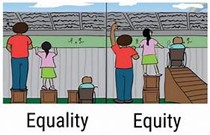
How do you work towards equity in your setting?
Further information
To read further on issues of equity and social identity, see:
- Derman-Sparks, L., Tanaka Higa, C., Sparks,B. (1980) Children , Race and Racism: How Race Awareness Develops, Interracial books for Children Bulletin, 11 (3 and 4), Council on Interracial Books for Children
- MacNaughton, G. (2000) Rethinking Gender in Early Childhood Education London: Paul Chapman Publishing.
Click to download files.
Being and Becoming who I am: Connecting with feelings
Reflection point 1: Further thinking about Primary and secondary emotions
In the handbook we discuss how the basic or primary emotions are built on within a socio-cultural contest to create secondary and tertiary emotions. Look at this list based on Shaver et al. (1987) and Parrott (2001) to extend your understanding of this further.
Primary emotion |
Secondary emotions |
Tertiary emotions |
Love |
Affection |
Adoration, fondness, liking, caring, tenderness, compassion, sentimentality |
Lust |
Arousal, desire, passion, infatuation, |
|
Longing |
Yearning |
|
Joy |
Cheerfulness |
Amusement, bliss, gaiety, glee, jolliness, delight, |
Zest |
Enthusiasm, zeal, thrill, exhilaration, excitement |
|
Contentment |
Pleasure, satisfaction, serenity |
|
Pride |
Triumph, gratification, dignity, respect, conceit |
|
Optimism |
Hope, eagerness, confidence |
|
Surprise |
Surprise |
Amazement, astonishment, wonder |
Anger |
Irritability |
Aggravation, agitation, grumpiness, annoyance |
Exasperation |
Frustration |
|
Rage |
Fury, hostility, hatred, agitation, outrage, wrath, bitterness, scorn, spite, dislike, resentment |
|
Disgust |
Revulsion, contempt, loathing |
|
Envy |
Jealousy |
|
Sadness |
Suffering |
Agony, anguish, hurt |
Sadness |
Sorrow, depression, despair, unhappiness, grief |
|
Disappointment |
Dismay, displeasure |
|
Shame |
Guilt, regret, remorse |
|
Neglect |
Alienation, embarrassment, humiliation, insecurity, isolation, loneliness, rejection |
|
Sympathy |
Pity, sympathy |
|
Fear |
Horror |
Alarm, shock, fright, terror, panic, hysteria |
Nervousness |
Anxiety, tenseness, uneasiness, apprehension, worry, dread |
Reflection point 2: Reflecting on feelings
Look at the list of feelings you made in response to the reflection point in the handbook and identify which are primary, secondary or tertiary emotions.
- How do the secondary emotions relate to the primary emotions?
- Can you identify how the expression of your emotions has been shaped by your socio-cultural context?
Feelings are physical as well as emotional, look at your list of feelings and note down a description of the physical feelings that went along with each of them. You may notice how your emotions are always accompanied by a physical feeling and how your mood can be affected by your physical state.
Reflection Point 2: What is your experience of being a leader?
Reflect on your ability to regulate your emotions. What triggers your emergency emotional responses? For example, have you ever shouted at a motorist who didn’t indicate and caused you to brake hard?
How does your emotional regulation change over the course of the day?
What might cause that to change?
Reflection point 4: Identifying what makes you feel good
Spend a minute with your eyes closed envisaging what makes you feel good.
Note the detailed features of environments (people, places and things) that have a positive impact on your well-being.
Think about:
- Things that make you feel physically positive
- Things that make you feel emotionally positive
- Things that reinforce a positive self-identity
- Interactions and relationships that supported any of the above.
Further information
Chapter 5 Being and becoming who I am: Connecting with feelings and 5.1 Key Aspect of Practice
To think further about a neuro-scientific perspective on emotional processing, read;
- Eliot, L. (1999) Early Intelligence. How the brain and mind develop in the first five years of life. London: Penguin.
To think further about regulating emotion: Emotional Intelligence and Literacy, read
- Goleman, D. (1996) Emotional Intelligence: Why it can matter more than IQ. London: Bloomsbury Publishing.
- Gardner, H. (1999) Intelligence Reframed. Multiple Intelligences for the 21st Century. New York: Basic Books.
For further reading on transitional objects, see:
- Winnicott, D.W. (1971) Playing and Reality. Abingdon Oxon: Routledge Classics. This is a challenging read!
For a more accessible overview, you might be interested in this conversation with Dr Solomon on YouTube
Click to download files.
Key Aspect of Practice: Further thinking about Transitions
Reflection Point 1: Reflect on your own attitudes and responses to change
What are your beliefs about change? Grade the following statements according to how much you agree with them
5=totally agree 4=agree 3=neither agree nor disagree 2=disagree 1=completely disagree
| Idea about change | 1 |
2 |
3 |
4 |
5 |
Change is bad. |
|||||
I could never adjust to that change. |
|||||
Change is unfair. |
|||||
Things in my life should always remain the same. |
|||||
I've experienced too much change in my life, and I don't want any more change. |
|||||
If I ignore it, it will go away. |
|||||
There must be something I can do to avoid this change. |
|||||
I am never happy and relaxed at the same time; I need change to keep me alive. |
|||||
You should adjust to all changes easily. |
|||||
Change is the spice of life. |
|||||
There is only one way I want my life to be. |
|||||
Change should be avoided at all cost. |
|||||
I don't need to change; the others involved in my life need to change. |
|||||
You must always lose a part of yourself in order to adjust to a change. |
Now note down your feelings and responses to change in your life.
Reflection point 2: Further thinking about Transitional Objects
As adults we often carry things around with us that remind us of people we love and keep us connected to them in some way, whether it’s photo, a ring or something else. Reflect on why you keep this thing close to you and how you’d feel if someone took it away from you or you lost it.
For further reading on transitional objects, see: Winnicott, D.W. (1971) Playing and Reality. Abingdon Oxon: Routledge Classics. This is a challenging read! For a more accessible overview, you might be interested in this conversation with Dr Solomon on YouTube
Click to download files.
Chapter 3: Being and becoming who I am
PPTX Chapter 3 video 4 Agency and Autonomy
PPTX Practice task 1: Supporting agency and autonomy
DOCX Practice task 2: Observing agency and autonomy and sense of self
DOCX Practice task 3: Giving choices and praise
DOCX Chapter 3: Workbook
DOCX
Click to download files.
Chapter 4: Being and becoming who I am: Social Identities
Click to download files.