Making connections through being active; moving and doing: Further Thinking about Physcial Development
Further information
Thinking further about the physical growth of the brain
Watch this lecture on the Developing Brain by Joan Stiles PhD at the Department of Cognitive Science, University of California, San Diego.
Now consider the idea that development is a ‘constant interaction between the emerging structures of the brain and the child’s experience of the world’ (Karmiloff-Smith 1994, p.26).
What do you think are the implications of this statement for early years practice in relation to physical development?
- Thinking further about Pikler and ‘typical phases’: Weblinks
- You can find a lot of information and resources on the Pikler approach here: https://thepiklercollection.weebly.com/
- And also on the Pikler House Vimeo channel: https://vimeo.com/piklerstudio
- For access to the Pikler chart of the main stages of free motor development go to: https://shop.pikler.hu/en/spl/143483/English
Thinking further about reflexes
An example of how retaining reflexes affects later development is given here: Retaining the asymmetrical tonic neck reflex (ATNR) beyond 6 months affects
- Hand eye co-ordination
- The ability to cross the vertical midline
- Balance
- The ability to use different sides of the body together and separately
- Ability to track (affecting reading and writing)
- Thinking (when writing does not become automatic)
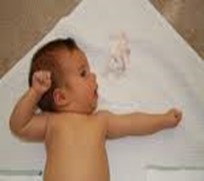
Fig 1
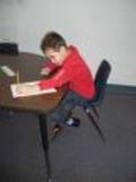
Fig 2
When the head turns to follow the direction of the writing hand, the arm and hand want to extend, making it difficult to hold on to the pen, bend the arm and bring the hand back to write on the left side of the page
Click to download files.
Key Aspect of Practice: Further Thinking about Movement Play
Reflection point 1: Physical Activity
- Think about the benefits you gain through being physically active and perfecting physical skills.
- Do you find you can think more clearly or feel more confident?
- Any other benefits?
Reflection point 2: Embodiment
If you engage in a lot of specific physical activity such as dance, yoga or sport, you probably already have a lot of awareness of your body. Also, if you have a particular health or physical impairment, you may constantly be aware of your physical states. But for others, you probably don’t often think about how your body is until it doesn’t work as well as it might. So, here you can spend some time reflecting on your own physical self-awareness in order to get in touch with children’s experience.
How in touch are you with your body right now? Are you aware of it at all, or are you all in your mind?
Read through the questions below, then close your eyes and picture each part of your body in turn and answer them in your mind. Then make some notes afterwards.
- Notice how you are holding your body, the position you are in, what feels comfortable / uncomfortable, where is there tension?
- Become of aware of your body position, are you sitting, lying down, lounging?
- Take your attention to your feet, your calves, knees, thighs, buttocks, hips, back, belly, chest, shoulders, neck and head, are they comfortable?
- What are you touching, what is touching you? The texture of your clothes, the softness or hardness of cushions or desk top
- Feel the chair or whatever you are on, supporting you.
- How is your face? Is your jaw tense or relaxed, your eyes strained or soft, your forehead smooth or wrinkled?
- What does this say about how you are feeling?
Open your eyes and note down how you feel, physically and emotionally.
Is there anything you have learnt about your body / yourself?
How are your thoughts, feelings and body sensations connected?
How much do you think about your body as separate to ‘you’? Notice the difference between the question ‘How in touch are you with your body?’ and ‘How in touch are you with yourself?’
For babies and young children, this separation of the self or the mind and the body hasn’t yet taken hold; their bodies are themselves. Physical sensation and thinking and feeling are completely intertwined. Any activity, whether it is lifting an arm, or walking, talking, going to sleep, learning something, or thinking out a problem involves an interrelationship between “mental” and “physical” processes: The distinction between “mental” and “physical” is a social construction.
Click to download files.
Further information: Common infectious childhood illnesses
| Disease and cause | Incubation/Exclusion period | Signs and symptoms | Treatment |
| Common cold Virus |
1–3 days | Sneezing, sore throat, running nose, headache, slight fever, irritable, partial deafness | Treat symptoms. Apply a barrier cream to nostrils |
| Chickenpox Virus |
10–14 days to develop. Exclude for 5 days from the onset of the rash. |
Slight fever, itchy rash, often with severe headache Red spots with white centre on trunk and limbs at first; blisters and pustules |
Rest, fluids, cooling cram on rash, cut child’s nails to prevent secondary infection |
| Food poisoning Bacteria or virus |
1½ to 36 hours | Vomiting, diarrhoea, abdominal pain | Fluids only for 24 hours; medical aid if no better |
| Gastro-enteritis Bacteria or virus |
Bacterial: 7–14 days Viral: 1½ to 36 hours Exclusion: 48 hours after the last episode of diarrhoea or vomiting. |
Vomiting, diarrhoea, signs of dehydration | Replace fluids; medical aid urgently in the case of dehydration |
| Measles Virus |
7–15 days Exclusion: 4 days from the onset of the rash. |
High fever, fretful, heavy cold; later cough, spots inside mouth. Day 4: blotchy rash starts on face and spreads down to body | Rest, fluids, tepid sponging. Shade room if dislikes bright light |
| Meningitis Bacteria or virus |
Variable Usually 2–10 days Exclusion: Until fully recovered. |
Fever, headache, drowsiness, confusion, dislike of bright light, arching of neck. Can have small red spots or bruises | Take to hospital, antibiotics and observation |
| Mumps Virus |
14–21days. Exclusion period: 5 days after the onset of swollen glands. |
Pain, swelling of jaw in front of ears, fever, pain when eating and drinking, | Fluids: give via straw |
| Pertussis (whooping cough) Bacteria |
7–21 days Exclusion: 5 days from start of antibiotic treatment. |
Starts with a cold, slight cough, mild fever Spasmodic cough with whoop sound, vomiting | Rest and reassurance; feed after coughing attack; support during attack |
| Rubella (German measles) Virus |
14–21 days Exclusion: 4 days from the onset of the rash |
Slight cold, sore throat, mild fever, swollen glands behind ears, pain in small joints. Slight pink rash starts behind ears and on forehead. Not itchy | Rest if necessary. Treat symptoms |
| Scarlet fever (or scarlatina) Bacteria |
2–4 days Exclusion: 5 days after the start of antibiotics |
Sudden fever, loss of appetite, sore throat, pallor around mouth. Bright red pinpoint rash over face and | Rest, fluids, observe for complications antibiotics, |
| Tonsillitis Bacteria or virus |
2–4 days Exclusion: until recovered |
Very sore throat, fever, headache, pain on swallowing, aches and pains in back and limbs Throat reddened, tonsils swollen and may be coated or have white spots on them | Rest, fluids, medical aid antibiotics, iced drinks to relieve pain |
Click to download files.
Further information
Further thinking: The links between perceptual and other aspects of development
To think specifically about the relationship between locomotion and depth perception watch this YouTube video: Babies on the Brink, showing experiments by Karen Adolph of NYU's Infant Action Lab
Developing a Growth Mindset with Carol Dweck
Learning Dispositions: Carol Dweck’s ideas about motivation
If you’d like to explore Carol Dweck’s ideas about motivation further, you can watch her talk.
Click to download files.
Practice task 1: Outdoor play or being in nature?
In many early years settings, children might have access to outside but not necessarily to a green space: The outdoor space may be small, built with concrete paving and afford little that is natural or wild. If a setting is also far from a park or wild open space, the opportunities for children to be in nature are limited. Even in these spaces though, there are aspects of nature that can be enjoyed such as puddles or a trail of ants and they are still open to the elements (weather conditions, fresh air, water). After that, it is up to leaders of settings and their teams to enhance their outdoor space and introduce as much of the natural environment as possible.
Ideas for facilitating children’s engagement with nature:
- Containers for growing vegetables, flowers or wild grasses
- Minibeasts or small animals (a wormery, rabbits, chickens etc.)
- Areas for digging and exploring sand/water/mud,
- Providing wet and cold weather clothing
- Natural area with trees and shrubs or in containers
In addition, to enable babies to enjoy being outside you could:
- Set up a blanket for young babies to lay on and look up at the sky.
- Give them opportunities to move over soft grass, feel soft flower petals, smell lavender or hear the sound of Autumn leaves or trickling water.
- Attach mirrors to the garden fence at baby and toddler height so they can look at themselves.
- Set up an obstacle course with balance beams to move along, hoops to jump into, tunnels to crawl through and something to climb over.
- Have balls of different sizes.
- Have a collection of ride-on toys and trolleys to practice pushing, pulling and filling up.
- Bring the musical instruments outside for singing and dancing
- Provide a sheltered area for water and sand play that babies can sit in, including a cover for the sand pit and a range of tools and equipment.
Think about the kinds of resources and areas you have in your outdoor area
- What are the things you could have both in and outdoors? How could these be used differently outdoors?
- What experiences and resources are particular to outdoors?
Click to download files.
Making connections through creating and imagining
Resources, substances and materials that children can explore and incorporate
into their pretend and imaginative play, this may include:
- Dry substances and materials: Rice, lentils, oats, dough, (unless the setting ethos does not use food for play) pieces of shiny, dull, textured and smooth fabric and paper.
- Wet substances and materials: Plain water, ice cubes, coloured water, clay, mud, paste, soap suds
- Both wet & dry: Sand, paint, flour, cornflour, jelly and other foods (if acceptable)
- Loose parts: conkers, cotton reels, corks, cogs and rods
- Tools: Domestic as well as nursery paint brushes and rollers of different sizes, nail and scrubbing brushes, shaving brushes, sticks, feathers, straws, spreaders, various spoons, string, rope, ribbons, chain lengths, chubby wax crayons, chubby chalks, thick felt tips, thick pencils, charcoal
- Containers: wide bottomed buckets and containers – both domestic and sand pit type, film canister cases with lids, squeezy bottles, hose pipes, watering cans
- Items that leave a pattern/shape such as wellington boots, balls, wheeled toys, corks and cotton reels,
- Surfaces: Outdoor walls, paving stones, fences, trees, clear surfaces, baby height paper covered screens, wallpaper, bubble wrap, fabric, netting, corrugated cardboard, plastic contact roll fastened sticky side out taped to the floor or wall, large cardboard boxes.
All substances and materials should be checked for allergies, safety and for the acceptability of using food items in play.
Click to download files.
Making connections through play
Click to download files.
Chapter 9.1: Key Aspect of Practice: Movement Play
Click to download files.
Chapter 9.2: Key Aspect of Practice: Health and Well-being
Click to download files.
Chapter 10: Making connections through being curious, thinking, and understanding
Click to download files.
Chapter 12: Making connections through play
DOCX Practice Task 2: Further thinking about Treasure Basket
DOCX Practice Task 3: Further thinking about Heuristic Play
DOCX Practice Task 4 Review the play opportunities
DOCX Template for planning or evaluating play opportunities
DOCX Chapter 12 and 12.1: Workbook
DOCX Chapter 12, 12.1 Practice check
DOCX
Click to download files.