16th - 17th Century
Eighty Years War
During the Dutch fight for independence from Spain, England raised and sent soldiers to the Netherlands.
Beaver Wars
A series of ongoing wars in the seventeenth century between the Iroquois Confederacy and the French and their Native American allies for control of the fur trade in the St. Lawrence River region and into the Ohio River Valley
English establish Jamestown in Virginia
Founded as a commercial enterprise, Jamestown was the first permanent English settlement in America. As the colony spread, so did conflict with Native Americans.
French establish Quebec
In 1608, explorer and trader Samuel de Champlain established Quebec, the first permanent French settlement in Canada, or the colony of New France, with subsequent communities founded farther up the St. Lawrence River at Trois-Rivières (1634) and Montreal (1642).
Starving Time
As part of the First Anglo-Powhatan War, Native Americans of the Powhatan Confederacy besieged the English settlement at Jamestown, Virginia, ultimately causing the death of half of the English settlers from famine and disease.
First Anglo-Powhatan War
By 1609, relations between the English and local natives were deteriorating. The result was the first of a series of wars in the Chesapeake.
Dutch establish Ft. Nassau
In 1614, the Dutch established the trading post of Ft. Nassau, later replaced by Ft. Orange, upriver at what is today Albany.
1622 Massacre
Masterminded by Chief Opechancanough in a bid to force the settlers out of the Virginia colony, a native massacre of over 300 English settlers claimed more than 25 percent of the colony’s population and saw the survivors flee to settlements along the James River.
English found Massachusetts Bay Colony
Founded in 1628, the largely Puritan English colony would experience a series of conflicts between settlers and natives.
Pequot War

English assumptions about perceived Pequot hostility would lead to vicious extirpative warfare that nearly destroyed the Pequots.
Massacre at Mystic River
One of the most infamous episodes in American colonial history, colonists’ slaying of an entire native village was well beyond what New England’s Indians conceived as appropriate in war
English Civil War
The British Isles were ravaged by the Civil Wars of the 1638-51, having a profound impact on the Americas.
Treaty of Hartford is signed
With this document, colonial authorities stipulated that Pequot refugees displaced after the devastating Pequot War would adopt their hosts’ identity rather than identify any longer as Pequot.
Oliver Cromwell’s New Model Army forms
The New Model Army may have existed for only fifteen years in England, but it had a profound influence in the American colonies.
Anglo-Dutch Wars
A series of three commercial conflicts in the seventeenth century (1652-54, 1664-67, and 1672-74) between the English and Dutch, the second war saw the English take the Dutch colony of New Netherlands, becoming New York under English rule.
The English colony Charles Towne is founded
In 1670, a group of English colonists began a new settlement on the southern portion of North America’s Atlantic seaboard, called Charles Town in honor of their reigning monarch (later Charleston).
Great Swamp Fight
A winter campaign during King Philip’s War, the Great Swamp Fight saw colonial militia along with Indian allies targeting Narragansett homes and fortifications, leaving upwards of 1,000 men, women, and children without shelter or supplies at the cost of 200 colonial casualties.
King Philip’s War
One of the most devastating conflicts in New England’s history, King Phillip’s War left a dozen English villages destroyed, 800 to 1,000 colonists killed, and one-quarter of the Indian population dead and others sold into slavery. https://www.militaryhistoryonline.com/horsemusket/kingphilip/
Bacon’s Rebellion
Poor freemen resentments toward the large plantation owners in colonial Virginia exploded into rebellion when the government’s response to frontier violence appeared to promise higher taxes for poor freemen without enhancing their safety.
King William’s War
The North American theater of a larger war in Europe – the War of the League of Augsburg – King William’s War pitted the Europeans’ colonial territories against one another along with their various Indian allies.
Schenectady attacked and destroyed
When French and Indian allies descended upon Schenectady in February 1690 during King William’s War, they attacked and destroyed the New York settlement.
Salmon Falls destroyed
After attacking Schenectady, French and Indian forces destroyed the New Hampshire settlement of Salmon Falls.
Falmouth attacked
Part of the same French campaign during King William’s War, Falmouth, Maine was attacked by over 500 French soldiers and native warriors, forcing inhabitants to flee to nearby Fort Loyal.
Battle of Quebec
Part of an colonial two-pronged attack into New France during King William’s War, the Massachusetts Bay expedition to take Quebec ended in failure.
18th Century
Treaty of Ryswick is signed
King William’s War came to an end when English and French officials signed this peace on September 20, 1697, thus ending the first of a series of imperial wars that involved American colonies.
Queen Anne’s War
Like King William’s War that preceded it, Queen Anne’s War was a North American theater to a larger war in Europe, involving France, Spain, and England. https://colonialwarsct.org/1702.htm
Deerfield Raid
Part of Queen Anne’s War, the raid on this Massachusetts town by Frenchmen and their Indian allies resulted in over fifty settler deaths and the captivity of over one hundred.
Tuscarora War
This conflict began with native raids of white settlements and featured two invasions organized by South Carolina against fortified Indian towns, which resulted in the enslavement of about 1,000 Tuscarora and the deaths of perhaps 1,400.
Treaty of Utrecht is signed
With the signing of the Treaty of Utrecht, Queen Anne’s War came to an end.
Yamasee War
This conflict in colonial South Carolina would pit British settlers against their one-time allies, the Yamasee.
Dummer’s War
Named after the Massachusetts governor, Dummer’s War was fought between New England colonists and the Abenaki people.
Natchez War
The French retaliation for the Natchez destroying colonial settlements and killing or capturing hundreds of white settlers and black slaves caused many Natchez to disperse and live with other native peoples.
War of Jenkins’ Ear
Spanish and British tussling over colonial holdings along the southern Atlantic seaboard would lead both sides to attempt but fail to capture each other’s major cities in the American southeast .
King George’s War
King George’s War pitted New France against Britain’s colonial holdings, and was the North American theater of a larger war in Europe, the War of Austrian Succession.
Louisbourg Falls
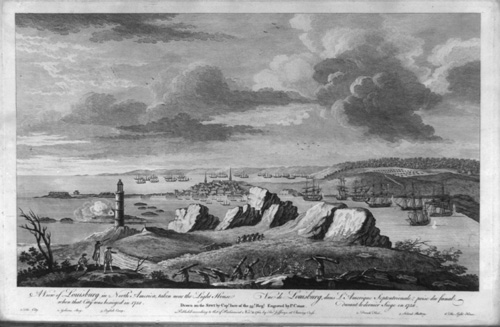
An engraving by Pierre Charles Canot from 1768 depicting Louisbourg when it was besieged
Courtesy: Library of Congress, LC-USZ62-2771
France’s major naval base in North America, Louisbourg fell to New England colonial forces in June 1745 during King George’s War.
Treaty of Aix-la-Chapelle is signed
With its signing, the Treaty of Aix-la-Chapelle restored all territories lost during King George’s War to their original owners.
French and Indian War
The North American theater of a larger war between European belligerents, the French and Indian War pitted French and British colonial forces, both often augmented by various Indian allies. http://www.wqed.org/tv/specials/the-war-that-made-america/
George Washington inadvertently starts the French and Indian War
In a twist of historical fate, it was George Washington, the future leader of the United States, who started the conflict that would sow the seeds of revolution in America, the French and Indian War. http://www.gilderlehrman.org/history-by-era/thirteen-colonies/essays/george-washington%E2%80%99s-french-and-indian-war
Battle of the Monongahela
This July 9, 1755 battle during the French and Indian War was a bitter defeat for the British.
Fort Oswego destroyed
A key British fort on Lake Ontario, French forces destroyed Fort Oswego in August 1756 during the French and Indian War, prompting more warriors to join the French cause.
Fort William Henry surrendered
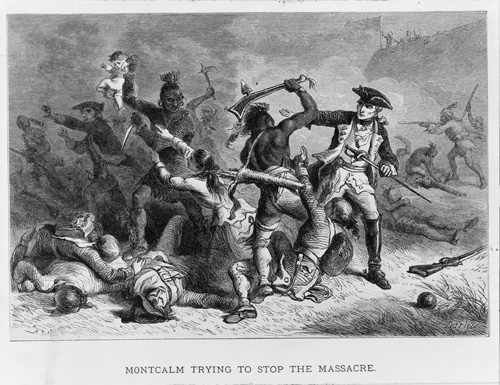
A nineteenth-century interpretation of General Louis-Joseph de Montcalm's role in the massacre at Fort William Henry
Courtesy: Library of Congress, LC-USZ62-120704
Known for the massacre that happened after its surrender, Fort William Henry and the events surrounding it would change the nature of French and British relations during the French and Indian War.
Treaty of Easton is signed
In 1758, this agreement brought peace between the British and formerly hostile native peoples who had been allied with the French during the French and Indian War.
Fort Niagara captured
A French fort at the head of Lake Ontario and a key part of their supply system of the interior during the French and Indian War, Fort Niagara was captured by the British in July 1759
Battle of the Plains of Abraham
Waged between French and British forces, this battle ended in French defeat and the British capture of Quebec. http://bataille.ccbn-nbc.gc.ca/en/bataille-des-plaines-d-abraham/contexte/l-urgence-d-agir.php
Battle of Quiberon Bay
This naval battle saw a British squadron destroy a French fleet, making certain Britain controlled the high seas and thereby make a French reinforcement of New France impossible.
Peace Of Paris is signed
Ending the French and Indian War, and the larger Seven Years’ War, this treaty had considerable ramifications for the Americas.
Pontiac’s War
In the last years of the French and Indian War, a native spiritual movement began to grow.
Boston Massacre
Rising tensions between British troops and Boston residents erupted on March 5, 1770, when soldiers fired on a crowd that was taunting them. http://www.bostonmassacre.net/
Battles of Lexington and Concord
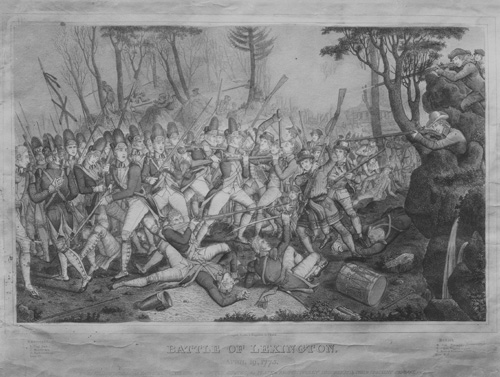
An early nineteenth-century romanticized print of the Battle of Lexington
Courtesy: Metropolitan Museum of Art, Bequest of Charles Allen Munn, 1924
The skirmishes at Lexington and Concord would have profound consequences, sparking the American Revolutionary War.
Battle of Breed’s Hill
Also known as the Battle of Bunker Hill, the Battle of Breed’s Hill proved American militiamen were capable of defeating regular British troops. http://www.masshist.org/revolution/bunkerhill.php
The Continental Army is established
On this date, the Continental Congress passed a resolution that established the Continental Army.
Battle of Long Island
A defeat for the Americans, the Battle of Long Island pitted George Washington’s young Continental Army along with militia against British General William Howe’s force of regulars augmented by Hessians.
Battle of Trenton
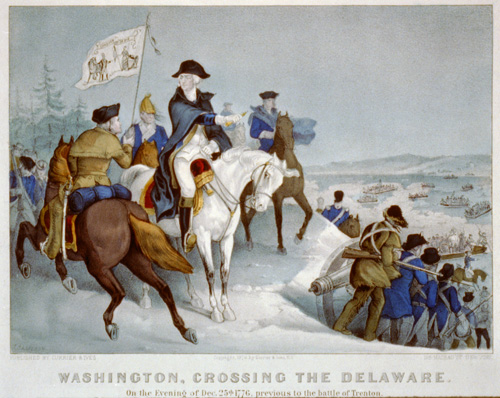
A nineteenth-century interpretation of Washington crossing the Delaware
Courtesy: Library of Congress, LC-USZC2-3156
On Christmas night, 2,400 Continental soldiers under the command of George Washington crossed the Delaware River to attack occupied Trenton.
Battle of Princeton
Part of Washington’s campaign that yielded a victory at Trenton, skirmishes at Princeton resulted in 950 British casualties to the Americans’ 200.
Battle of Brandywine Creek
The American defeat at Brandywine Creek allowed British General Howe to take Philadelphia.
First Battle of Saratoga (Freeman’s Farm)
This battle would result in a tactical victory for the British, but the Americans would come away with the more important operational victory.
Second Battle of Saratoga (Bemis Heights)
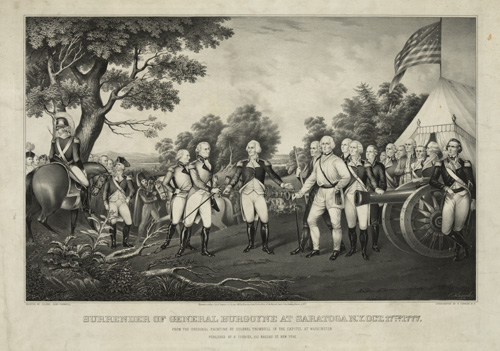
A print depicting General Burgoyn's surrender at Saratoga
Courtesy: Library of Congress, LC-DIG-pga-00926
More important than simply taking the day, the Second Battle of Saratoga and the American victory there convinced France to enter the war.
Battle of Germantown
In an attempt to repeat his success at Trenton, George Washington split his forces at Germantown, but fog created confusion that led to an American defeat.
Valley Forge
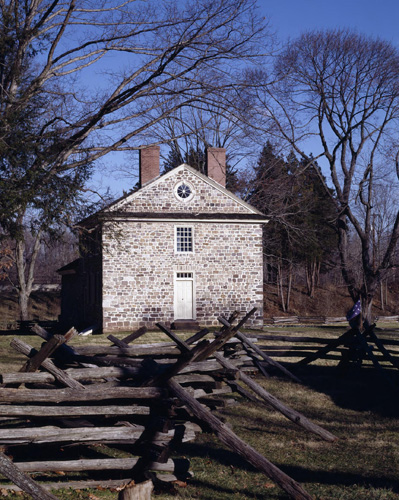
Headquarters of the Continental Army while it was encamped at Valley Forge
Courtesy: Library of Congress, LC-DIG-highsm-12310
George Washington knew if his army had any chance of winning against the British, he would have to ensure that it could stay alive and strike when the opportunity presented itself. But his first goal was to survive the winter of 1777-78.
Monmouth Courthouse
This battle may not have had a clear victor, but George Washington’s troops performance was vindication that the training the Continental Army received from Baron de Steuben during the months spent at Valley Forge had transformed the once ragtag force.
Sullivan Expedition
Named after its commander, John Sullivan, the expedition invaded and destroyed Seneca towns and fields in 1779 in what is today western New York State as a reprisal against the Seneca for Indian raids the year prior during the American Revolutionary War.
Battle of King’s Mountain
A battle in South Carolina during the American Revolutionary War, this skirmish was in retaliation for the purported Loyalist massacre of surrendering Continental troops at the Battle of Waxhaws.
Siege of Charleston
This British siege of Charleston, South Carolina eventually led to the capture of the city.
Battle of Cowpens
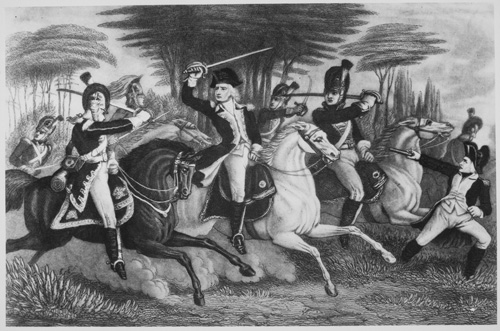
Colonel William Augustine Washington at Cowpens
Courtesy: National Archives, 148-GW-390
This battle saw Continental Army forces, led by Daniel Morgan, defeat the British under Banestre Tarleton by using militia as a trap, ultimately contributing greatly to the defeat of the British southern campaign.
Battle of Guilford Courthouse
A battle that pitted Nathanael Greene’s American forces against Lord Cornwallis’s British units, this battle was a tactical loss for the Americans, but an operational and strategic victory as a result of the British casualties Greene’s men incurred, helping put an end to the British strategy of controlling the southern states.
Siege of Yorktown
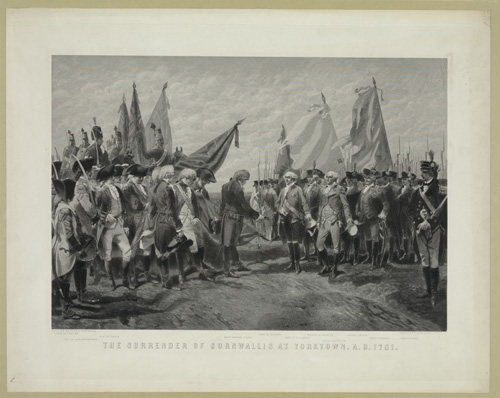
General Cornwallis surrendering to General Washington at Yorktown
Courtesy: Library of Congress, LC-DIG-pga-01668
Rather than follow Nathaniel Greene, Cornwallis went north to Virginia. Having failed to quell violence in the Carolinas, Cornwallis now believed that only operations in Virginia could produce an eventual British victory in the American south.
Battle of Virginia Capes
It was this naval battle between the French and British that disallowed the evacuation of Lord Cornwallis’s surrounded British army at Yorktown, Virginia.
Newburgh Conspiracy
The Newburgh Conspiracy reflected prolonged frustration with the weakness of the Second Continental and Confederation Congresses.
“Sentiments on a Peace Establishment”
In spring 1783, General George Washington proposed a peacetime American military in an attempt to balance the need of regulars with American fears of a standing army and reliance on militia.
Treaty of Paris is signed
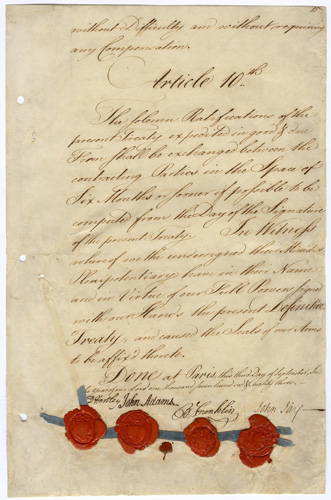
The signature page of the Treaty of Paris, with the American signatures clearly visible
Courtesy: National Archives, 299805
After years of war, the signing of the Treaty of Paris ended the American Revolutionary War.
Shays’ Rebellion
An uprising in western Massachusetts that began in summer 1786 and led to calls to strengthen the federal government, Shays’ Rebellion was the result of economic hardship and the lack of state reforms, eventually leading to protestors preventing the local governments and courts that adjudicated debt and tax collection cases from operating.
Congress creates the United States military
On the last day of Congress’s first session, representatives and senators established the U.S. military. Given the nature of civil-military relations in North America, it was an important day.
Harmar’s Expedition
In late 1790, Josiah Harmar led a campaign in the Northwest Territory in response to increasing frontier violence between Indians and settlers. His subsequent defeat led to calls for a more professional American military.
St. Clair’s Defeat
Though President George Washington wanted to avoid militia for a main 1791 campaign in the Northwest Territory to respond to Indian attacks, he approved of it for other operations.
Whiskey Rebellion
In 1794, George Washington’s administration confronted a major rebellion.
Legion of the United States is created
Founded in 1792 and disbanded four years later, the well-trained Legion of the United States, commanded by Anthony Wayne, helped attain victory for the United States over Indians in the Northwest Territory.
Militia Acts of 1792
These acts passed by Congress stipulated how the president of the United States could call militia into federal service, and required all capable male citizens from 18 to 45 years old to maintain their own weapons and equipment for use in militias.
Battle of Fallen Timbers
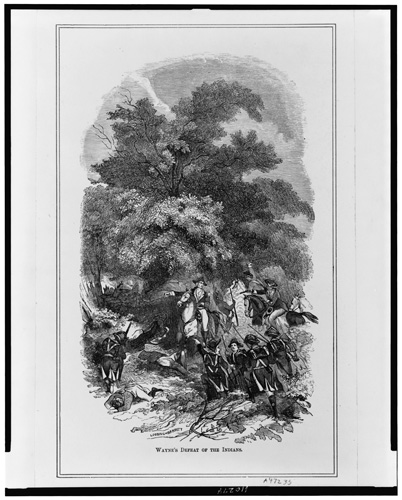
A nineteenth-century depiction of the Battle of Fallen Timbers
Courtesy: Library of Congress, LC-USZ62-110274
A frontier battle in August 1794 near Toledo, Ohio between the Legion of the United States and Indians led by Blue Jacket, this American victory helped cause the collapse of Indian resistance in the Northwest Territory.
Jay’s Treaty is signed
In 1793, President Washington declared U.S. neutrality in the war between Great Britain and France.
Treaty of Greenville is signed
In August 1795, the United States and Indian chiefs brought a declared end to hostilities in the Northwest Territory by signing the Treaty of Greenville, ultimately turning control of land in present-day Ohio and Indiana over to the United States
XYZ Affair
In the wake of the American Revolution, France threatened to call on the United States to defend its western hemisphere possessions. In reply, Washington declared neutrality rather than honor alliance commitments.
Quasi-War
Infuriated by the XYZ Affair, Americans rallied behind the Federalists. Adams did not request a declaration of war, but in May 1798 Congress proclaimed U.S. “public vessels” could capture armed French ships off the American coast, and later anywhere on the high seas.
19th Century
Convention of Mortefontaine is signed
Signed at the end of September 1800, this treaty ended the Quasi-War.
Tripolitan War
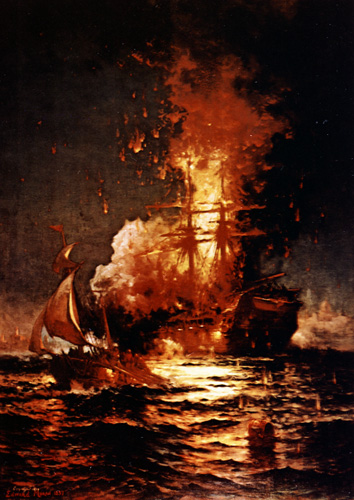
An 1897 painting by Edward Moran named "Burning of the Frigate Philadelphia in the Harbor of Tripoli, February 16, 1804"
Courtesy: Naval History & Heritage Command, KN-10849
While the Quasi-War was mostly limited to commerce raiding and a few small battles in the nearby Caribbean, the Tripolitan War was the first major American projection of force overseas.
United States Military Academy is established
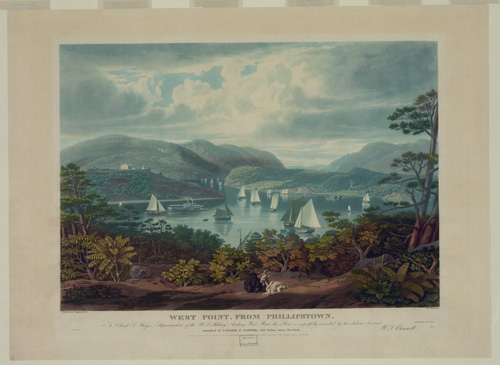
A painting made by W. J Bennett in 1831, showing what West Point originally looked like.
Courtesy: Library of Congress, LC-DIG-pga-00209
One of the first steps toward a professional fighting force was the establishment of the U.S. Military Academy.
Military Peace Establishment Act of 1802
In President Thomas Jefferson’s attempt to depoliticize the U.S. Army, this act established the United States Military Academy at West Point, New York and a permanent Army Corps of Engineers.
Chesapeake-Leopard Affair
Though the American Revolution had been concluded decades before, tensions between the United States and Britain still existed on the high seas
Battle of Tippecanoe
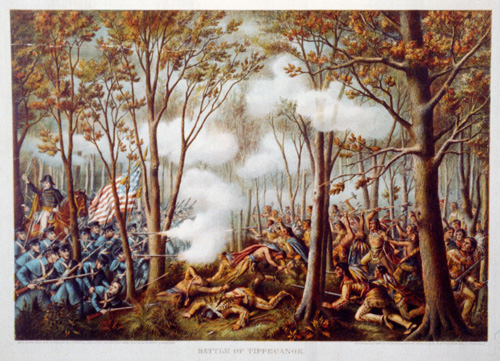
An 1889 print showing William Henry Harrison's troops fighting Tenskwatawa forces at the Battle of Tippecanoe
Courtesy: Library of Congress, LC-DIG-pga-01891
In present-day Indiana, a battle between William Henry Harrison’s force of regulars and militia and Indian warriors led by the brother of Tecumseh, Tenskwatawa, ended in an American victory.
War of 1812
Regarded by some as the “second war for Independence,” the War of 1812 would pit the United States against Great Britain and their respective Indian allies from 1812-1815.
Battle of Lake Erie
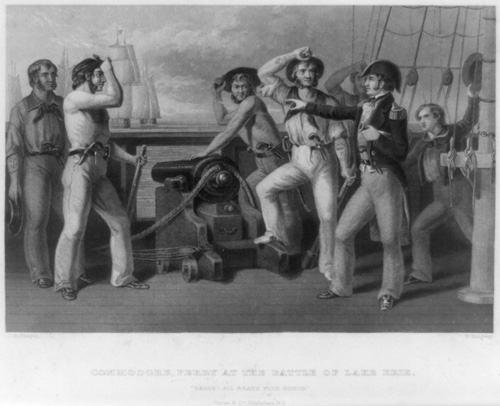
A depiction of Commodore Oliver Hazard Perry telling his men during the Battle of Lake Erie, "Ready! All ready your honor"
Courtesy, Library of Congress, LC-USZ62-8503
In September 1813, American Commodore Oliver Perry sailed across Lake Erie and destroyed a British squadron based at Fort Malden, giving the Americans control of shipping on the lake and forcing the British to abandon Forts Detroit and Malden.
Battle of the Thames
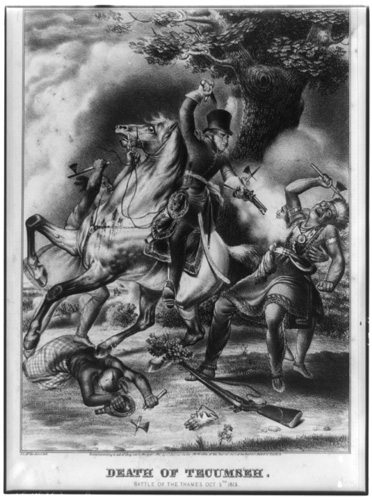
A fanciful depiction of the death of Tecumseh at the Battle of the Thames
Courtesy: Library of Congress, LC-USZ62-8
At this battle in October 1813, William Henry Harrison’s forces killed Shawnee Indian leader, Tecumseh.
Creek War
A product of imperial, regional, and local tensions, the Creek War was a brutal conflict between American forces and a faction of the Creek nation.
Battle of Horseshoe Bend
At this battle during the Creek War, Andrew Jackson’s forces broke Red Stick resistance.
Battle of Chippewa
Winfield Scott bested British regulars in this battle that was part of an American offensive into Canada.
Battle of Lundy’s Lane
Some of the most intense combat of the War of 1812, this battle was fought mostly at night next to Niagara Falls, Ontario.
Battle of Bladensburg
An American defeat at this battle allowed the British to continue to Washington, D.C. where they burned the Capitol Building, the Library of Congress, and the White House.
Treaty of Fort Jackson is signed
This treaty ended the Creek War and ceded half of all Creek lands to the United States , ironically expanding American control farther than the War of 1812 would.
Battle of Lake Champlain
This American naval victory ended a British offensive from Canada as well as the last major northern campaign of the war.
Treaty of Ghent is signed
This peace agreement between the United States and Britain that ended the War of 1812 did not see many appreciable gains by either party, as they agreed to end the war on the basis of the status quo ante bellum.
Battle of New Orleans
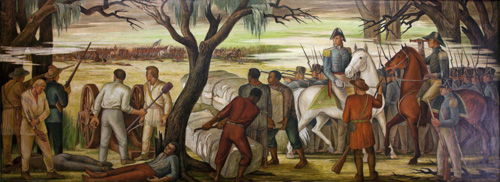
A mural of Andrew Jackson at the Battle of New Orleans, located in Washington, D.C. at the Recorder of Deeds Building
Courtesy: Library of Congress, LC-DIG-highsm-09901
The last major engagement of the War of 1812 and an American victory over the British led by Andrew Jackson, the battle occurred after the two belligerents had agreed to peace.
Algerian War/Second Barbary War
After Barbary corsairs had once again begun targeting U.S. shipping, a naval war between the United States and Barbary States broke out.
First Seminole War
In the name of denying aid to the Seminole Indians, Andrew Jackson marched into Spanish Florida and captured two Spanish forts, executing two Britons he accused of supplying the Seminole Indians. The lack of a conclusion to the war would later lead to a second conflict.
Wars of Indian Removal
A period of conflict and forced migration in the early nineteenth-century in the American southeast, the Wars of Indian Removal would be a long, violent affair when the United States government attempted to relocate Native American tribes from their traditional homelands.
Transcontinental Treaty is signed
This treaty ceded all of Florida to the United States
Reduction Act of 1821
This act reduced the U.S. Army from 12,000 personnel, mostly enlisted men, down to 6,000.
Indian Removal Act of 1830 enacted
When Andrew Jackson became president, he used federal authority to force Indians from their traditional homelands.
Black Hawk’s War
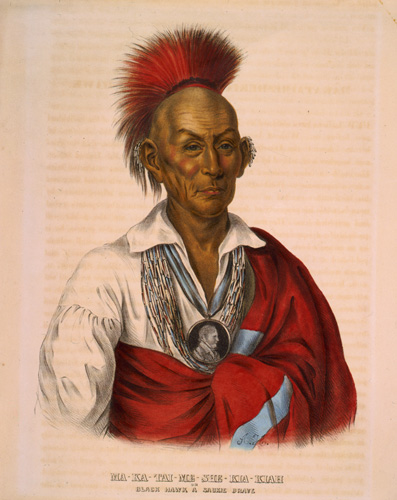
A lithograph of Black Hawk
Courtesy: Library of Congress, LC-USZC4-2677
The first conflict of Andrew Jackson’s presidency was more of a tragic chase than a war.
Treaty of Payne’s Landing is signed
This agreement between the Seminoles and the United States called for the Seminoles to abandon Florida and move west of the Mississippi.
Second Seminole War
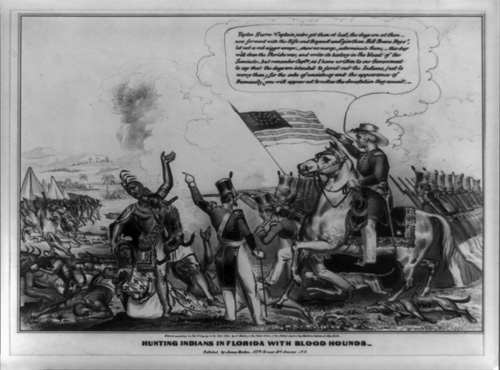
This lithograph is a tableau that dramatizes the tactics used during the Second Seminole War. Zachary Taylor is on horseback while bloodhounds pursue Seminole Indians. The caption reads: "Hurra! Captain, we've got them at last, the dogs are at them - now forward with the Rifle and Bayonet and 'give them Hell Brave Boys,' let not a red nigger escape, show no mercy, exterminate them, this day we'll close the Florida War, and write its history in the blood of the Seminole - but remember Captn., as I have written to our Government to say that the dogs are intended to ferret out the Indians, (not to worry them) for the sake of consistency and the appearance of Humanity, you will appear not to notice the devastation they commit"
Courtesy: Library of Congress, LC-USZ62-89725
One of the most unpopular wars in American history, the Second Seminole War stemmed from Andrew Jackson’s Indian removal policies.
Treaty of New Echota is signed
This treaty became the prelude to the Trail of Tears .
Second Creek War
When white speculators defrauded Creeks of their land titles and squatters settled what was rightfully Creek territory in Alabama, tensions erupted, leading to U.S. military intervention.
Battle of Lake Okeechobee
This would be the largest engagement of the Second Seminole War.
Trail of Tears
In the wake of the Indian Removal Act of 1830, the U.S. government forcibly relocated Cherokees and other native groups to areas west of the Mississippi River.
Battle of Palo Alto
This would be one of the first engagements of the Mexican-American War.
Battle of Resaca de la Palma
One day after the Battle of Palo Alto, Zachary Taylor and his forces achieved victory at Resaca de la Palma.
Battle of Monterrey
Mostly urban fighting, this battle was eventually taken by the Americans.
Congress approves declaration of war with Mexico
In response to Mexican incursions, the United States declares war on Mexico.
Doniphan’s March
A military movement by over 850 mounted volunteers from Missouri led by U.S. commander in New Mexico, Alexander Doniphan, the march was over 3,500 miles of desert and mountains, and included two engagements before Doniphan’s men finally arrived to the front.
Battle of Buena Vista
Despite large numbers of desertions, this battle was an impressive tactical victory for outnumbered an inexperienced Americans led by Zachary Taylor against Santa Anna.
Vera Cruz Campaign
This campaign in early March was the first amphibious invasion ever made by U.S. forces.
Battles of Contreras and Churubusco
These two linked battles, fought outside of Mexico City, were some of the last fighting of the war, as well as the bloodiest for the victorious Americans.
Battle of Chapultepec
When American forces successfully attacked this hill-top mansion that housed the Mexican military academy, Mexico City was open for an American occupation.
Indian Wars in the Pacific Northwest
The influx of thousands of migrants, including prospectors attracted to recent gold strikes, inflamed tensions with indigenous peoples and precipitated numerous conflicts in the Pacific Northwest before the Civil War.
Indian Wars in the Southwest
The territories acquired the U.S. acquired via the Mexican Cession in 1848, and later the Gadsden Purchase of 1853, extended and complicated the army’s mission on the frontier.
Indian Wars on the Great Plains
Treaty of Guadalupe Hidalgo is signed
This treaty that ended the Mexican-American War called for the Mexican government to pay the United States $15 million, set the Rio Grande as the Texas border, and hand over Mexico’s northernmost territories.
Army of Northern Virginia organized
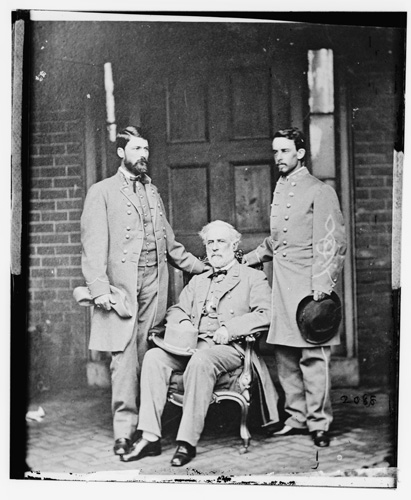
Commander of the Army of Northern Virginia, Robert E. Lee. The man to Lee's right is his son, George Washington Custis Lee, who served as President Jefferson Davis's aide-de-camp. To Lee's left is Walter Taylor, the general's aide-de-camp
Courtesy: Library of Congress, LC-DIG-cwpb-06234
The Army of Northern Virginia was the primary army for the Confederacy in the Eastern Theater.
Army of the Potomac organized
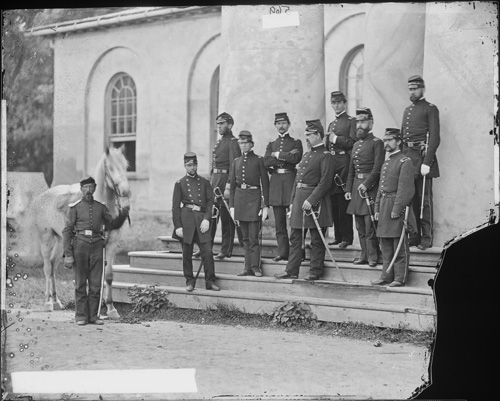
Irwin McDowell, the first commander of the Army of the Potomac, with his staff
Courtesy: National Archives, 111-B-4448
The Army of the Potomac would be the Union’s largest army of the war.
Battle of Fort Sumter begins
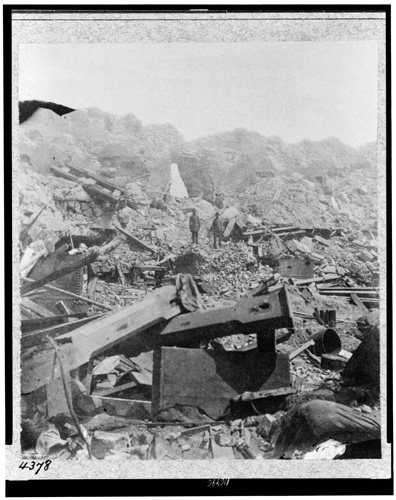
Inside Fort Sumter after the bombadment, taken by a Confederate soldier
Courtesy: Library of Congress, LC-USZ62-116996
At 4:30 AM, the Civil War began with a Confederate bombardment of Fort Sumter in Charleston harbor, signifying the first shots of what would be a long, bloody war.
Anaconda Plan outlined
A Union strategy developed by U.S. General Winfield Scott, this plan sought to deny the Confederacy resources to support its war effort by implementing a U.S. blockade of Confederate ports along the southern coastline and controlling the Mississippi.
First Battle of Bull Run (Manassas)
With armies raised, Union and Confederate authorities organized their largest forces around their respective capitals, which were only 100 miles away from each other.
Union troops take Forts Henry and Donelson
In February 1862, Union troops took these Confederate forts that were on the Tennessee and Cumberland Rivers, respectively.
Valley Campaign
Stonewall Jackson would use speed, deception, and terrain in the Shenandoah Valley to distract Union attention away from the Peninsula Campaign.
Peninsula Campaign begins
For five months, a Union force far superior in size would fail to smash Robert E. Lee’s Army of Northern Virginia.
Battle of Shiloh
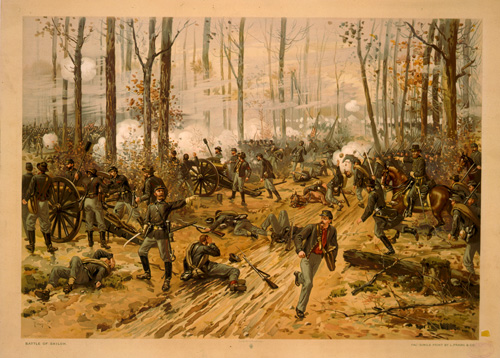
Chromolithograph of the Battle of Shiloh
Courtesy: Library of Congress, LC-DIG-pga-04037
Shiloh was the first truly grisly Civil War battle.
Confederate Conscription Act
In April 1862, the Confederacy called for all able-bodied men between 18-35 years old to be eligible for the draft.
Battle of Fair Oaks (Seven Pines)
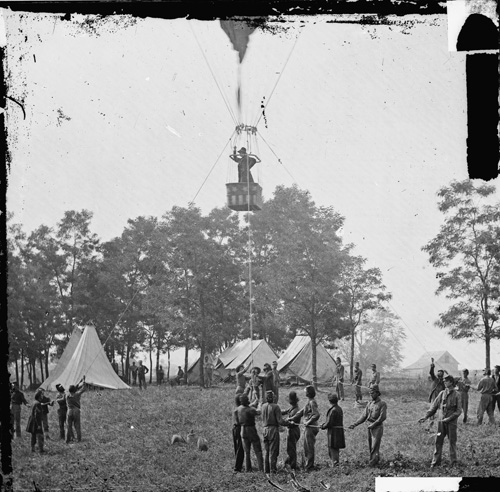
Professsor Thaddeus S. Lowe watches the Battle of Fair Oaks from his balloon, the Intrepid
Courtesy: Library of Congress, LC-DIG-cwpb-01560
Part of the Peninsula Campaign, this battle was a southern defeat.
Second Battle of Bull Run (Manassas)
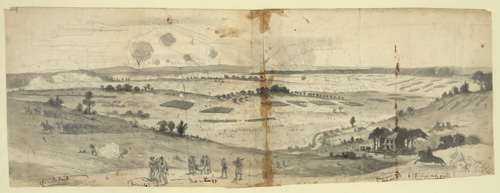
A sketching of the Second Battle of Bull Run, drawn by Edwin Forbes. The sketching has numbers labeling key features and moments of the battle. They are: (1) Thoroughfare Gap (2) Confederate Line of Battle (3) The old Railroad embankment behind (4) The old Stone House on the Turnpike used as a hospital (5) Warrenton Turnpike (6) Baldface Hill (7) Henry Hill (8) Union Line of Battle (9) McDowell's Corps moving to the left flank to repel Longstreet's attack, which had just commenced (10) Sudley Springs road
Courtesy: Library of Congress, LC-DIG-ppmsca-22552
To revive Union fortunes in the war, Lincoln made significant command changes in July.
Battle of Antietam
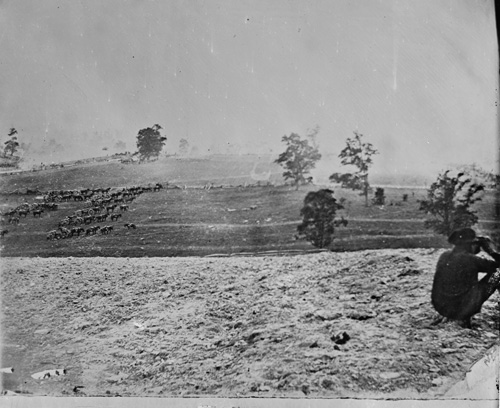
A rare Civil War photograph of a scene that is not outwardly staged. This picture is probably from the afternoon of September 18, the day after the battle. The man with binoculars is placed in front of McClellan's headquarters, looking toward Antietam Creek. The inactive artillery unit in the background is thought to be General Andrew A. Humphreys' Fifth Corps division
Courtesy: Library of Congress, LC-DIG-cwpb-01162
Lee sought to move onto Union soil, defeat Federal forces and threaten a major city such as Washington, Baltimore or Philadelphia.
Battle of Fredericksburg
In this battle, Robert E. Lee’s Army of Northern Virginia inflicted heavy losses on the Army of the Potomac as a result of the Union force’s near-suicidal frontal attacks that never reached their destinations.
Battle of Stones River (Murfreesboro)
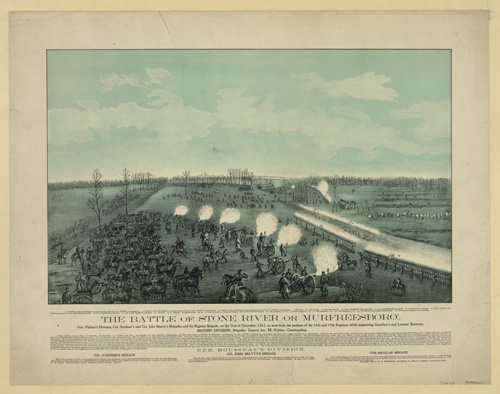
A lithograph of the Battle of Stones River, sketched by A. E. Mathews, 31st Regiment, O.V.I. The caption reads, "General Palmer's Division, Col. Scribner's and Col. John Beatty's Brigades and the Regular Brigade, on the 31st of December, 1862, as seen from the position of the 15th and 19th Regulars while supporting Guenther's and Loomis' Batteries"
Courtesy: Library of Congress, LC-DIG-pga-03447
At Stones River, both sides suffered the highest percentage of casualties in the war.
Emancipation Proclamation
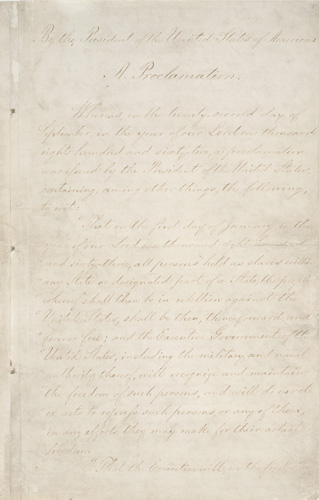
Page one of the Emancipation Proclamation
Courtesy: National Archives, ARC Identifier 299998
By September 1862, Lincoln realized he needed to change the Union’s war aims to achieve victory.
Enrollment Act
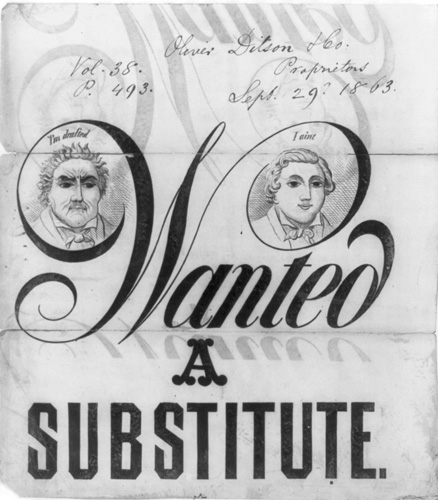
An illustrated sheet music cover, which protests the inequities of the draft or proscription system enacted under the Enrollment Act of 1863. The act allowed drafted men to purchase an exemption or to furnish a surrogate or "substitute" in lieu of their own service. The unfairness of the measure to the economically disadvantaged is dramatized in the illustration to this piece, showing the bust portrait of one man, "I'm drafted," in contrast to that of an obviously more well-to-do young man, "I aint"
Courtesy: Library of Congress, LC-DIG-ppmsca-35356
In the Union Enrollment Act, all able-bodied men between 20-45 years old became eligible for the draft, yet substitutes could be hired or a $300 fee could be paid to avoid service.
Battle of Chancellorsville
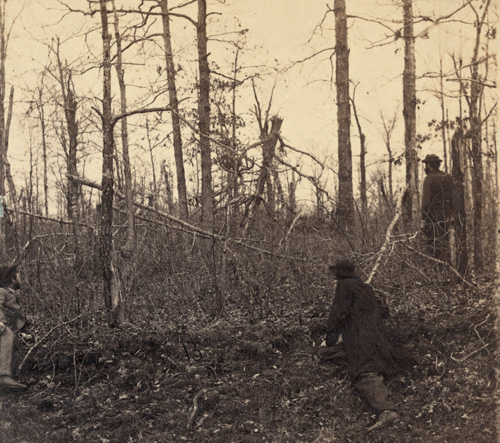
Three men surveying the effects of artillery fire after the Battle of Chancellorsville. It was near this location where Stonewall Jackson was mistakenly shot by his own men
Courtesy: Library of Congress, LC-DIG-ppmsca-23669
Chancellorsville was a victory for Lee due to his near recklessness as much as Hooker’s timidity.
President Abraham Lincoln signs General Orders 100
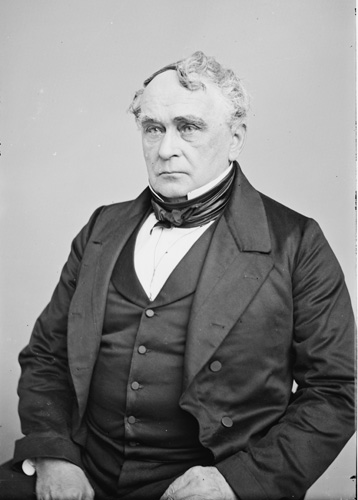
Francis Lieber, author of General Orders No. 100
Courtesy: Library of Congress, LC-DIG-cwpbh-01402
General Orders No. 100, otherwise known as the Lieber Code after its author, Francis Lieber, was the first attempt to codify the laws of war. Lincoln signed the order to dictate how Union soldiers should conduct themselves in war.
New York City Draft Riots
The largest and most lethal draft riot in the north during the Civil War, the New York draft riot was a result of Irish immigrants angry about their conscription, leading to dozens of black residents being attacked and killed.
Battle of Gettysburg
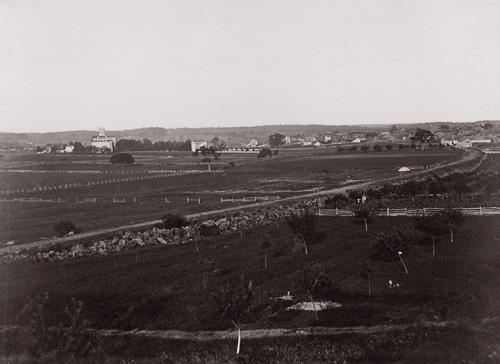
Looking into Gettysburg, taken from one of the surrounding hills that offer a commanding view of the town
Courtesy: Metropolitan Museum of Art, photographer Timothy H. O'Sullivan, Harris Brisbane Dick Fund, 1933
Recently given command of the Army of the Potomac, General George Meade won a dramatic victory for the Union over Robert E. Lee’s Confederate forces in the Civil War’s bloodiest battle.
Battle of Chickamauga
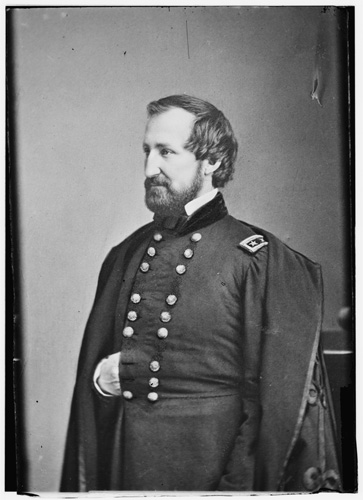
Commander of the Army of the Cumberland and the loser at Chickamauga, General William Rosecrans
Courtesy: Library of Congress, LC-DIG-cwpb-06052
In this battle in northwest Georgia, the Union’s Army of the Cumberland, led by William Rosecrans, lost to Confederate General Braxton Bragg’s Army of Tennessee, with both sides enduring some of the worst casualties of the war.
Battle of Chattanooga
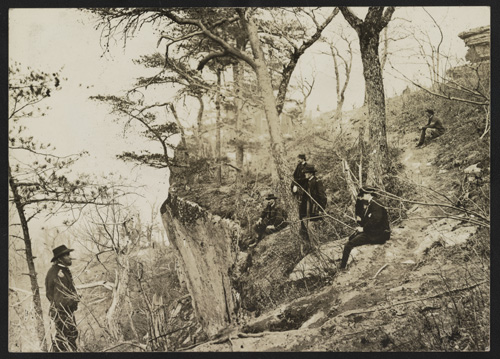
General Ulysses S. Grant, left, on Lookout Mountain, the dominating high ground of the strategically important area, after the Battle of Chattanooga
Courtesy: Library of Congress, LC-DIG-ppmsca-32399
This battle in southeast Tennessee was a momentous victory for the Union in the Western Theater, giving control of Tennessee to Federal forces and allowing Chattanooga to become a supply line for drives deeper into the south
Petersburg
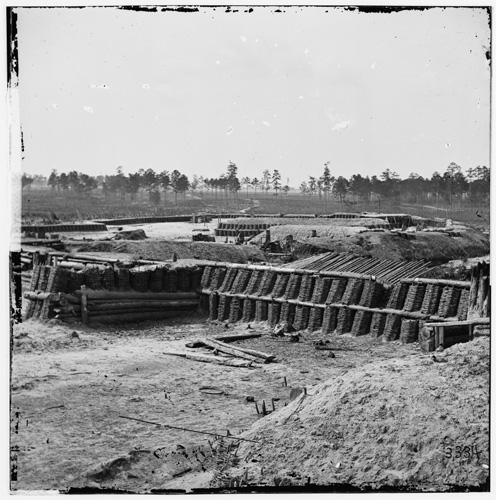
Looking inside the Union Army's Fort Sedgwick, the closest outpost to the Confederate line. Its proximity to the Confederates led Union soldiers to dub the position "Fort Hell"
Courtesy: Library of Congress, LC-DIG-cwpb-02839
A town in eastern Virginia and the site of a Union victory that marked the final battle of the Overland Campaign during the Civil War, Petersburg was punctuated by almost continual combat, most of it involving elaborate fortifications.
Battle of the Wilderness
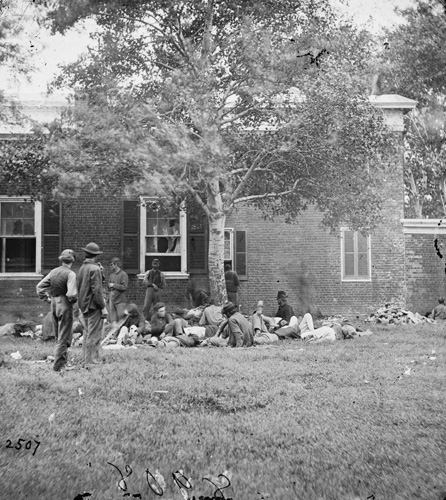
Wounded soldiers from the Battle of the Wilderness at a hospital in Fredericksburg, Virginia
Courtesy: Library of Congress, LC-DIG-cwpb-01842
The start of Ulysses S. Grant’s Overland Campaign, the Wilderness engagement was mostly close-quarters combat that claimed 17,000-18,000 Union casualties while the Confederates lost around 10,000.
Cold Harbor
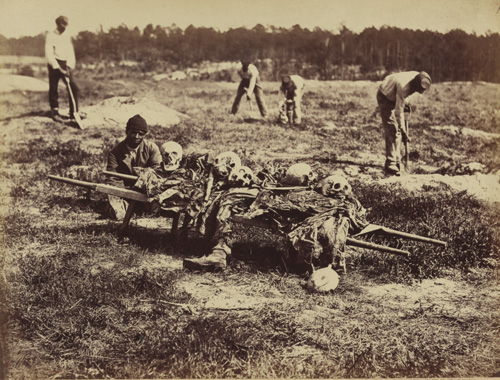
Months after the battle, a burial party collects the bones of Union soldiers who died at Cold Harbor
Courtesy: Library of Congress, LC-DIG-ppmsca-12615
Fought in eastern Virginia as part of Ulysses S. Grant’s Overland Campaign, Cold Harbor saw Union forces suffer tremendous casualties for no tactical gain.
March to the Sea
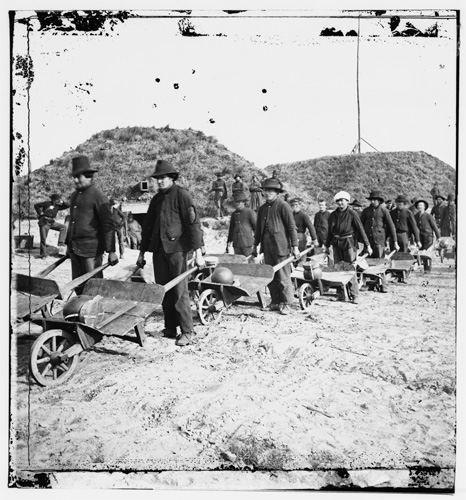
Sherman's troops carrying away ammunition from the recently-fallen Confederate stronghold in Savannah, Fort McAllister
Courtesy: Library of Congress, LC-DIG-cwpb-03159
After Sherman’s drive through Georgia, he turned to the sea and set about destroying the southern infrastructure, capturing or destroying anything of perceived military value to the Confederacy along the 300 mile march.
Battle of Spotsylvania Courthouse
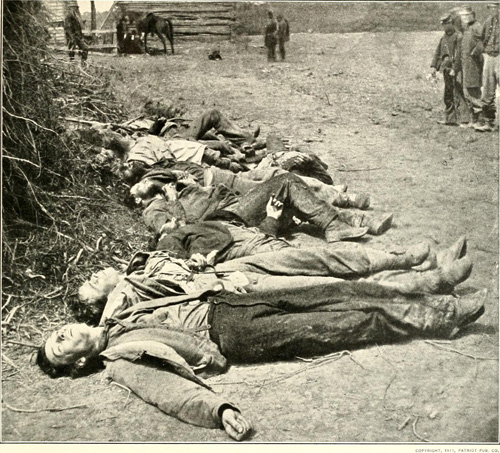
Confederate soldiers collected for burial at Spotsylvania Courthouse
Courtesy: Internet Archive Book Images / Flickr
The second battle of Ulysses S. Grant’s Overland Campaign in Northeast Virginia.
Atlanta Campaign
William Tecumseh Sherman’s famous campaign through Georgia culminated with his capture of Atlanta on September 2.
Sand Creek Massacre
An attack of a peaceful Indian village by Colorado militia on November 29, 1864, the Sand Creek Massacre resulted in about 150-200 slaughtered men, women, and children.
Robert E. Lee surrenders
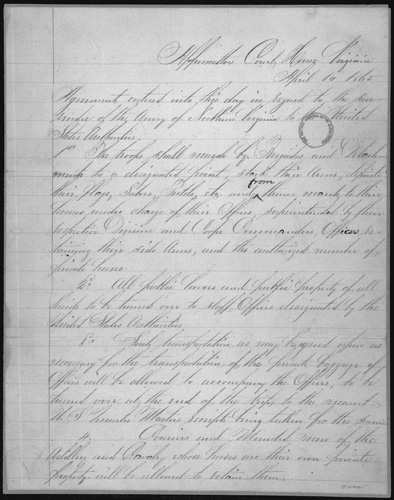
The Articles of Agreement that generals Lee and Grant wrote and signed on April 10, 1865
Courtesy: National Archives, ARC Identifier 300386
On April 9, 1865, the two adversaries, Robert E. Lee and Ulysses S. Grant, finally met once again, but the occasion was the surrendering of the Army of Northern Virginia and the effective ending of the Civil War.
Reconstruction
The postwar Union occupation of the South, Reconstruction saw several iterations before finally ending in 1877.
Red Cloud’s War
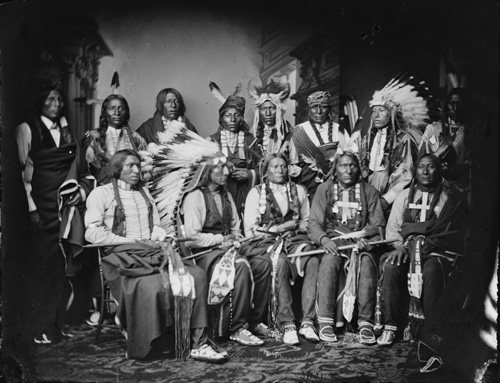
Red Cloud with a group of Sioux
Courtesy: Library of Congress, LC-DIG-cwpbh-04626
Red Cloud, the most prominent of the hostile Lakota chiefs, led attacks against civilian routes to Montana gold mines and against U.S. Army soldiers in 1866 until the 1868 Treaty of Fort Laramie ended the conflict.
Fetterman Massacre
Eighty U.S. Army soldiers were killed in the Fetterman Massacre by 1,500 Native American warriors in northern Wyoming during Red Cloud’s War.
Memphis and New Orleans Race Riots
While the violence in Memphis was a spontaneous release of social tensions due to a growing black population, the New Orleans riot was political, with the disruption of a convention who sought to expand black rights.
1867 Medicine Lodge Treaty is signed
Ultimately, this treaty which sought to confine natives on the southern plains to reservations, namely the Kiowa, Comanche, Kiowa Apache, Cheyenne, and Arapahoe peoples, would fail.
1868 Treaty of Fort Laramie is signed
This treaty between the United States government and Indian groups in the Wyoming Territory gave the native peoples of the Great Sioux Reservation all of present-day South Dakota west of the Missouri River in exchange for continued peace with white settlers.
Enforcement Acts are signed
These Reconstruction-era acts passed by Congress in 1870-1871 that outlawed the KKK and similar groups made depriving people of their civil and political rights a federal offense, and allowed presidents to impose martial law in the event of an insurrection.
Modoc War
This Pacific Northwest conflict beginning in 1872 was triggered when a band of disgruntled Modoc Indians, unhappy with their reservation, attempted to return to their homelands on the California-Oregon border. A series of clashes between the Modoc, white settlers, and U.S. Army troops finally ended in June 1873.
Colfax Massacre
One of the bloodiest events of the Reconstruction period, this massacre in Louisiana began when confused election results prompted African American men to gather in Colfax in order to protect Republican officials from a potential attack. Hundreds of alarmed whites confronted the group and a battle ensued with up to 100 black men dying.
Red River War
This conflict in the American Great Plains resulted from Kiowa, Comanche, and Cheyenne warrior bands leaving Indian territory to ravage settlements and travelers in Texas and Kansas. Philip Sheridan led U.S. Army troops in numerous battles against belligerent natives until defeated bands drifted back to the reservations.
Great Sioux War
On the northern plains, the Lakota peoples, led by Sitting Bull, along with their Cheyenne allies, clashed with U.S. military forces.
Battle of the Little Bighorn
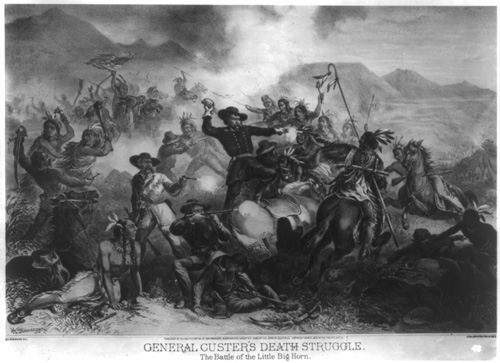
A fanciful depiction of Custer's last stand
Courtesy: Library of Congress, LC-DIG-pga-04166
Part of the Great Sioux War, Sitting Bull and his forces clashed with American forces at this battle. Some regard the outcome the worst U.S. military disaster in American history.
Battle of the Rosebud
An outgrowth of the forced relocation of the Lakota peoples, this battle was part of the Great Sioux War.
Alfred Thayer Mahan’s Influence of Sea Power Upon History, 1660-1783 is published
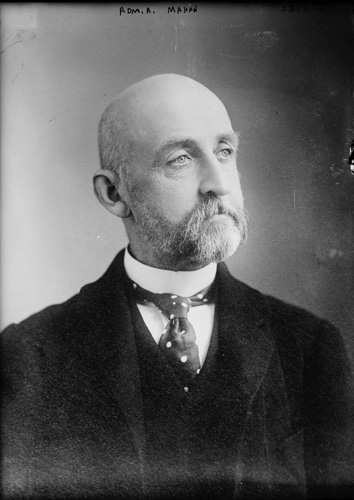
Alfred Thayer Mahan
Courtesy: Library of Congress, LC-DIG-ggbain-17956
Mahan’s book would go on to become one of the most influential books during the era of American expansion abroad.
Battle of Wounded Knee
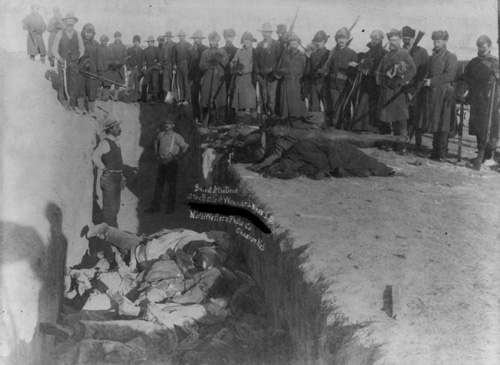
U.S. soldiers burying the Indian dead in a mass grave after the Battle of Wounded Knee
Courtesy: Library of Congress, LC-USZ62-44458
The last engagement of the Indian Wars, the battle took place at Wounded Knee Creek, South Dakota. A botched attempt to disarm a group of Lakota warriors ended in fighting that killed 150 Lakota men, women, and children and twenty-five U.S. soldiers.
USS Maine explodes and sinks in Havana Harbor
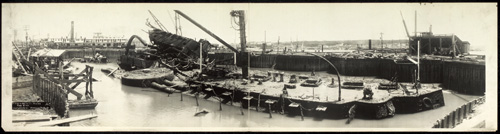
The USS Maine pictured as she looked on June 16, 1911, 13 years after she sank. On March 16, 1912, the U.S. Navy raised the Maine from Havana Harbor, towed her out into the Atlantic Ocean, and scuttled her
Courtesy: Library of Congress, LC-USZ62-52723
The sinking of this American battleship in Havana Harbor would spark the Spanish-American War.
Spanish-American War begins
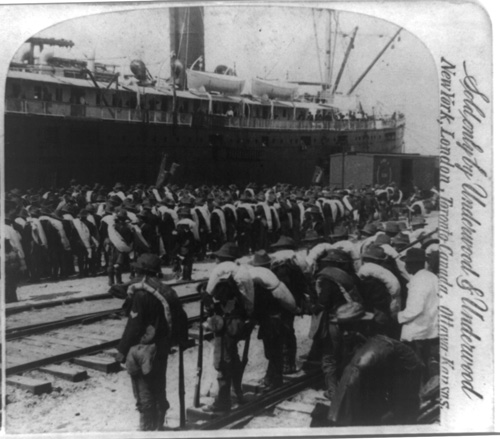
The Eighth U.S. Infantry stands ready to embark for Cuba
Courtesy: Library of Congress, LC-USZ62-92730
From April to August 1898, this war between the United States and Spain was fought in two theaters, the Caribbean and Pacific. Fighting did not last long in either Cuba or the Spanish holdings in the Philippines, though it revealed fractures in the U.S. military and its ability to mobilize.
Battle of Manila Bay
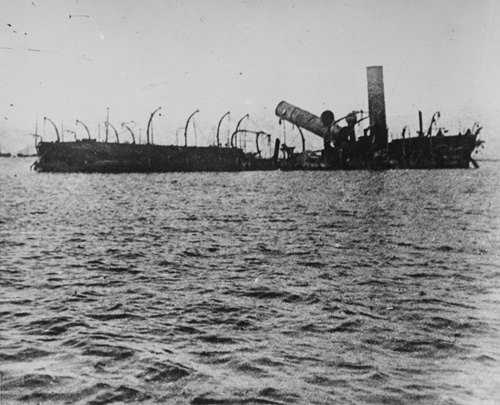
The wreckage of the Spanish cruiser Reina Cristina after the Battle of Manila Bay
Courtesy: Naval History & Heritage Command, USN 902936
This naval battle during the Spanish-American War in the Philippines saw U.S. Navy Commodore George Dewey’s Asiatic Squadron destroy Spanish vessels commanded by Patricio Montojo, thereby eliminating Spain’s naval power in the Pacific and making Dewey a hero in the United States.
Battle of Santiago
The land battle began on July 1, 1898 and the sea battle that destroyed the Spanish fleet in the Caribbean followed two days later, virtually secured American victory in the war and eventually leading to a negotiated settlement.
Treaty of Paris is signed
This negotiated settlement brought the Spanish-American War to an end.
Philippine-American War
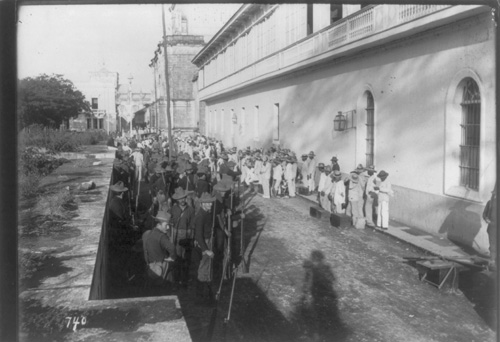
U.S. soldiers, left, and captured Filipine revolutionaries
Courtesy: Library of Congress, LC-USZ62-46689
For the first year this war between Filipino revolutionaries and the United States remained a conventional conflict, but in 1900 it transformed into guerrilla warfare and U.S. counterinsurgency operations that utilized punitive measures.
Elihu Root becomes Secretary of War
As Secretary of War from 1899 to 194, Elihu Root initiated sweeping reforms that helped create a modern Army capable of fighting a modern war.
20th Century
General Board of the Navy is established
Secretary of the Navy John D. Long established the General Board of the Navy, maing Admiral George Dewey as its first president, to centralize administrative power in the Navy.
The United States Army War College is founded
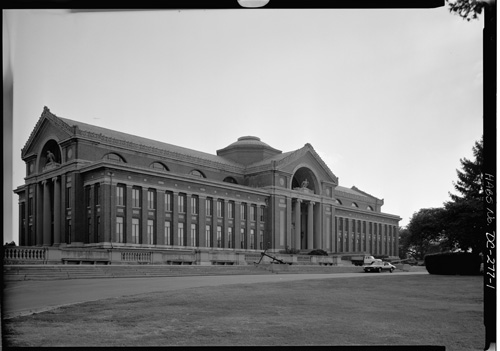
The original home of the U.S. Army War College, Washington Barracks in Washington, D.C. In October 1951, the War College moved to its present home in Carlisle, Pennsylvania
Courtesy: Library of Congress, HABS DC,WASH,393—1
Further professionalizing the U.S. Army, the founding of the War College would have a profound effect on the service.
American forces capture Emilio Aguinaldo
The resistance leader of the Filipino revolutionaries, Emilio Aguinaldo was captured in his headquarters and subsequently took an oath recognizing American sovereignty over the Philippines.
The Militia Act
In response to the performance of American militia units in the Spanish-American War, this act sought to reform and standardize the militia.
Congress passes the General Staff Act
Secretary of War Elihu Root succeeded in convincing Congress to pass the General Staff Act on this date, but a watered-down version called for a small General Staff of 45 officers that would be assigned to the War Department.
Theodore Roosevelt establishes Joint Army-Navy Board
Created by President Theodore Roosevelt, the Joint Board comprised of representatives from the military heads and chief planers of the Navy’s General Board and Army’s General Staff. It was an advisory committee that planned joint operations and to smooth rivalries between each other.
Marines occupy the Dominican Republic
With the sudden increase in American territory after victory in the Spanish-American War, the deployment of thousands of Marines and soldiers as agents for American corporate influence were required, including to the Dominican Republic twice.
U.S. occupation of Cuba
Just as with the Dominican Republic, the sudden increase in American territory after the Spanish-American War meant the United States deployed thousands of Marines and soldiers as agents for American corporate influence. In Cuba, there were three separate U.S. occupations.
The Great White Fleet sets out
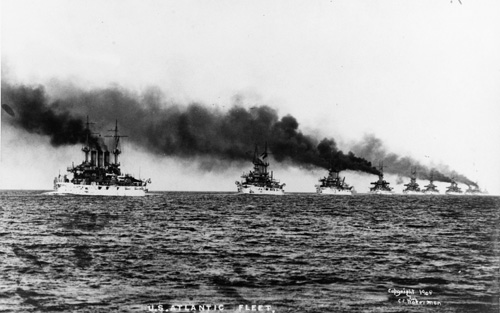
The battle fleet underway
Courtesy: Naval History & Heritage Command, NH-92091
In December 1907, in a show of American power, an American battle fleet left steamed out of Hampton Roads and embarked on a circumnavigation of the globe.
U.S. occupation of Nicaragua
Part of what became known as the Banana Wars, American forces occupied Nicaragua three times.
U.S. Navy’s first dreadnoughts are constructed
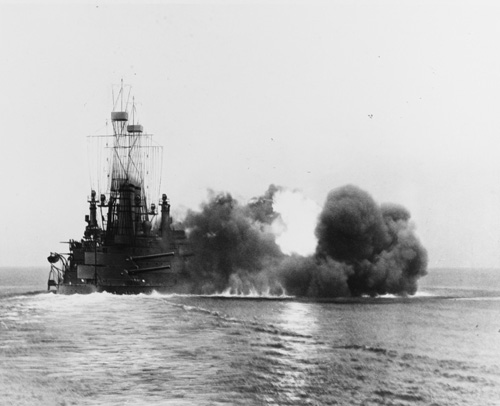
The USS Michigan firing a broadside from her eight main guns
Courtesy: Naval History & Heritage Command, NH 66299
With a new overseas empire, the U.S. Navy’s creation of first-class battleships signalled a greater American presence on the high seas.
Battle of Veracruz
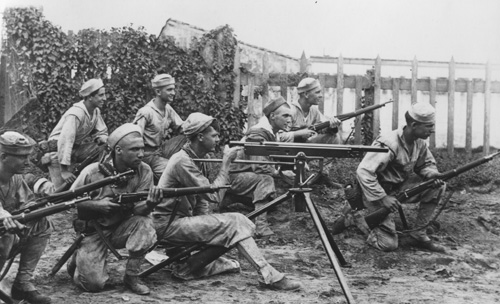
Sailors from the USS Michigan ashore during the occupation of Veracruz
Courtesy: Naval History & Heritage Command, NH 100616
Between 1914 and 1916, for example, President Wilson used military force several times, notably in Mexico, then in Haiti, and again in Mexico.
Gavrilo Princip assassinates Franz Ferdinand
Battle of Tannenberg
While the Western Front of the First World War settled into trench warfare, on the Eastern Front saw a war of maneuver on a grand scale between German and Russian forces.
First Plattsburgh Citizens Camp is founded
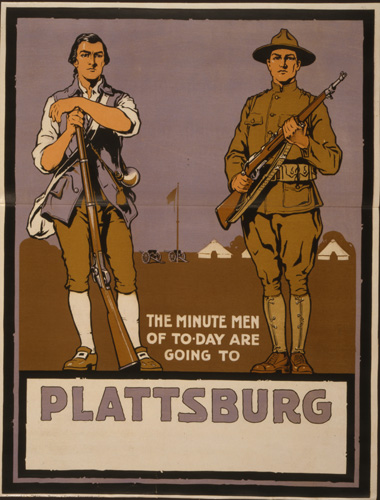
Recruitment poster for the Plattsburgh camps
Courtesy: Library of Congress, LC-USZC4-9034
With the possibility of conflict becoming more real in 1915, a few far-sighted Americans decided to increase the level of preparedness through unofficial means. In Plattsburgh, New York, private citizens created a camp where thousands of middle-class American men went through training in military procedures and leadership
U.S. occupation of Haiti begins
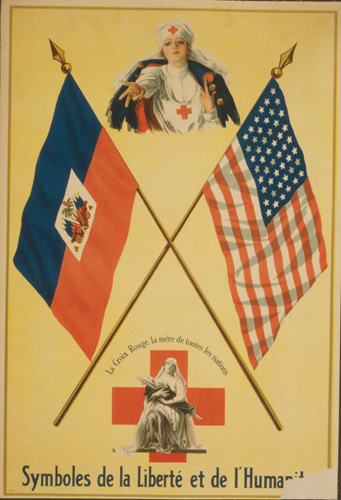
Red Cross poster during the U.S. occupation of Haiti
Courtesy: Library of Congress, LC-USZC4-7386
In 1915, President Wilson decided to use military force to restore order in Haiti on the western side of Hispaniola.
United States Naval Reserve is created
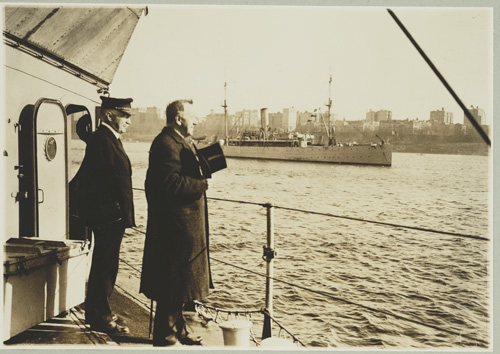
Josephus Daniels, the Secretary of the Navy who strengthened the branch considerably, reviewing the mine sweeper fleet in the Hudson River
Courtesy: Library of Congress, LC-DIG-ds-00152
In a bid to create a more expandable American force structure, Congress established the Naval Reserve, thus giving the branch three manpower components – regular, guard, and reserve – by the start of the First World War in 1914.
A German U-Boat torpedoes the RMS Lusitania
The most infamous German U-boat attack of the First World War occurred when the British luxury ship RMS Lusitania was torpedoed.
Gallipoli
This operation in the northeastern corner of the Mediterranean Sea saw French, Australian, New Zealand, British, and Indian troops make an amphibious assault on the Turkish peninsula of Gallipoli in a bid to capture Istanbul. The operation proved to be a fiasco.
Mexican Punitive Expedition
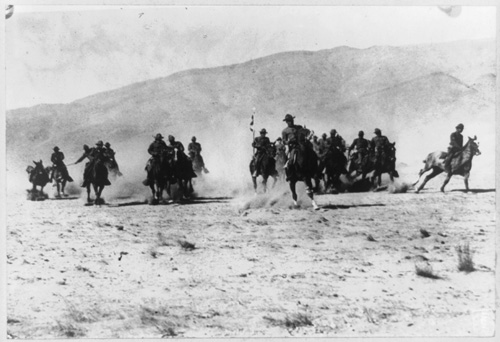
The 8th Gun Cavalry practices a charge during the Mexican Punitive Expedition
Courtesy: Library of Congress, LC-USZ62-92488
In the spring of 1916, Army units massed on the United States’ southern border for what would be known as the Mexican Punitive Expedition.
Army Reserve Officers Training Corps is established
The National Defense Act of 1916 established the Reserved Officer Training Corps for students at universities and colleges.
Battle of Verdun
The Battle of Verdun started in February 1916 when German forces launched an ill-fated attack against the French. The two sides suffered a total of one million casualties over the next eleven months.
Battle of the Somme
Following their week-long artillery bombardment, some 100,000 British troops attacked German trenches. German troops repelled the British attack in shocking fashion, killing 20,000 and wounding another 40,000 British soldiers on the first day of combat alone.
National Defense Act of 1916
The National Defense Act of 1916 set the Army and the War Department on the road to preparedness.
Naval Act of 1916
The largest naval expansion program to date, the Naval Act of 1916 enlarged and modernized the U.S. Navy, providing the foundation to build the world’s most powerful fleet.
United States enters the First World War
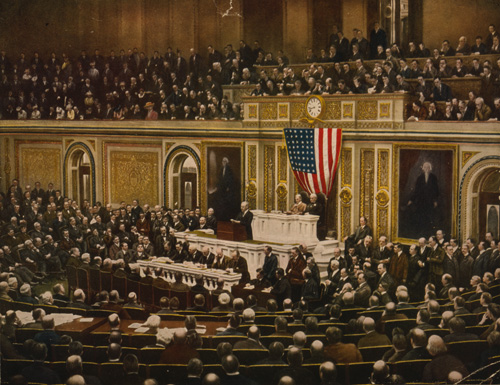
President Wilson addressing Congress, April 2, 1917
Courtesy: Library of Congress, LC-USZC4-10297
On this date, President Woodrow Wilson addressed a joint session of Congress, enumerating Germany’s transgressions and asking for a declaration of war.
Amalgamation Controversy
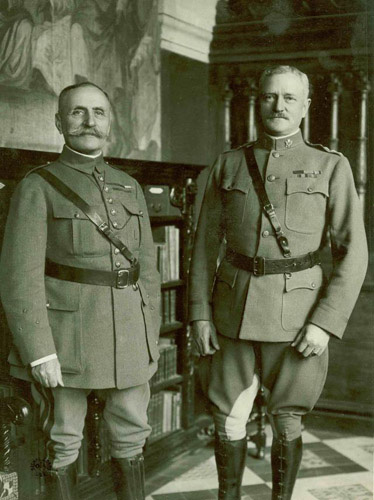
General John J. Pershing (right) standing beside Ferdinand Foch, Marshal of France and supreme commander of all allied armies
Courtesy: USAHEC, Roy Coles Album
When the United States joined the fight in the First World War, a debate erupted about which flag Americans would fight under.
Congress passes the Selective Service Act
This program of universal conscription registered some 24 million men for the service as part of a national lottery.
1st Division arrives in France
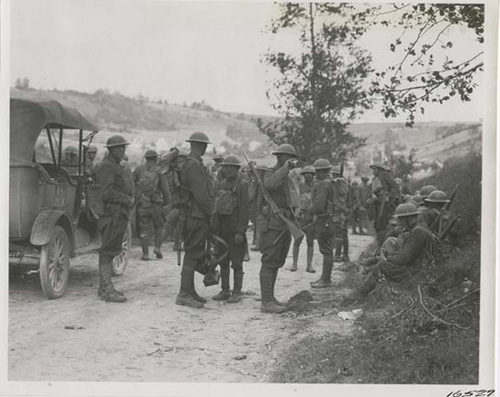
Soldiers of the Big Red One, 28th Infantry
Courtesy: U.S. Army Signal Corps Photo
The understrength 1st Division’s 18,000 men arrived in France piecemeal during the summer and fall of 1917.
2nd Division arrives in France
Following on the heels of its sister division, the 2nd came on the line shortly after the 1st Division.
Aviator Eddie Rickenbacker scores his first aerial victory
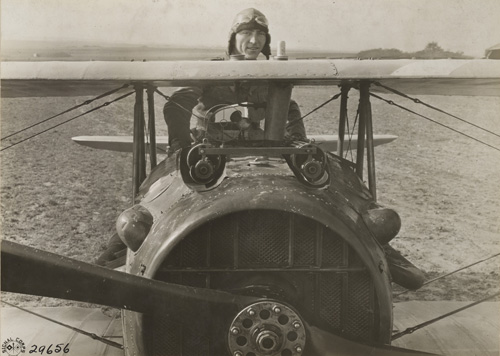
Courtesy: National Archives, 111-SC-29656
Rickenbacker became known as America’s "Ace of Aces" because he shot down twenty-six German aircraft and balloons during the First World War. This made him the most deadly fight pilot in U.S. Army Air Service and national hero back on the American home front.
Battle of Cantigny
In April, the U.S. 1st Division moved into a French-controlled sector just south of Amiens and north of Paris, where the German drive had formed a bulge or salient in Allied lines.
Battle of Belleau Wood
To help stop the German onslaught that reached to within 50 miles of Paris, General d again sent AEF units into the breach in what is known as the Aisne-Marne Campaign.
The 369th Infantry, New York National Guard lands in France
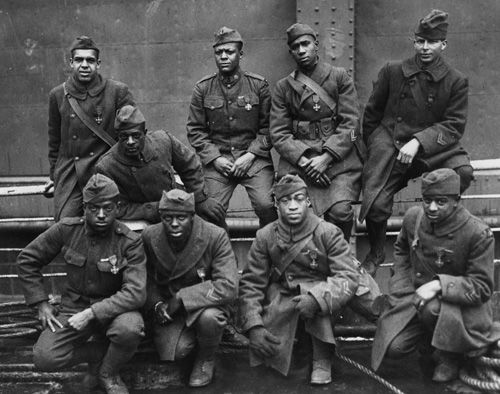
Men of the 396th who were awarded France's Croix de Guerre
Courtesy: National Archives, 165-WW-127[8]
Nicknamed the “Harlem Hellfighters,” the 369th was the first African American regiment to serve with the American Expeditionary Force during the First World War.
3rd Infantry Division earns “Rock of the Marne” reputation
As part of the AEF forces that General Pershing sent to stop the German march to Paris, the 3rd Infantry absorbed the brunt of the German attack on the Marne River, thus earning them the nickname “Rock of the Marne.”
Battle of St. Mihiel
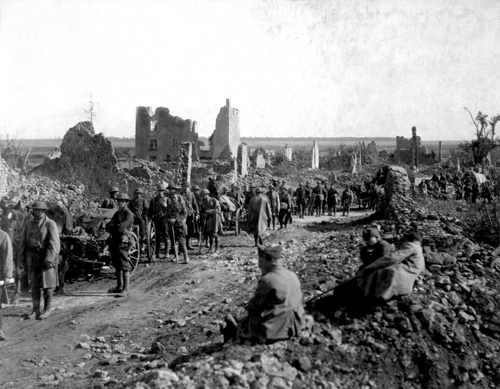
The 18th Infantry, Machine Gun Battalion advancing toward St. Mihiel a day after the battle began
Courtesy: Sgt. J.A. Marshall / US Army / Wikimedia Commons
The Battle of St. Mihiel commenced when the American doughboys flung themselves into the German line, representing another first for the AEF – a combined arms operation using artillery, aircraft, tanks, and infantry
Meuse-Argonne Offensive
Franco-American forces launched the massive Meuse-Argonne offensive on September 26, constituting the largest concentration of manpower in American military history. This gave future military leaders such as George C. Marshall experience in planning and operating on a very large scale.
Armistice

Lt. Col. George S. Patton, Jr., in front of a French-built Renault FT-17 tank in summer 1918.
Courtesy: U.S. Army Signal Corps Photo
Fighting in the First World War ended on the eleventh hour of the eleventh day of the eleventh month – 11:00 AM on November 11, 1918.
Treaty of Versailles is signed
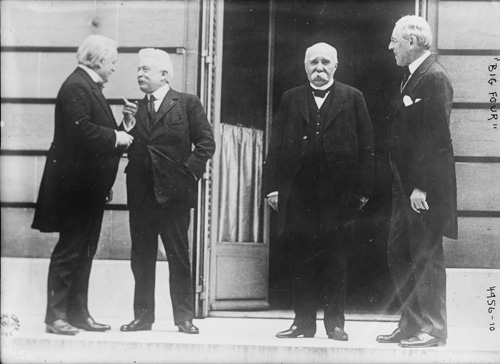
Negotiations in Paris dragged on for several months until the Treaty of Versailles was unveiled in June 1919.
National Defense Act of 1920
This act did away with the idea of an expansible U.S. Army and instead organized it as three parts: the Regular Army, National Guard, and Reserves, while also continuing to support the Reserve Officer Training Corps (ROTC) in colleges and universities.
Naval bombing experiments
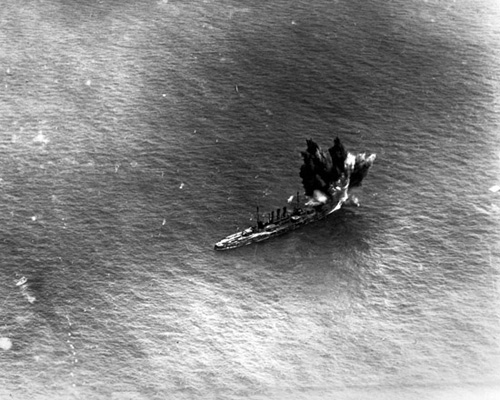
The Ostfriesland being struck by a bomb
Courtesy: U.S. Air Force Photograph
It would be an important event in the airpower debate.
Washington Naval Arms Treaty is signed
A five power treaty coming out of the Washington Naval Conference of 1921, this treaty sought to prevent a naval arms race. Great Britain, United States, Japan, Italy, and France agreed to reduce the size, number, and armament of their capital ships.
U.S. Navy launches its first aircraft carrier, the USS Langley
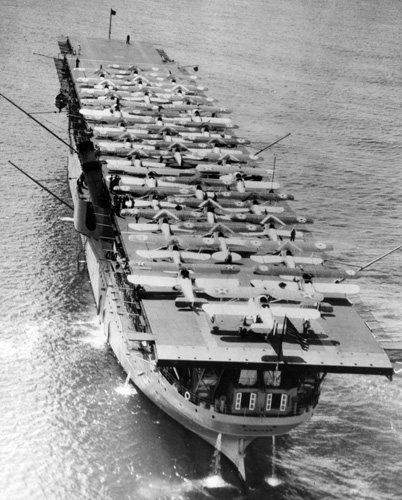
The USS Langley underway in Pearl Harbor, May 1928
Courtesy: Naval History & Heritage Command, 80-G-424475
Commissioned in 1922, the first take-offs and landings from its deck occurred that same year.
Billy Mitchell court-martial
Always outspoken, Billy Mitchell made his worst mistake when he criticized his superiors for ignoring the airplane’s potential.
Japan invades Manchuria
When Japan invaded Manchuria in 1931, President Herbert Hoover condemned this aggressive act and refused to recognize the Japanese conquest of Manchuria. His words meant nothing to the Japanese, who likewise ignored the condemnations leveled at them by the League of Nations.
Bonus Army March
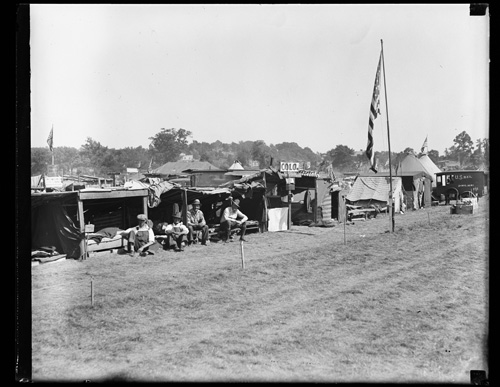
Part of the Bonus Army camp in Anacostia, Washington, D.C., before it was burned
Courtesy: Library of Congress, LC-DIG-hec-36889
When American veterans demanded payment for their service, it quickly turned violent.
Boeing XB-17 makes its maiden flight
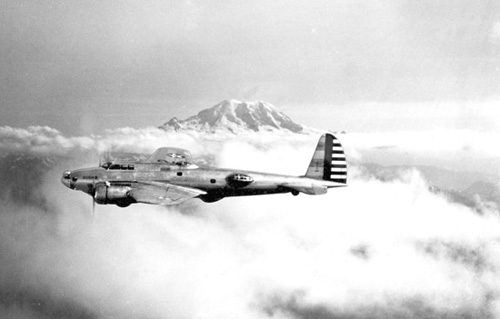
An XB-17 on one of its early flights, with Seattle's Mount Rainier in the background
National Museum of the U.S. Air Force Photo
A leap in American bomber development, the B-17 Flying Fortress would go on to be the U.S. Army Air Force’s workhorse in the Second World War, alongside the B-24 Liberator
Molotov-Ribbentrop Pact is signed
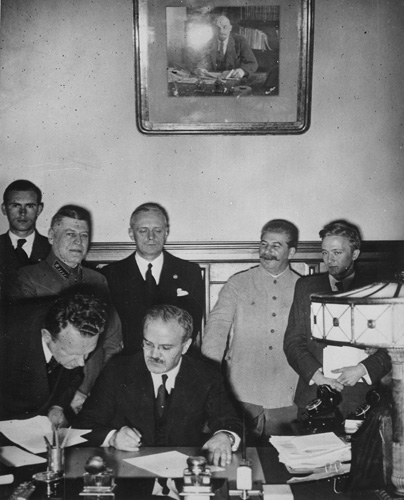
As Joseph Stalin and Joachim von Ribbentrop look on, Soviet Foreign Commissar Vyacheslav Molotov signs the Nazi-Soviet non-aggression pact, August 23, 1939
Courtesy: National Archives, 242-JRPE-44
A non-aggression pact between the Soviet Union and Nazi Germany, this treaty stunned the world when the foreign ministers unveiled the plan.
Germany invades Poland
What some regard as the opening salvos of the Second World War, the German invasion was followed later in the month by the Soviet invasion of Poland from the east, ending in the division and annexation of the sovereign nation.
Battle of Atlantic begins
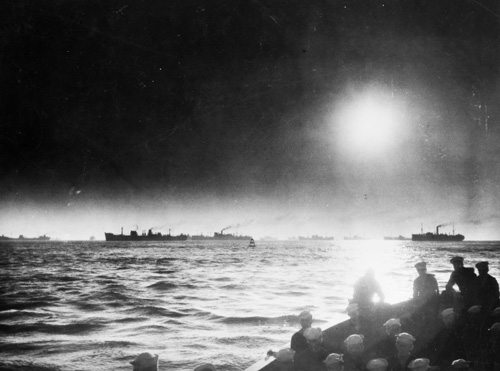
Courtesy: Library of Congress, LC-USZ62-132803
This struggle for primacy of the Atlantic Ocean lasted the entirety of the war. Britain’s very existence, along with the ability for the Western Allies to supply an invasion of Europe, relied upon keeping sea lanes clear.
France falls to Nazi Germany
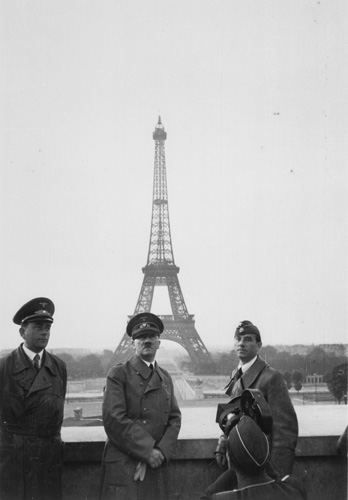
An unimpressed Hitler surveys the spoils of war, Paris
Courtesy: National Archives, 242-HLB-5073-20
In just over a month, France was overwhelmed by the German onslaught.
Battle of Britain begins
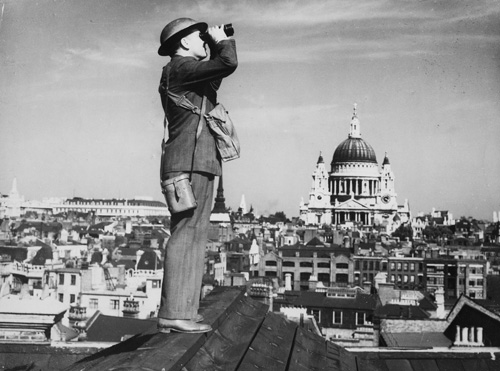
With St. Paul's Cathedral in the background, a spotter stands on a roof in London, searching for German aircraft
Courtesy: National Archives, 306-NT-901B-3
With France’s quick fall, it looked as if Nazi Germany was unstoppable. Hitler next turned his sights on Britain, unleashing an air campaign that would shake the British Isles but not break them.
Destroyer-for-Bases Agreement is made
With his hands tied because of the neutrality acts of the 1930s, President Franklin Roosevelt attempted to assist Britain against Nazi Germany as best he could, eventually penning a deal to give fifty American destroyers of First World War vintage to Great Britain in exchange for leasing bases that were scattered over four thousand miles of ocean.
Selective Training and Service Act is signed
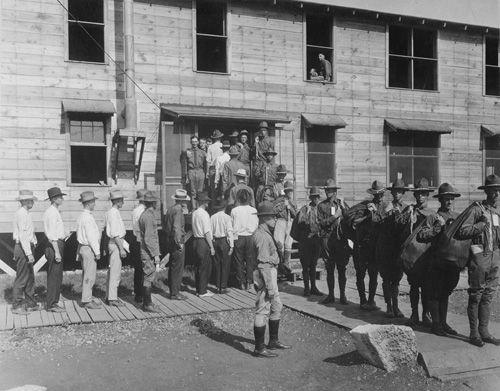
Men entered as civilians and exited in Army uniforms at Camp Travis, San Antonio, Texas
Courtesy: National Archives 165-WW-474B[1]
America’s first peacetime draft, this act required all American men aged 21 to 35 to register with local draft boards.
Tripartite Pact is signed
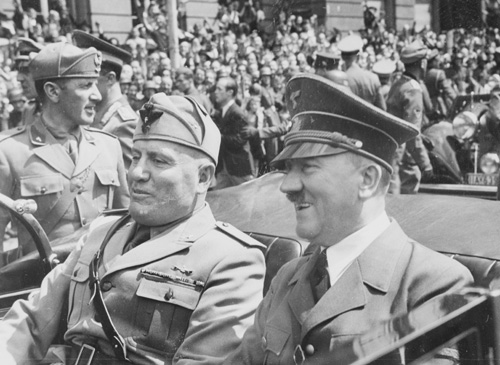
Hitler and Mussolini together in Munich, June 1940
Courtesy: National Archives,ARC identifier 540153
The Tripartite Pact alarmed the world and aligned Germany, Italy, and Japan to a common cause of consolidating their gains, expanding further beyond their borders, and assisting one another if attacked.
Lend-Lease is enacted
This act sent $50 billion worth of supplies to the British, Chinese, and later the Soviets to help them fight the Axis powers. Both symbolically and substantively, this act marked a break with isolationist foreign policies.
Operation BARBAROSSA is launched
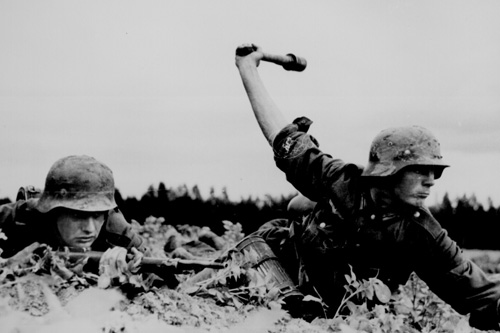
German troops fighting in the Soviet Union
Courtesy: National Archives Photo
Despite Stalin’s best efforts to diplomatically stave off a German invasion of the Soviet Union, Hitler launched his gigantic operation codenamed BARBAROSSA.
Japan attacks Pearl Harbor
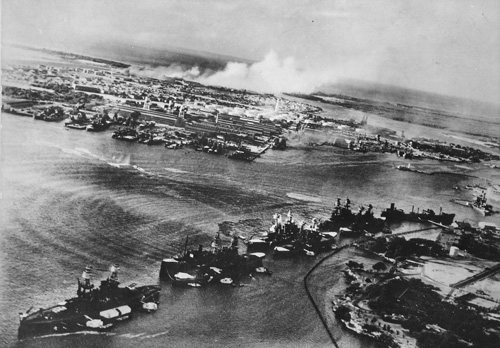
The view of battleship row from an attacking Japanese airplane, with smoke rising from Hickam Airfield in the background
Courtesy: National Archives, 80-G-30550
The Sunday morning in December dawned to find the U.S. Pacific Fleet at peace in Pearl Harbor on the island of Oahu in Hawai’i. Eight battleships, the pride of the U.S. Fleet and the main surface force in the Pacific Ocean, had steamed into the harbor.
Guam is attacked
The day after the attacks on Pearl Harbor, Japan attacked and eventually took the American base on Guam.
President Roosevelt signs Declaration of War against Japan
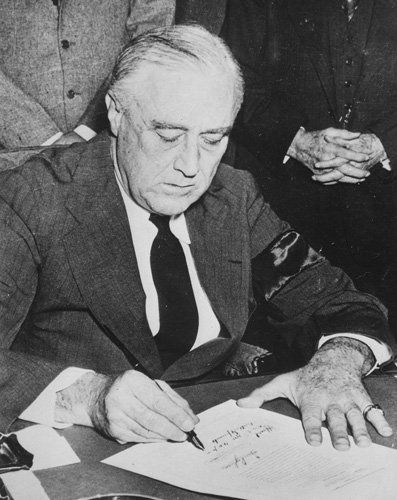
Roosevelt siging the declaration of war
Courtesy: National Archives, ARC Identifier 520053
The day after the attacks on Pearl Harbor, the United States was at war with the Empire of Japan.
Wake Island falls
Initially bombed at the same time as Pearl Harbor, the American base on Wake Island survived the bombing and then repelled one Japanese landing attempt on December 11 before finally falling on December 23, 1941.
First Joint Chiefs of Staff meeting
At the ARCADIA Conference at the end of December 1941 and into January 1942, the United States and Great Britain would create the Combined Chiefs of Staff, which would have a profound effect not only on American-British relations but the military’s relationship with its commander in chief.
Americans surrender in the Philippines
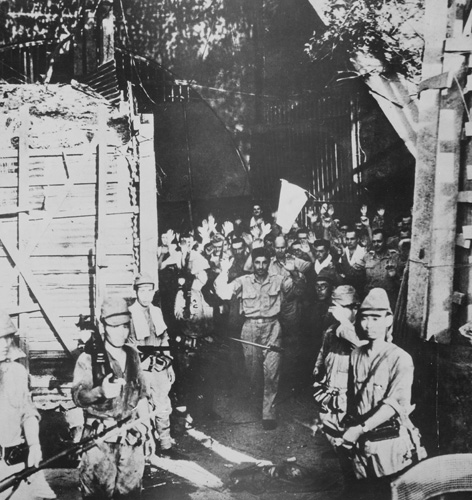
American troops surrendering on Corregidor
Courtesy: National Archives, 208-AA-80B-1
Overwhelmed by the Japanese, the American and Filipino soldiers on Bataan surrendered on April 9, 1942, followed by the troops on Corregidor a month later. Surrendering would not be the end of the soldiers’ ordeal, as they were forced to walk seventy miles for six days to a prisoner of war camp, with any stragglers being killed alongside the road by their Japanese captors. Ultimately, 18,000 men were killed by the Japanese in the Bataan Death March.
Doolittle Raiders launch from the USS Hornet
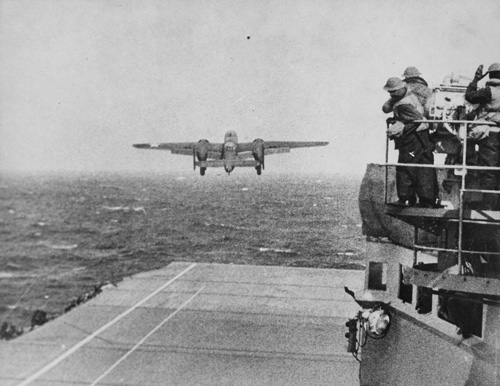
A B-52 lifts off from the deck of the USS Hornet on its way to bomb Tokyo
Courtesy: National Archives, 80-G-41196
A brazen mission, the Doolittle Raid would stun Japan.
Battle of the Coral Sea
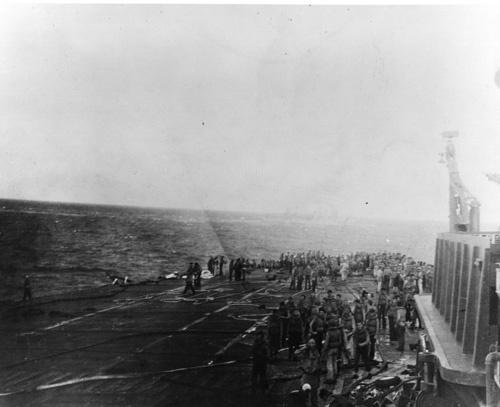
A view of the USS Lexington's flight deck as her men prepare to abandon ship after several bomb and torpedo hits disabled the ship
Courtesy: Naval History & Heritage Command, 80-G-16811
The first naval battle fought completely over the horizon solely by aircraft, the Battle of the Coral Sea saw torpedo and dive bombers from the USS Lexington and Yorktown sink a Japanese light carrier and cripple two heavy carriers at the cost of sinking the Lexington and badly damaging the Yorktown.
Battle of Midway
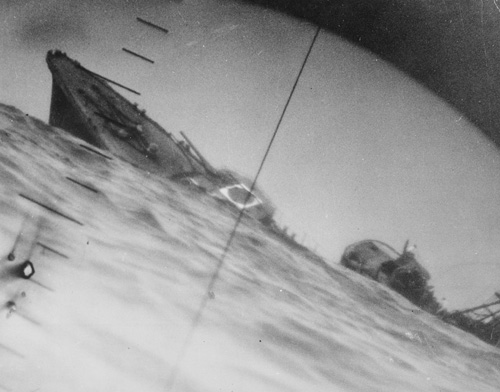
Looking through the periscope of either the USS Wahoo or Nautilus, a torpedoed Japanese destroyer sinks
Courtesy: National Archives, 80-G-418331
An American breakthrough in deciphering enemy message set the conditions for the Americans to surprise the Japanese at Midway.
Battle of Guadalcanal
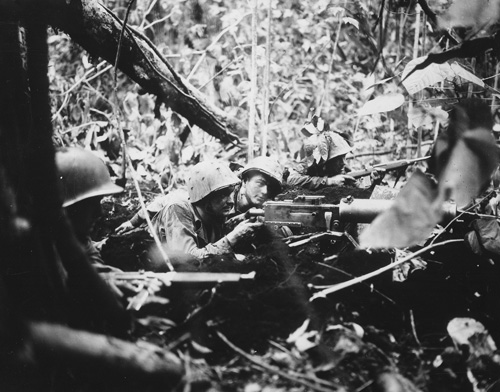
Marines man a .30 caliber Browning machine gun
Courtesy: National Archives, 127-N-71981
The first major American offensive in the Pacific War, the Battle of Guadalcanal was six months of hard fighting that cost the Americans 29 warships sunk, 1,600 Marines and soldiers killed, and another 5,000 wounded.
Invasion of North Africa, Operation TORCH
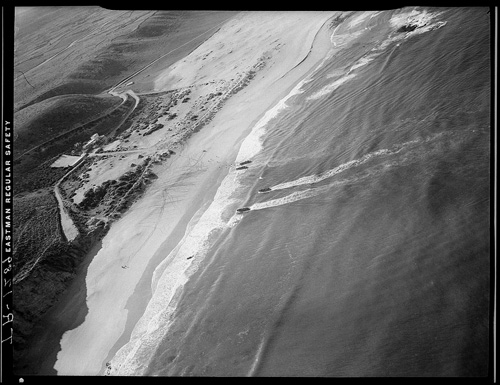
A view from above as some of the first American troops land in North Africa during Operation TORCH
Courtesy: National Archives, 80-G-470021
The American invasion of North Africa, TORCH was the first major American military effort against German and Italian forces.
Casablanca Conference
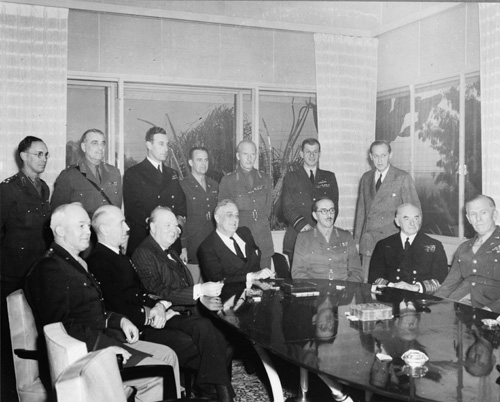
Allied leaders meeting at Casablanca
Courtesy: Library of Congress, LC-USZ62-104901
Wartime conferences between the Allied Powers played a key role in the execution of the war, perhaps none more so important than Casablanca. The Western allies heard the Soviet pleas for the invasion of Europe quite well, but ultimately Prime Churchill’s plan won out and the Allies were bound for Sicily.
Battle of Kasserine Pass
Kasserine Pass would reveal systemic problems for the Americans, including an inability of new troops to prepare for German armor, leadership that was situated too far behind the front lines, a lack of unity of command, and ineffectual use of combined arms.
Battle of El Guettar
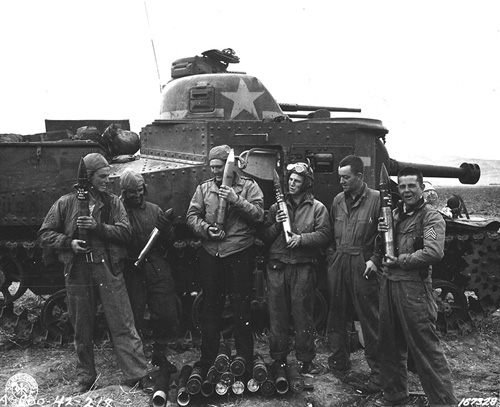
The U.S. Army relied upon the M-3 Stuart light tank during early operations
Courtesy: U.S. Army Center of Military History, Signal Corps Photo NA-COO-42-217
This battle in southern Tunisia between Italian and German units and the U.S. Army II Corps forced an Axis withdrawal toward Tunis, and teaching American units the importance of combined arms warfare.
The Afrika Korps surrenders to Allied forces
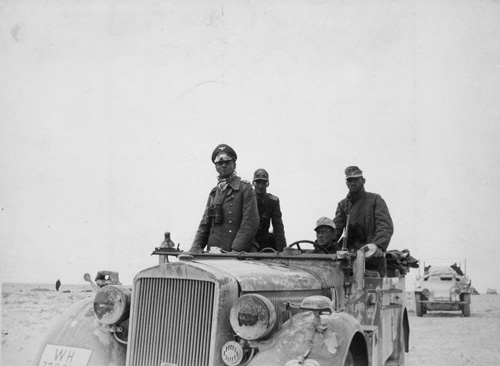
Commander of the Afrika Korps, Erwin Rommel
Courtesy: National Archives, 242-EAPC-6-M713a
Though an impressive force led by General Erwin Rommel, these German desert forces surrendered to Allied forces after the American victory at El Guettar stranded them near Tunis.
Tuskegee Airmen fly first mission
Overcoming discrimination in the United States, the African American pilots of the 99th Pursuit Squadron were the first of the Tuskegee Airmen to fly a combat mission, clearing sea lanes in preparation for the invasion of Sicily.
Operation HUSKY, the invasion of Sicily, begins
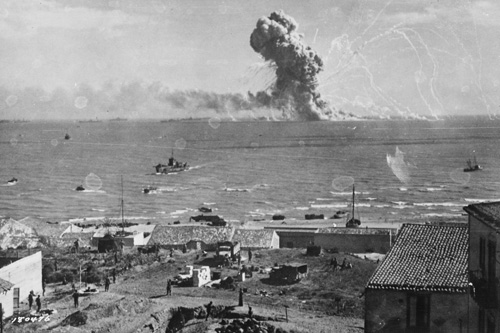
Looking from Gela, the American liberty ship Robert Rowan explodes after being hit by a German bomb
Courtesy: National Archives, 111-SC-180476
While fighting continued in North Africa in early 1943, the Allies looked toward next phase of the Mediterranean campaign – Operation HUSKY.
Battle of Troina
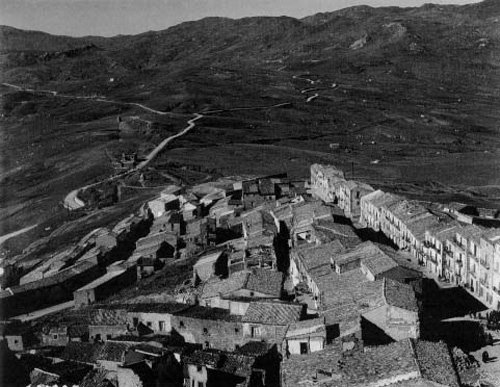
A view of Troina, where German units were positioned
U.S. Army Photograph
With a consolidated defense at the foot of Mount Etna, German and Italian forces stubbornly defended the hill-top town of Troina, forcing American forces to assault uphill on sloping, open ground.
The Allied invasion of Italy, Operation AVALANCHE, begins
Beginning near Salerno, Anglo-American forces landed but met a determined German defense. Logistical problems left the Allied line weak and geographical difficulties hampered movement.
Battle of Tarawa
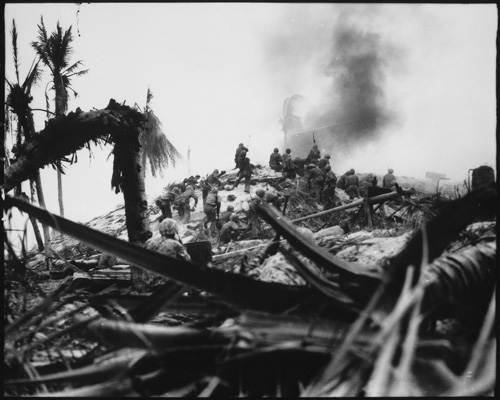
Marines storming Tarawa
Courtesy: National Archives, 127-N-63458
Though a small atoll in the Gilberts island chain, the Battle of Tarawa saw fierce fighting.
Battle of Monte Cassino
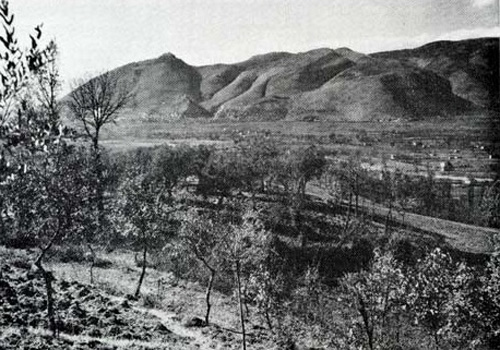
Looking west across the Rapido River valley in February 1944, the monastery is visible on the summit of Monte Cassino farthest to the left
U.S. Army Medical Corps Photograph
Part of the fighting along the German Gustav Line, the costly Battle of Monte Cassino resulted in large numbers of casualties and would destroy the sixth century monastery built by the founder of the Benedictine Order, Benedict of Nursia.
American assault on Anzio
An amphibious assault during the Italian Campaign in a bid to breach the Gustav Line and take Rome, this operation suffered from poor planning and resulted in a bottling up of the Allies in a 20 mile wide by 15 mile deep beachhead for months.
Big Week begins
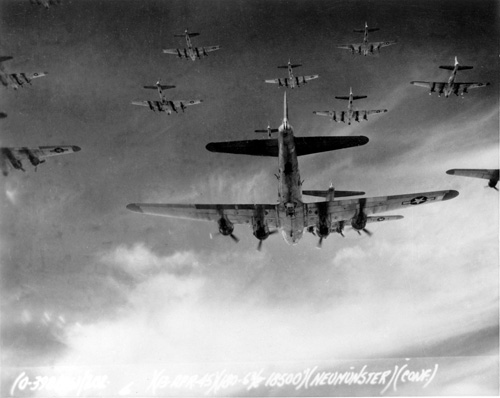
398th Bombardment Group, 8th Air Force
U.S. Air Force Photograph
An Allied air offensive codenamed Operation ARGUMENT, Big Week saw some 3,000 bombers of the U.S. 8th Air Force and 500 from the 15th Air Force hit German aircraft factories and other strategic targets.
Rome falls to the Allies
In a controversial decision, General Mark Clark ordered VI Corps to turn westward toward Rome when the Allies were chasing a retreating German army.
The Allied invasion of Europe, Operation OVERLORD, begins
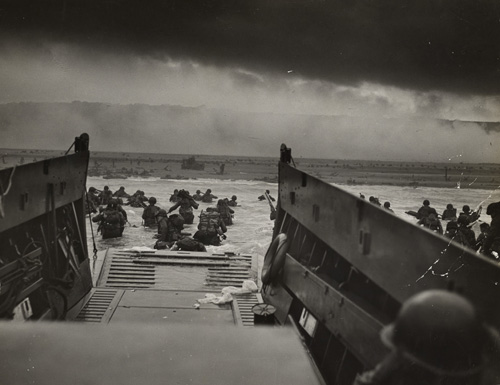
GIs from the 16th Infantry, 1st Infantry Division are offloaded onto Omaha Beach in the face of withering German fire
Courtesy: National Archives, 26-G-2343
Dubbed “D-Day,” the Allied invasion of Europe was years in the making and put everything on the line.
Battle of the Philippines Sea
The Battle of the Philippine Sea – nicknamed the “Great Mariana Turkey Shoot” – resulted in the final destruction of Japan’s carrier-based air power
Battle of Saipan
Only a twelve-by-four mile island in the Pacific, Saipan would be the site of a fierce fight to control the Marianas archipelago.
GIs breach the Siegfried Line
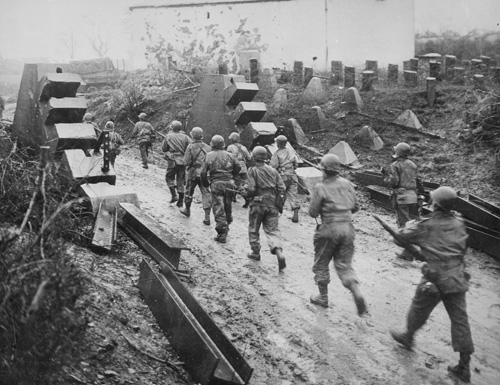
American soldiers stream past Siegfried Line defenses
Courtesy: National Archives, 208-YE-193
American units first breached Nazi Germany’s border defenses in August 1944, only to be thrown back by German counterattacks. By early spring, the Allies would comprehensively breach the Siegfried Line and flood into Germany.
The Allies liberate Paris
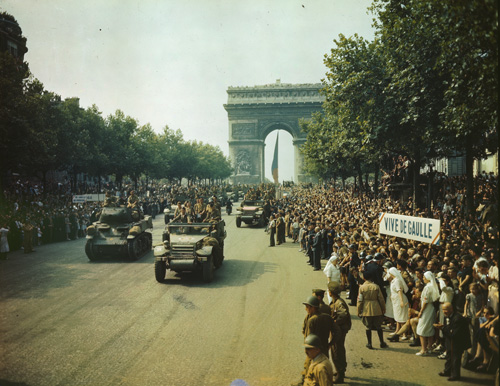
Parisians line the Champs-Élysées as American tanks and half-tracks stream past the Arc de Triomphe
Courtesy: Library of Congress, LC-DIG-fsac-1a55001
After a difficult thrust from the Normandy coast, the Allies finally reached Paris on August 19, 1944, and defeated the German garrison there six days later.
Battle of Falaise Pocket
After General George S. Patton’s 3rd Army cut through German territory, they trapped German forces to their west in the so-called Falaise Pocket, 30 miles south of Caen.
Operation MARKET GARDEN
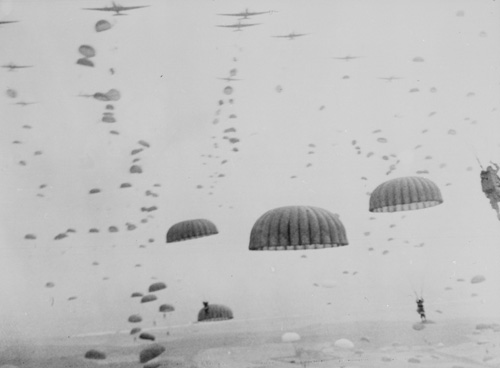
Paratroops of the 1st Allied Airborne Army float down to Holland on September 17, 1944 during Operation MARKET GARDEN
Courtesy: National Archives, 111-SC-354702
Designed by British Field Marshal Bernard Montgomery, this operation comprised of two phases, airborne (MARKET) and ground (GARDEN).
Battle of Peleliu
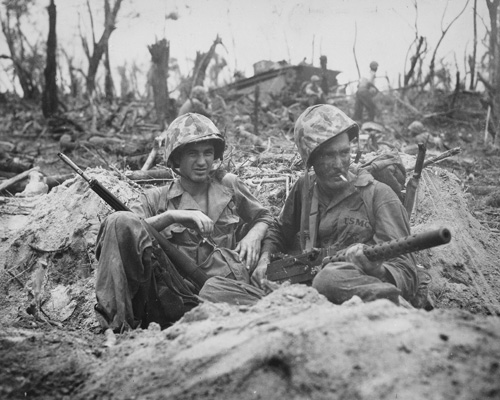
Marines Gerald P. Thursby and Douglas Lightheart during mop-up operations on Peleliu
Courtesy: National Archives, 127-N-97628
The Japanese-held island and its airfield threatened U.S. shipping routes to the Philippines, convincing American planners that Peleliu needed to be taken.
Battle of Hürtgen Forest
Rather than going around the rugged and dense Hürtgen Forest in September 1944, the Americans went through it – and the Germans forced the U.S. Army to pay for every inch of advance.
Battle of Leyte Gulf
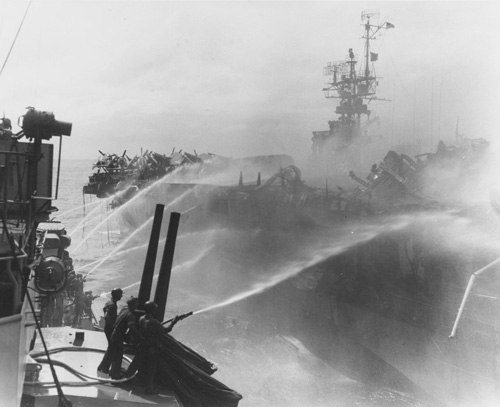
The USS Birmingham alongside the USS Princeton, attempting to put out fires that were the result of a Japanese air attack. An explosion from the Princeton killed 200 men from the Birmingham
Courtesy: Naval History & Heritage Command, 80-G-270357
The largest naval battle in history, the Battle of Leyte Gulf saw the U.S. Navy and the Imperial Japanese Navy square off for two days.
Battle of the Bulge
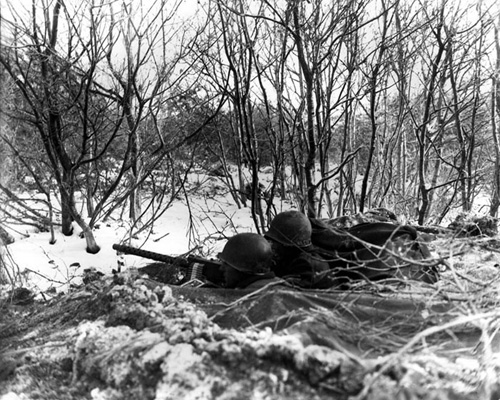
GIs from the 45th Infantry Division set up a road block
Courtesy: U.S. Army Center of Military History, SC 364311
The German offensive codenamed Operation Wacht am Rhein bent but did not break the American line in the Ardennes Forest, signifying the last desperate Germany attempt to halt the Allied advance.
Yalta Conference
A wartime meeting in the Crimea between Allied leaders Franklin D. Roosevelt, Winston Churchill, and Joseph Stalin, Yalta resolved issues but also created others.
Battle of Iwo Jima
Of the 22,000 Japanese defenders, all but 216 died. The Americans suffered 6,800 killed and 19,200 wounded for total of 26,000 casualties, making Iwo Jima the first battle in which the American casualties surpassed Japanese casualties.
Allies execute Operation PLUNDER
In coordinated maneuvers, Field Marshal Montgomery’s 21st Army Group crossed the Rhine River in the blatantly-named Operation PLUNDER.
Battle of Okinawa
Only 400 miles southwest of the home islands, Okinawa was part of Japan, and its defenders were determined to hold it at all costs.
Buchenwald is liberated
In the afternoon of April 11, troops from the 9th Armored Infantry Battalion, U.S. 6th Armored Division liberated the Buchenwald concentration camp outside Weimar, Germany.
The Americans and Soviets meet at Torgau, Germany
After years of bitter war, the Red Army and U.S. Army finally met at the riverside town of Torgau, Germany, on the Elbe River.
Adolf Hitler commits suicide in Berlin
With defeat imminent, Adolf Hitler and his wife, Eva Braun, committed suicide together in the Führerbunker. Berlin fell to the Soviets three days later.
Germany surrenders
Over a week after Hitler committed suicide, Nazi Germany surrendered, signalling the end of the Second World War in Europe.
The United States detonates Trinity, the world’s first nuclear device
In a race with Germany to be the first to successfully make an atomic bomb, the United States won.
Potsdam Conference
The third, longest, and final conference of the leaders of the Grand Alliance.
Enola Gay drops atomic bomb on Hiroshima
In a bid to force Japan to surrender and forgo an American invasion of the Japanese home islands, Harry Truman okays the order to drop an atomic bomb.
Bockscar drops atomic bomb on Nagasaki
Three days after the Hiroshima bombing, the United States dropped a second atomic bomb.
Japan surrenders
After seeing a second American super-weapon destroy another city, Emperor Hirohito realized his nation’s situation was untenable and announced his decision to surrender in the best interest of preserving the Japanese nation and culture.
Japanese representatives sign the instrument of surrender on the deck of the USS Missouri
On the deck of the USS Missouri, Japan officially surrendered to General Douglas MacArthur.
International Military Tribunal in Nuremberg begins
Also known as the Nuremberg Trials, the nearly year-long trial following World War II of twenty-one Nazi war leaders by the victorious Allied powers for accused war crimes.
Truman unveils Truman Doctrine in a speech before a joint session of Congress
Comprised predominately of monetary and military aid to Europe, the Truman Doctrine personified containment.
Truman signs the National Security Act of 1947
The Truman administration intended to updated an antiquated defense system and created the foundation for a national security state.
U.S. Air Force is created
A product of the National Security Act of 1947, the U.S. Army Air Force had finally become an autonomous service.
Soviets blockade Berlin
In a bid to force the Western powers out of Berlin, Stalin ordered all ground access to West Berlin shut off. In response, the Americans, British, and French launched a year-long airlift to sustain the besieged city, ultimately forcing Stalin to relent.
Executive Order 9981
Angered by post-war racial harassment and violence in the military against African Americans and other minorities in uniform, President Harry S. Truman issued Executive Order 9981, a demand for equality in the armed forces and an end to discrimination based on matters of race, religion, and national origin.
NATO is established
In response to fears of Soviet incursions into Western Europe, the North Atlantic Treaty Organization, a military alliance, is formed.
Secretary of Defense Louis A. Johnson cancels the USS United States
This cancellation of the U.S. Navy’s supercarrier sparked a crisis in civil-military relations.
National Security Council issues National Security Council Report 68 (NSC-68)
): Born out of the fears of the Cold War, NSC-68 would further militarize U.S. foreign policy.
North Korea invades South Korea
On a rainy Sunday morning, more than 150,000 North Korean soldiers streamed cross the border into the south.
Defense of Pusan Perimeter
An important port-city on the southeastern coast of South Korea, Pusan became the last toehold on the mainland.
President Harry Truman orders Military Assistance Advisory Group to Vietnam
Slowly, American involvement in Southeast Asia would increase.
Inchon invasion
A daring, last-ditch plan to flank North Korean forces, the plan was a stunning success.
Battle of Chongchon Valley
In trying to escape the Chinese noose, the U.S. 2nd Infantry Division was made combat ineffective after losing 5,000 men.
Battle of Chosin
One of the bitterest fights of the Korean War for the U.S. Marine Corps, some 70,000 Communist Chinese suddenly surrounded 30,000 U.S. and U.N. troops in northeastern Korea.
Battle of Chipyong-ni
This battle would ultimately be a decisive American victory that broke the Chinese momentum.
President Truman relieves General MacArthur of command
): In what some regard as the worst civil-military relation breakdown in U.S. history, President Harry S. Truman relieved General Douglas MacArthur of command.
Occupation of Japan ends
While the occupation would be officially over, the U.S. military would remain.
Battle of Triangle Hill
This battle would exemplify the offensive and defensive aspects of trench warfare in the Korean War.
Battle of Pork Chop Hill
One of the Korean War’s bloodiest battles, the Battle of Pork Chop Hill saw the U.S. 7th Infantry Division repel three tenacious Chinese attacks.
Armistice is signed
After three years of war, the belligerents agreed to stop fighting.
NSC 162/2
This National Security Council report became the basis of President Eisenhower’s “New Look” policy.
Occupation of West Germany officially ends
Though founded on May 23, 1949, the Federal Republic of Germany was not declared sovereign until May 1955. American troops did not leave; rather, they became redesignated part of the NATO presence.
President Dwight Eisenhower orders 101st Airborne to Little Rock, Arkansas
In response to Arkansas’s governor refusing to desegregate his schools, President Dwight Eisenhower ordered soldiers to Little Rock to guarantee a group of nine black students could go to school without being harmed or stopped.
Soviet Union launches Sputnik into orbit
A shock to the United States, the Sputnik launch would spur on American technical development.
Francis Gary Powers is shot down over the Soviet Union
https://www.cia.gov/readingroom/collection/francis-gary-powers-u-2-spy-pilot-shot-down-soviets
Dwight Eisenhower gives his presidential farewell address
In his farewell address on January 17, 1961, Eisenhower expressed a sense of foreboding about two threats to the United States.
The Bay of Pigs invasion fails
This amphibious assault by 1,400 American-supplied and trained counter-revolutionaries on the southwest coast of Cuba ultimately proved a dismal failure, undermining American credibility and bolstering a Cuba-Soviet Union partnership.
Crisis in Berlin
Kennedy and Khrushchev attempted to settle long-standing disputes regarding Berlin, but an ultimatum that was met with resolve escalated tensions over Berlin for the second time in the Cold War.
Cuban Missile Crisis
By the fall of 1962, a dangerous confrontation between the superpowers over Soviet military activities on Cuba pushed the world to the brink of nuclear war.
Battle of Ap Bac
The poor performance of American-advised Army of the Republic of South Vietnam against an outnumbered group of Viet Cong fighters in this battle convinced some of the increased need of American assistance.
USS Maddox engages three North Vietnamese torpedo boats in the Gulf of Tonkin
The USS Maddox coming under attack by three North Vietnamese torpedo boats would be the first of two incidents in the Gulf of Tonkin that led the United States to argue a military response in Vietnam was justified.
USS Turner Joy is allegedly attacked in the Gulf of Tonkin
On the evening of August 4, 1964, Turner Joy’s radar operators reported several small, fast-approaching crafts, prompting the destroyer to take evasive action. Though it has never been corroborated that the Turner Joy actually did come into contact with North Vietnamese torpedo boats, the response from Washington was to increase American combat units in Vietnam.
Operation ROLLING THUNDER
When American bases came under attack in South Vietnam in February 1965, President Johnson decided to retaliate by ordering the U.S. Air Force to bomb targets in North Vietnam. The bombing would last three years.
First U.S. combat troops arrive in Vietnam
Harkening back to their Second World War forbearers, 3,500 U.S. Marines launched a curiously dramatic amphibious landing at China Beach, where they were met by a scrum of news reporters.
Combined Action Program begins
In this U.S. Marine pacification program, Marines lived in villages and hamlets while training, caring for, and protecting South Vietnamese civilians.
Battle of Ia Drang
In mid-November, General Westmoreland found a likely opportunity to test air mobility in the Ia Drang valley in the South Vietnam’s central highlands near the border with Cambodia.
Operation ATTLEBORO
This search and destroy operation would be one of the largest airmobile operations by U.S. Army forces to date in the Vietnam War.
Operation CEDAR FALLS
U.S. units conducted this search and destroy operation in the “Iron Triangle” region of South Vietnam.
Operation JUNCTION CITY
An extensive military operation, JUNCTION CITY featured one of the largest air assaults to date with 240 helicopters participating in one battle on a single day.
Siege of Khe Sanh
A seventy-seven day siege of a U.S. Marine Corps base in South Vietnam’s Central Highlands, Khe Sanh was NVA planners’ attempt to distract attention and resources away from the key areas in South Vietnam in preparation for the coming Tet Offensive.
Battle of Hue
This five day battle in the South Vietnam city of Hue during the Tet Offensive saw fierce street fighting and house clearing operations by U.S. Marine Corps, ARVN, and U.S. Army units.
Tet Offensive
Ignoring the holiday cease-fire agreement, some 85,000 NVA soldiers and VC fighters struck more than 200 cities, towns, and bases across South Vietnam.
My Lai Massacre
In this massacre, American soldiers killed nearly four hundred South Vietnamese civilians.
President Johnson declares he will not run for a second term
Weary from leading the country into a divisive war, Lyndon Johnson shocked the nation when he announced he would not run for a second term as president.
Creighton Abrams succeeds William Westmoreland as commander of MACV
The much-maligned William Westmoreland was promoted to Chief of Staff of the U.S. Army, leading to Creighton Abrams becoming commander of MACV and supposedly overhauling the American strategy in Vietnam.
Cambodian Incursion
Sensing opportunity after the communist government in Cambodia was overturned, President Richard Nixon ordered forces into South Vietnam’s neighboring country.
Operation Lam Son 719
Nowhere were the ARVN’s flaws more conspicuous than in Operation LAM SON 719 in February and March 1971.
Operation LINEBACKER
In an attempt to stop a North Vietnamese push into South Vietnam, President Nixon ordered LINEBACKER, a massive strategic bombing campaign whose 27,000 sorties devastated NVA troop concentrations and demolished enemy supply lines to the south.
Operation LINEBACKER II
Thinking that strategic bombing could achieve political objectives, Nixon ordered LINEBACKER II in a bid to bomb the North Vietnamese to the negotiation table
End of the draft formally announced
With the end of the draft, the U.S. military transitioned to the All-Volunteer Force.
U.S. military leaves Vietnam
Between 1964 and 1973, the United States sent 3.4 million service personnel to Southeast Asia. In the end, 58,260 died, 1,655 are still missing in action, and 300,000 were wounded.
Yom Kippur War
American military strategists would take notes of this war between Israel and neighboring Arab nations, Egypt and Syria, becoming the model for how the United States would fight the Soviet Union in Europe.
SALT I is signed
The Strategic Arms Limitation Talks froze the numbers of certain nuclear missile systems and their launch sites at the current levels.
SALT II Treaty is signed
Negotiated during the Gerald Ford presidency, SALT II placed limits on strategic offensive weapons system.
Iranian Hostage Rescue Mission fails
Codenamed Operation EAGLE CLAW, the mission to rescue American hostages in Iran would end in failure.
AirLand Battle outlined in U.S. Army Field Manual 100-5
Developed by General Donn Starry of TRADOC, this doctrine called for an offensive approach against the Soviet Union in a potential war by using combined arms to execute “close,” “deep,” and “rear” operations.
Invasion of Grenada, Operation URGENT FURY
This invasion of Grenada was an attempt to evacuate American citizens and remove the government in power.
The Berlin Wall falls
An unlikely event, the wall that had separated West and East Berlin since 1961 came crashing down, signalling a real and metaphorical crumbling of communism
Invasion of Panama, Operation JUST CAUSE
Even before the dissolution of the Soviet Union, President Bush began to reorient the United States’ posture from anti-communism to self-preservation in a post-Cold War world.
Saddam Hussein invades Kuwait
From Saddam’s perspective, the invasion represented both compensation for his nation’s economic losses and proof of Iraq’s increased status as a regional power.
President George H.W. Bush orders the start of Operation DESERT SHIELD
Responding to Iraq’s invasion of Kuwait, the United States sent American aircraft to the region and lead elements of the 82nd Airborne Division arrived to take up defensive positions along the Saudi border.
Operation DESERT STORM starts
After Iraq disregarded a United Nations’ ultimatum to leave Kuwait by January 15, 1991, coalition forces, led by the United States, unleashed a devastating air campaign, flying 100,000 sorties and dropping nearly 90,000 tons of bombs on Iraqi targets.
Coalition forces cross into Iraq
The ensuing ground campaign stood as a prime example of a precisely executed plan by General Schwarzkopf and his staff.
Soviet Union formally dissolves
More the result of internal policies than American pressures, the Soviet Union quietly dissolved, ending an international struggle that most people believed would either destroy the world or continue infinitum.
Bosnian War
Once a Yugoslavian province, Bosnia would be the location of NATO peace keeping efforts beginning in 1995 after Serbian military forces invaded in 1992.
Battle of Mogadishu
This raid by elite U.S. special operations units to locate and capture key Somali leaders in the nation’s capital went wrong when several helicopters from the U.S. Army’s 160th Special Operations Aviation Regiment crash landed due to hits taken, necessitating rescue attempts.
NATO forces enter Kosovo
In response to atrocities committed by Serbians in the Kosovo War, American and NATO forces undertook peacekeeping efforts.
21st Century
Terrorists attack the United States
In coordinated attacks by an Al-Qaeda cell, two airliners flew into the World Trade Center towers in New York City, one into the west wall of the Pentagon, and a fourth went down in a field near Shanksville, Pennsylvania.
Operation ENDURING FREEDOM begins
Just four weeks after the 9/11 attacks, President George W. Bush ordered the start of Operation ENDURING FREEDOM.
Operation ANACONDA
This would be the last major battle of Operation Enduring Freedom’s second phase, with approximately 2,000 heli-borne U.S. soldiers landing in valleys and mountain passes near the Pakistani border and engaging with Taliban and Al-Qaeda fighters.
Operation IRAQI FREEDOM begins
Even before the end of the combat phases of Operation ENDURING FREEDOM in Afghanistan, President George Bush began shifting his attention toward Iraq.
U.S. forces capture Saddam Hussein
Saddam Hussein would spend the next three years on trial before being hanged for committing war crimes, crimes against humanity, and genocide.
First Battle of Fallujah
American units spent much of 2004 trying to clear insurgents from the Sunni Triangle, particularly elements of the 1st Marine Division in Fallujah.
Second Battle of Fallujah
After the Marines withdrew from Fallujah, insurgents regained control of the city. In response, a more powerful coalition force of 6,500 Marines, 1,500 American soldiers, 2,000 Iraqi soldiers, and 850 British soldiers launched determined assaults against 3,000 Iraqi insurgents and newly arrived Al-Qaeda fighters defending the city.
Counterinsurgency doctrine outlined in U.S. Army Field Manual 3-24
One of the most important documents of the Iraq and Afghanistan Wars, Field Manual 3-24 Counterinsurgency influenced the U.S. Army’s low-intensity warfare doctrine after 2006.
President George W. Bush announces Iraq War troop surge
On the heels of the completion of FM 3-34, President Bush ordered the deployment of 20,000 additional troops to Iraq, raising the total strength to 170,000.
Operation NEW DAWN unveiled
Beginning in September 2010, Iraqis took more responsibility to maintain the peace between religious factions while American troops began returning home.
Seal Team Six raids compound in Abbottabad and kill Osama bin Laden
After nearly a decade of the United States hunting the leader of Al Qaeda, Seal Team Six raided a compound in Abbottabad, Pakistan and killed Osama bin Laden.
Barack Obama repeals “Don’t Ask, Don’t Tell”
In his first month as president, Barack Obama began working to repeal the policy created under Bill Clinton.
The end of the Iraq War declared
In a welcome-home speech to returning troops at Fort Bragg, President Barack Obama declared an end to the Iraq War. Four days later, the last U.S. troops withdrew from Iraq.
“Arab Spring” protests start
Young people in Tunisia started demonstrating against their nation’s authoritarian government, and then the “Arab Spring” spread across the North Africa and the Middle East resulting in violence and civil strife.
Civil War erupts in Syria
As a result of the “Arab Spring,” Syrians wanted to remove the nation’s dictator President Bashur al-Assad from officer, and Assad reacted by trying to crush the protester with his armed forces. The resulting Civil War also became a proxy conflict for Russia, Turkey, Iran, and the United States.
Osama bin Laden Killed
Americans located the mastermind beyond the 9/11 attack in Pakistan, and American special forces killed him.
Rise of ISIS
Known by one name as ISIS (the Islamic State of Iraq and Syria), this terrorist group entered the Syrian Civil War and disrupting the U.S.-supported Iraqi governments attempt to keep Iraq stable. The ISIS fighters used brutal terror tactics.
Operation INHERENT RESOLVE
American military personnel trained Syrians to fight combat ISIS in Iraq and Syria. American military units provided support to Syrian rebels clearing ISIS-held territory in ongoing operations.
“Iran Deal”
President Barack Obama helped create an agreement with Iran to curtail development of nuclear weapons in return for an end to severe economic and trade sanctions. The Iranians will also allow their nuclear research facilities to be inspected by the international community.
Donald Trump becomes President of the United States
The surprising election of Donald Trump as President November 2016 and his assumption of the office in 2017 leave many American and global observers puzzled about level and type of American use of military forces.
U.S. Space Force created
The first independent military service created since the U.S. Air Force in 1947. This U.S. Space Force controls and sustains American military operations in space.
Insurrection at the Capitol in Washington, DC
Encouraged by President Donald Trump, a mob of at least 2,000 people assaulted the building, attacking police, vandalizing and destroying Congressional offices and meeting spaces, and sending members of Congress into lockdown in secure spaces for their protection. Within a few hours, Capitol police along with Washington, D.C. Metropolitan police pushed the rioters out of the building, and they were then supported by late-arriving National Guardsmen. Congress then reconvened and finished certifying the election results, while Trump agreed to peaceful transition of power.
COVID-19
The rapid spread of Coronavirus disease (COVID-19) across the U.S. caused President Trump to declare a national emergency in March. Estimates of American deaths exceeded one million people. In 2021, Secretary of Defense Lloyd Austin mandated that all military personnel be vaccinated. He later lifted this mandate in 2023.
U.S. forces withdraw from Aghanistan
Withdrawal of American military forces from Afghanistan began in August, leaving a weak Afghan government that was quickly toppled by Taliban forces.
Ayman al-Zawahiri killed
Americans located al-Qaeda leader Ayman al-Zawahiri and killed him with a drone strike.
Russian invasion of Ukraine
In February, the Russian military launched full-scale invasions of northern, eastern, and southern Ukraine. New weapons have been tested during combat. Combat operations are ongoing.
First woman Chief of Naval Operations
Admiral Lisa Franchetti became the first woman promoted to be the Chief of Naval Operations and the first women to sit on the Joint Chiefs of Staff.
Hamas attacks Israel
On October 7, 2023, the terrorist group Hamas launched a massive attack from Gaza against Israel, killing 1,000 Israelis, wounding another 3,400, and taking 250 people hostage. Israel's retaliation in bitter combat operations are onging in Gaza, where many thousands of Palestinian combatants and civilians alike have been killed, wounded, or left homeless.