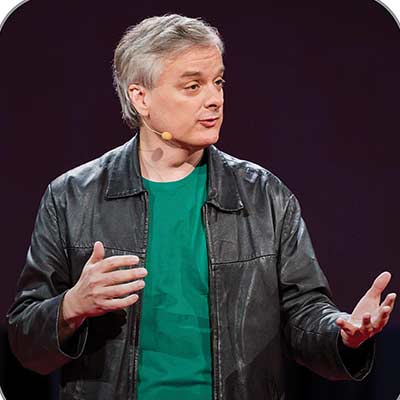
David Chalmers
Professor of Philosophy and Neural Science, Director of the Center for Mind
Brain and Consciousness at New York University, United States; Distinguished Professor of Philosophy at the Australian National University, Australia
Profile – David Chalmers (b. 1966)
Born in Australia, David Chalmers originally intended to be a mathematician, but then he spent six months hitchhiking around Europe on his way to taking up a Rhodes scholarship at Oxford and spent most of his time thinking about consciousness. This led him to Douglas Hofstadter’s research group and a PhD in philosophy and cognitive science. He is responsible for the distinction between the ‘easy problems’ and the ‘hard problem’ of consciousness, and he is one of that rare breed: a self-proclaimed dualist. Having helped get a science of consciousness off the ground, his current interests include artificial intelligence and virtual reality, philosophical issues about meaning and possibility, and the foundations of cognitive science. For many years, he co-organised the ‘Toward a Science of Consciousness’ (now ‘The Science of Consciousness’) conferences in Tucson, Arizona. He is University Professor of Philosophy and co-director of the Center for Mind, Brain, and Consciousness at New York University. His most recent book is Reality+, which argues that virtual reality is genuine reality.
More biographical information
His own photo Gallery
Co-director and editor of PhilPapers
Entry in The Information Philosopher
Interviews with Dave Chalmers
John Horgan in Scientific American, April 2017
Daniel Keane in ABC Australia, July 2017
What is it like to be a philosopher?, September 2016
Edge conversation, January 2017
Publications
Complete list of articles
Citations on Google Scholar
Quotes on Goodreads
Selected publications relevant to consciousness
Chalmers, D. J. (1995a). Facing up to the problem of consciousness. Journal of Consciousness Studies, 2, 200–219. Reprinted in J. Shear (Ed.). (1997). Explaining consciousness – The ‘hard problem’ (pp.9–30). Cambridge, MA: MIT Press. Paywall-protected journal record here. Unformatted full text here.
Chalmers, D. J. (1995b). The puzzle of conscious experience. Scientific American,December, 62–68. Paywall-protected journal record here. Direct PDF download (final version) here.
Chalmers, D. J. (1996). The conscious mind: In search of a fundamental theory. Oxford: Oxford University Press. Google Books preview here.
Chalmers, D. J. (1997). An exchange with David Chalmers. In J. Searle (Ed.), The mystery of consciousness (pp. 163–167). New York: New York Review of Books. Google Books preview here.
Chalmers, D. J. (1999). First-person methods in the science of consciousness. Consciousness Bulletin, University of Arizona, June. Unformatted full text here.
Chalmers, D. J. (2000). What is a neural correlate of consciousness? In T. Metzinger (Ed.), Neural correlates of consciousness (pp. 17–39). Cambridge, MA: MIT Press. Google Books preview here. Unformatted full text here.
Chalmers, D. J. (Ed.) (2002). Philosophy of mind: Classical and contemporary readings. New York: Oxford University Press. Publisher record here.
Chalmers, D. J. (2007). Naturalistic dualism. In M. Velmans and S. Schneider (Eds), The Blackwell companion to consciousness (pp. 359–368). Malden, MA: Blackwell. Google Books preview here.
Chalmers, D. J. (2010). The character of consciousness. New York: Oxford University Press. Google Books preview here.
Chalmers, D. J. (2011). A computational foundation for the study of cognition. Journal of Cognitive Science, 12, 323–357. Unformatted full text here.
Chalmers, D. J. (2017). Panpsychism and panprotopsychism. In G. Brüntrup and L. Jaskolla (Eds), Panpsychism: Contemporary perspectives (pp. 19–47). New York: Oxford University Press. Google Books preview here.
Clark, A., and Chalmers, D. (1998). The extended mind. Analysis, 58, 7–19. Reprinted in Chalmers, D. (2002), Philosophy of mind: Classical and contemporary readings (pp. 643–651). New York: Oxford University Press. Also reprinted in in Clark, A. (2008), Supersizing the mind: Embodiment, action, and cognitive extension (pp. 220–232).Oxford: Oxford University Press. Paywall-protected journal record here. Unformatted full text here. Google Books preview here.
Dennett, D. C. (2001b). The fantasy of first person science. Debate with D. Chalmers, Northwestern University, Evanston, IL, Feb 2001. Full text (html) here.
Video
Chalmers’s own list of videos
The mind bleeds into the world. Edge, January 2017
Interview with Sue Blackmore, June 2015
How do you explain consciousness? TED, March 2014
Audio
The mind bleeds into the world. Edge, January 2017 (audio version of video above)