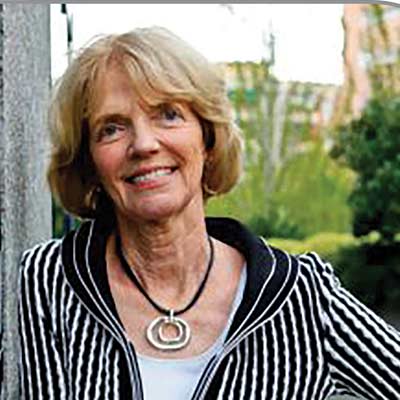
Patricia Churchland
Professor Emerita
University of California, San Diego, United States
Profile – Patricia Smith Churchland (b. 1943)
Pat Churchland is best known for her books on neurophilosophy showing how discoveries in neuroscience impact traditional philosophical ideas. She advocates a multidisciplinary approach involving neuroscience, psychology, evolutionary biology, and genetics, as well as computer science and AI. Her classic 1992 book with Terrence Sejnowski, The Computational Brain, was the first accessible overview of the emerging field of computational neuroscience. Her motto is ‘To understand the mind, we must understand the brain’. She grew up on a poor but beautiful farm in British Columbia, where her parents encouraged her to go to college even though many other local farmers thought it was a waste of money. She is now Professor of Philosophy Emerita at the University of California, San Diego and Adjunct Professor at the Salk Institute. She is married to the philosopher Paul Churchland, and they work closely together. She discredits as a boondoggle the philosophical strategy of relying on so-called ‘thought experiments’ to settle whether consciousness and reasoning are or are not brain functions. Instead, she commends testing a hypothesis and gathering the data as generally more productive.
More biographical information
Interviews with Pat Churchland
New Scientist, November 2013
The New Yorker, February 2007
Academic website/page
Personal website
Wikipedia
Twitter (@patchurchland)
Publications
Quotes on Goodreads
Selected publications relevant to consciousness
Churchland, P. M. (1985). Reduction, qualia, and the direct introspection of brain states. The Journal of Philosophy, 82(1), 8–28. Paywall-protected journal record here.
Churchland, P. (1988). Reduction and the neurobiological basis of consciousness. In A. J. Marcel and E. Bisiach (Eds), Consciousness in contemporary science (pp. 273–304). Oxford: Oxford University Press. Paywall-protected PsycNet record here.
Churchland, P. S. (1981). On the alleged backwards referral of experiences and its relevance to the mind–body problem. Philosophy of Science, 48, 165–181. Paywall-protected journal record here.
Churchland, P. S. (1996) The Hornswoggle problem. Journal of Consciousness Studies, 3(5–6), 402–408. Reprinted in Shear, J. (1997), Explaining consciousness – The ‘hard problem’ (pp. 37–44). Cambridge, MA: MIT Press. Paywall-protected journal record here. Google Books preview here.
Churchland, P. S. (1998). Brainshy: Nonneural theories of conscious experience. In S. R. Hameroff, A. W. Kaszniak, and A. C. Scott (Eds), Toward a science of consciousness: The Second Tucson Discussions and Debates (pp. 109–124). Cambridge, MA: MIT Press. Google Books preview here.
Churchland, P. S. (2002). Brain-wise: Studies in neurophilosophy. Cambridge, MA: MIT Press. Google Books preview here.
Churchland, P. S. (2006) The big questions: Do we have free will? New Scientist, 2578 42–45.
Churchland, P.S. (2013). Touching a Nerve: Our brains, Our selves. New York, NY: W.W.Norton & Company. Google Books preview here.
Video
The brains behind morality. TEDx, March 2016
Interview with Sue Blackmore, June 2015
The brains behind morality. Copernicus Center for Interdisciplinary Studies lecture, October 2014
Interview on neurophilosophy, self-control, morality, and language. Copernicus Center for Interdisciplinary Studies, October 2014
Interview on neuromorality, April 2011
Interview on eliminative materialism, July 2009