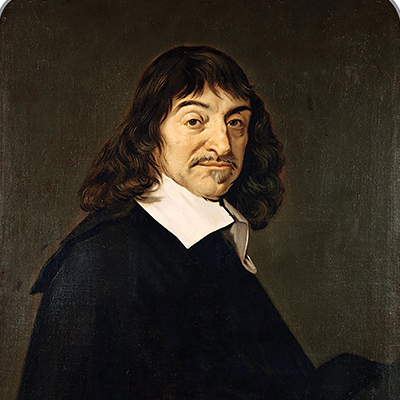
René Descartes
Profile - René Descartes (1596–1650)
Descartes was born near Tours in France, was educated at a Jesuit college, and was a staunch believer in an omnipotent and benevolent God. His father wanted him to become a lawyer, and he wanted to be a military officer. But on 11 November 1619, aged 23, he had a series of dreams, or auditory hallucinations, that inspired him with the idea of a completely new philosophical and scientific system based on mechanical principles. He was not only a great philosopher but also a physicist, a physiologist, and a mathematician. He was the first to draw graphs and invented Cartesian coordinates, which remain a central concept in mathematics. He is best known for his saying ‘I think, therefore I am’ (je pense, donc je suis, or cogito ergo sum), which he arrived at using his ‘method of doubt’. He tried to reject everything that could be doubted and accept only that which was beyond doubt, which brought him to the fact that he, himself, was doubting. He described the human body entirely as a machine made of ‘extended substance’ (in the Latin, res extensa), but concluded that the mind, spirit, or soul (which he called the animus) must be a separate entity made of a non-spatial and indivisible ‘thinking substance’ (res cogitans). The two substances were connected through the pineal gland. This theory became known as Cartesian dualism, a term that is now used synonymously with substance dualism—that is, any theory that posits causal interactions between fundamentally distinct substances, material and immaterial. For the last 20 years of his life, Descartes lived mostly in Holland. He died, probably of pneumonia, in Sweden in 1650.