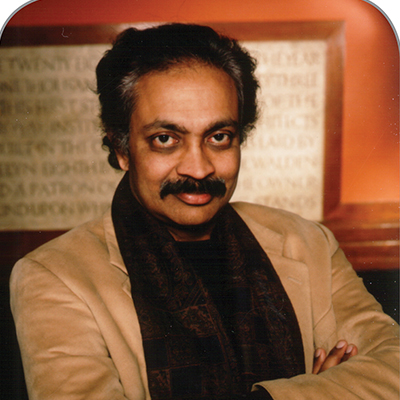
Vilayanur Ramachandran
Professor in Psychology and Neurosciences; Director, Center for Brain and Cognition
University of California, San Diego, United States
Profile – Vilayanur S. Ramachandran (b. 1951)
Usually known as Rama, V. S. Ramachandran is a neuroscientist specialising in the field he calls evolutionary neurocognition. He was born in Tamil Nadu, trained as a doctor in India, gained a PhD at Trinity College, Cambridge, and then worked on visual perception and neurology. He is Director of the Center for Brain and Cognition and Distinguished Professor of Neuroscience at the University of California, San Diego. Ramachandran is best known for inventing the mirror box to reduce pain in phantom limbs but has worked on many topics including autism, Capgras syndrome, synaesthesia, and the ‘bedroom intruder’ in sleep paralysis. He has been praised for his intuition, highly original thinking, and simple and elegant experiments, as well as criticised when his speculations reach beyond the evidence. He was one of the first to refer to vision as controlled hallucination—as if the brain were playing a 20-question game with the sensory input. His passion for Indian classical music and sculpture inspired him to study the neural basis of aesthetics. He suggests that the blind spot is filled in with qualia, and thinks that subjectivity resides mainly in the temporal lobes and cingulate gyrus.
More biographical information
The Marco Polo of neuroscience. Profile in the Observer, January 2011
Brain games: The Marco Polo of neuroscience. Detailed and fun profile in the New Yorker, May 2009
The Sherlock Holmes of neuroscience. Interview for Swarajya Magazine, April 2017
Center for Brain and Cognition, UC San Diego
Publications
Contributions on Edge
Citations on Google Scholar
Quotes on Goodreads
Selected publications relevant to consciousness
Ramachandran, V. S., and Blakeslee, S. (1998). Phantoms in the brain: Proving the mysteries of the human mind. London: Fourth Estate. Google Books preview here.
Ramachandran, V. S., and Gregory, R. L. (1991). Perceptual filling in of artificially induced scotomas in human vision. Nature, 350, 699–702. Direct PDF download (final version) here.
Ramachandran, V. S., and Hirstein, W. (1997). Three laws of qualia: What neurology tells us about the biological functions of consciousness. Journal of Consciousness Studies, 4(5–6), 429–457. Paywall-protected journal record here. Direct PDF download (final version) here.
Ramachandran, V. S., and Hubbard, E. M. (2001). Synaesthesia – A window into perception, thought and language. Journal of Consciousness Studies, 8, 3–34. Paywall-protected journal record here. Direct PDF download (final version) here.
Video
Ghandi neurons: The fascinating connections between brains. Talk at Being Human, April 2013
Embodied souls: Lessons from neurology. Graduate lecture at UC Berkeley, January 2016
Body and mind: Insights from neuroscience. Gifford lectures, University of Glasgow, 2012. Includes two talks (with blurb), on: Molecules, neurons, and morality; Illusions, delusions, and the brain
The neurons that shaped civilization. TEDIndia talk, November 2009
3 clues to understanding your brain. TED talk, March 2007
Audio
Interview with Sue Blackmore – this formed the basis for Rama’s chapter in Conversations on Consciousness, 2004
The emerging mind. Reith Lectures, BBC Radio 4 and World Service, 2003. Includes five talks (with transcripts), on: phantoms in the brain; synapses and the self; the artful brain; purple numbers and sharp cheese; neuroscience – the new philosophy