Part XV: Institutionalization
Class Activities
Queering DEI, Feminist, and Queer Work on Your Campus (75 minute activity)
Small group discussion (5 minutes)
Break students into groups of 3-4 to identify what DEI work looks like on your campus. Ask them to come up with responses to the following questions, written on the board: Where does DEI work happen on campus? Who does it? What kinds of activities do they do in order to reach their goals? Ask students to focus on spaces outside of the classroom. Students should write their answers to these questions on the board. This exercise should lead to a robust list of places where DEI work is happening on campus, including both the obvious folks (LGBTQ+ and feminist student groups, divisions of student affairs committed to the principles of DEI, the campus DEI office) as well as less obvious aspects of the university (athletics, new student orientation, requirements for creating student clubs, and so on).
Small group research (15 minutes)
Each small group should choose one of the places where DEI work happens on campus and explore it in greater depth. Look at their websites, social media pages, flyers they have circulated, videos they have posted online, and so on. What are their stated goals? What assumptions does this work rely upon? Is their work in line with what you have learned about gender, race, class, sexuality, ability, and geography throughout this class? In what ways might their ideas, discourses, or activities run counter to what you’ve learned throughout this class? What are the benefits and the limits of their current approach? How might Thomsen’s analysis of the FAGS flyers and related fallout be useful as you do this kind of cultural mapping of your campus?
Full group discussion (20 minutes)
Have each group present their ideas to the full class.
Creating Alternatives (15 minutes)
Ask students to return to their small groups to create alternative cultural texts—videos, a workshop outline, flyers—that are informed by the readings they have done this semester in this class. How might you be inspired by the FAGS! flyers as you create your alternatives? What aesthetic choices might you make? How would you reframe their content? Are there ways to share these alternative ideas with those who inspired them? How might you go about doing so?
Full group discussion (20 minutes)
Have each group present their cultural texts and share their small group conversations with the full class.
- Divide the class into small groups and ask each group to brainstorm ideas for alternative fundraising strategies that the NWSA could have pursued instead of the concert tour. Have each group present their ideas to the class and facilitate a discussion on the pros and cons of each approach. Also, use the opportunity to explore other examples of “messy contradictions that continue to haunt feminist fundraising today.”
- https://www.nwsa.org/home Provide students with a link to the National Women's Studies Association website, where they can explore the organization’s current initiatives, events, and fundraising efforts. This can help them understand how NWSA has evolved since the time of the fundraising tour and how it continues to address the challenges of fundraising for social justice-oriented projects.
- Jane Fonda and Gloria Steinem on Holly Near | Holly Near: Singing for Our Lives | American Masters Show a video of Holly Near performing one of her songs to give students a sense of her music and activism. This can help them understand the appeal of Near as a performer and the potential draw of the fundraising tour. Discuss the design choices and messaging used in these materials and how they may have influenced audience perception and engagement
Reflection Questions for Readings in Part XV
Chapter 59. Rachel Corbman, “Holly Near on Tour with the National Women’s Studies Association”
- How do the histories of US universities and nonprofits intersect?
- Why does Corbman tell the story of Holly Near’s fundraising tour for the National Women’s Studies Association to bridge critical conversations on the history of US universities and nonprofits?
- Why didn’t the tour make any money? What does this example tell us about the challenges of fundraising for social justice-oriented projects?
- This chapter is based on archival research at the University of Maryland and San Diego State University. Take a look at the footnotes. What sort of materials did Corbman find in these archival collections?
Chapter 60. Carly Thomsen, “In the University, But Not Of It: The Diversity Industry vs. Queer Epistemologies”
- Outline the differences in the assumptions made by the diversity office staff and those reporting the FAGS flyers to the bias board on the one hand, and, on the other, Queer Studies House students and Gender, Sexuality, and Feminist Studies faculty. What can we learn from these differences?
- How do the engagements here with Joan Scott and Cathy Cohen help you to think about the contours of their arguments (in Section II) as well as the usefulness of feminist and queer theoretical arguments in circulation?
- Why should scholars and students of Feminist and Queer Studies push back against the idea that “intellectualizing oppression” is negative? What has “intellectualizing oppression” opened up for you in your thinking, your life, and your engagement with the social world?
Materials developed by Rachel Corbman and Carly Thomsen
Part XVI: Meaning-Making
Class Activity
- “Mapping Class - In this activity, students create a visual representation of their own class experience and identity. They can use symbols, images, and words to represent their social class, as well as any other aspects of their lives that shape and are shaped by their class. After creating their maps, students can share and discuss their representations in small groups or as a class.
- “Class Identity Art Exhibition” - Students can create their own artwork that explores the theme of social class. This can include paintings, sculptures, photographs, or mixed media pieces that reflect their personal experiences, perceptions, or critiques of class. The artwork can be displayed in a class exhibition, allowing students to engage in dialogue and reflection on the different perspectives and narratives represented.
Videos
- Ideas on Fire: Mairead Sullivan on Lesbian Feminist World-Building
Reflection Questions for Readings in Part XVI
Chapter 63. Mairead Sullivan, “Lesbian Feminism and The Challenge of Community”
- Can you identify movements in your own life or in the current news stream that are trapped in a position of counterstance? How might these movements switch from reaction to action?
- Can you identify movements in your own life or in the current news stream that are demonstrating the work of collectivity or coalition? What makes this movement work? What barriers is this movement encountering?
- Talking about lesbian politics or lesbian feminism often elicits affective responses. What is your response to thinking about the promises or perils of lesbian feminism? Does your response lead you to a position of counterstance? How might you interrogate your own response to think about the difference between action and reaction?
- Anzaldúa notes that the new mestiza develops a “tolerance for ambiguity.” At its surface, a “tolerance for ambiguity” might seem like an inaction. How does the new mestiza’s “tolerance for ambiguity” lead her to action?
Chapter 64. Leigh Dodson, “Self-Craft and Coalition: Towards a New Class Consciousness”
- What comes to mind when you think of the “white working class?” How has this image been informed by media and political reporting?
- Why is women of color feminist theorizing particularly useful for understanding and deconstructing the white working class?
- What is a fulcrum point, and how might it serve as a moment of possibility for shifting identity?
- How does capitalism shape and inform the experiences of the white working class?
Materials developed and curated by Sameen
Part XVII: Revolution
Classroom Activity: What is the Prison Industrial Complex?
(Adapted from Critical Resistance’s Introduction to the Prison Industrial Complex. https://criticalresistance.org/resources/intro-to-the-prison-industrial-complex-101-workshop/)
- Materials: Dry erase board and markers, or multiple pieces of poster board/post it sheets and markers.
- Set up: On the paper/board write the following questions: (If using pieces of post it sheets, write one question per sheet). Use the follow up questions if students are struggling to come up with answers.
- What comes to mind when you hear “criminal?”
- Who do you picture?
- What did they do?
- What words are associated with them?
- What comes to mind when you think of a “victim of a crime”?
- Who do you picture?
- How do they act?
- What do “good victims” do?
- What comes to mind when you hear “prison industrial complex?”
- What are the tools of the PIC?
- Who benefits from the PIC?
- What types of institutions are included?
- What are the “goals” or aims of the prison industrial complex?
- What do prison and policing do?
- Who do they target/impact?
- What are the impacts or the results of the prison industrial complex?
- Read through the questions and have students write their thoughts on the board/large paper sheets. Follow up with additional prompts if students need more clarification. Have all students write 2-3 responses to each question.
- After they do so, read through their responses, asking for clarification or follow-up. Ask students if there is anything they would like to add, or if they can see any connections between the ideas within each prompt.
Points to stress and follow-up questions:
- How are our assumptions about who is a victim and who is an offender informed by our social world more broadly
- How do our stereotypes of victims and offenders alike shape the public discourse around prisons and policing?
- Highlight all parts of the prison industrial complex (imprisonment, policing, surveillance, courts, ICE and DHS, media, etc.)—the PIC is not just prisons.
- Highlight the “complex” portion of the prison industrial complex. Discuss why anti-prison advocates argue against focusing on privatization as well as unwaged and low-waged labor as the central problems of the PIC. The problems with the PIC cannot be reduced to privatization.
- The PIC encompasses our entire society. Is there anything that cannot be examined in relation to punishment, imprisonment, policing, or surveillance?
Related Media/Cultural Texts
Videos
- What is Transformative Justice?
Barnard Center for Research on Women
https://youtu.be/U-_BOFz5TXo?list=PLLlbjNglS2TANzUi1XI_D-z_aRn3lVr_g - Everyday Practices of Transformative Justice
Barnard Center for Research on Women
https://youtu.be/F-UE8wwXEtc
Images
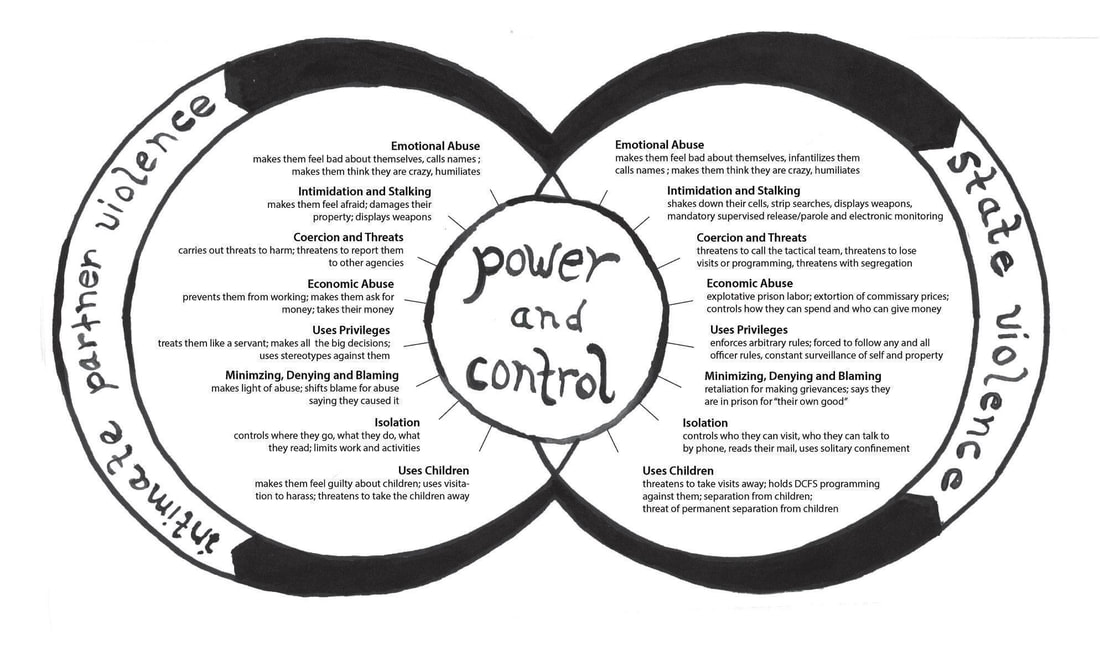
Power & Control Wheel from Moms United Against Violence and Incarceration Chicago Re-conceptualized by Monica Cosby. Graphic by Sarah Ross.
https://static.wixstatic.com/media/e223e1_7d8523db0d6d48d4b8946728f9df6aa0~mv2.jpg
Reflection Questions for Readings in Part XVII
Chapter 67. Preeti Sharma, “Mutuality in Mutual Aid: Radical Care, Mask Making, and the Auntie Sewing Squad”
- What are the relationships among care, mutual aid, and abolition?
- What is your understanding of “solidarity, not charity”? What makes giving a mask a form of “mutual aid”?
- Does a mutual aid organization count as a form of “care work”? Why or why not?
- Do you think practicing care should be incorporated into the internal efforts of a mutual aid organization? Why or why Not? Why is Auntie Care an important value and practice in the Auntie Sewing Squad, both to Aunties and more broadly?
Chapter 68. Abigail Barefoot, “From Demands to Action: Using Transformative Justice for Sexual Violence”
- What is transformative justice and how are its practices and values different from those found in the criminal legal system?
- What are some of the challenges of responding to sexual violence? How does New Leaf attempt to address them?
- What is meant by “carceral logic”? What is an example of carceral logic?
- What is mutual aid, and how might it connect to transformative justice practices?
Materials developed and curated by Abby Barefoot
Part XVIII: Speculative Futures
Class Activity
Debate and Discussion - a sixty minute class engagement module
10-minute class debate:
Have the class debate one of the following: a. Should we automate housework? or b. Given the pressure on the Earth's resources, should governments invest in exploring space?
10-15 minute class discussion:
Have the class come together to discuss which side was more compelling, giving reasons why. Write on the board the main points raised by both teams. Which of these are in tune with the texts for the week and what broader concepts and values are embedded within them?
Link the debate and discussion to key themes of Octavia Butler’s essay: NPR: Octavia Butler
10-minute class speculative quiet writing exercise:
Ask students to write a short story or essay with enforced empathy, inspired by Butler's thought experiment. Offer them a prompt depending on their level.
10-minute sharing:
Invite students to share what they wrote and the links it might have to the chapters in Part XVIII. Reflect on what our feminist and queer response to emerging AI technologies might look like when shaped by the speculative futures of Feminist Studies.
Reflection Questions for Readings in Part XVIII
Chapter 70. Erin L. Durban, “The Future-Past is Disabled”
- How do Afro-Futurism and Afro-Surrealism disrupt Euro-American time? How does this disruption disrupt social power?
- Define ableism. Using the work of Atiz Rezistans, discuss how ableism is bound together with environmental racism and imperialism.
- What are some of the goals of Atiz Rezistans? Discuss your answers in relation to environmental disaster, capitalism, and imperialism.
- How does Durban’s discussion of plastic contribute to materialist feminism discussed in Part III? Why might we embrace plastics?
71. Erin McElroy, “Speculations Beyond Real Estate”
- How do acts of speculative fiction writing and mapping counter speculative acts of real estate accumulation and gentrification?
- What are some of the dispossessive histories that inform current contexts of property-making?
- How do housing and land justice projects engage in speculative worldmaking by embracing feminist and racial justice perspectives?
- If you were to map out a city, neighborhood, or world that you want to live in, what would it look like, feel like, or be like?
Materials developed and curated by Sameen