Biographies
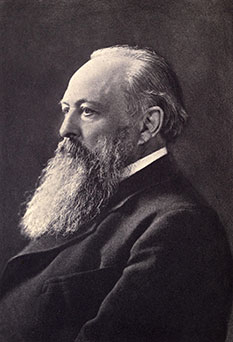
Lord Acton
Lord Acton
(10 January 1834 – 19 June 1902)
John Dalberg-Acton, 1st Baron Acton was an English historian and politician. Unable to study at Cambridge because he was a Roman Catholic, Acton was educated at the University of Munich in Germany. Politically, Acton was a liberal and served from 1859 to 1865 as a Member of Parliament. He was also the editor of the liberal Catholic periodical, The Rambler.
In 1895 he was appointed Regius Professor of Modern History at the University of Cambridge. He had previously been devising plans for a universal history, and at Cambridge began planning the Cambridge Modern History, though he would not live to see the project come to fruition. Aside from this work, he is perhaps best known for his remark, ‘Power tends to corrupt, and absolute power corrupts absolutely.’
https://www.acton.org/lord-emerich-edward-dalberg-acton
Biography from the Acton Institute
https://www.britannica.com/biography/John-Emerich-Edward-Dalberg-Acton-1st-Baron-Acton
Lord Acton’s entry in Britannica
More info, including a list of selected works:
https://en.wikipedia.org/wiki/John_Dalberg-Acton,_1st_Baron_Acton
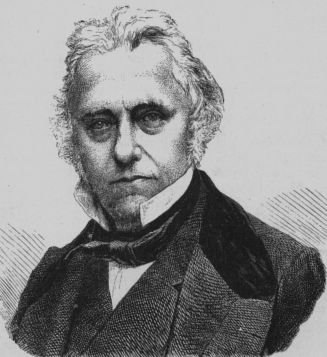
Thomas Babington Macaulay
(25 October 1800 – 28 December 1859)
Thomas Babington Macaulay was an English historian and politician in the nineteenth century. He was born in Leicestershire and studied at the University of Cambridge. He was elected as a Member of Parliament in 1830, where he was an advocate for parliamentary reform. From 1834 to 1838, he travelled to India where he served in the colonial government. There he encouraged the use of English in the education system instead of local languages, which he deemed inferior. On his return to Britain, he became an MP once more, from 1838 to 1857, with a five-year period out of office.
In the 1840s, he began working on the History of Englandfrom the Accession of James the Second, publishing the first two volumes in 1848 and the next two in 1855. The fifth and final volume was published posthumously. The volumes cover the years 1685 to 1702, discussing the Glorious Revolution and its aftermath. This work is now seen as a paradigmatic case of Whig history in which heroes contended against villains and England triumphantly attained its balanced constitutional monarchy. This kind of history came under attack in the middle of the twentieth century.
https://www.britannica.com/biography/Thomas-Babington-Macaulay-Baron-Macaulay
Macaulay’s entry in Britannica
More info, including a list of selected works:
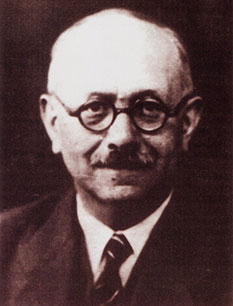
Marc Bloch
(6 July 1886 – 16 June 1944)
Marc Léopold Benjamin Bloch was born to a Jewish family in Lyon, France. He studied at universities in Paris, Berlin and Leipzig, and served in the infantry during the First World War, ultimately becoming a captain and receiving the National Order of the Legion of Honour. After the war, he taught at the University of Strasbourg, and then at the Sorbonne in Paris. When the Second World War broke out, Bloch again took up his position as captain in the French military. When France was defeated by Germany, Bloch joined the French Resistance. After being captured by the German secret police in 1944, Bloch was tortured and finally executed.
Bloch co-founded the Annales School with colleague Lucien Febvre in 1929. This new approach took a sweeping view of history and considered the effect of collective mentalities, an approach Bloch had previously explored in his 1924 work, The Royal Touch: Sacred Monarchy and Scrofula in England and France, on the popular belief in a monarch’s ability to cure scrofula through touch. In other works, Bloch examined rural French life and the impact of technology over the longue durée (the long term). During the Second World War, Bloch worked on a manuscript about the role of the historian – published posthumously in English as The Historians’ Craft.
Important Works:
The Royal Touch: Sacred Monarchy and Scrofula in England and France (1924)
French Rural History (1931)
Strange Defeat: A Statement of Evidence Written in 1940 (1940)
The Historians’ Craft (1949)
https://www.smithsonianmag.com/history/history-heroes-marc-bloch-134082792/?no-ist/
An article on Bloch’s life in the Smithsonian Magazine
More info, including a list of selected works:
https://en.wikipedia.org/wiki/Marc_Bloch
Fernand Braudel
(24 August 1902 – 27 November 1985)
Fernand Braudel was a French historian. With Marc Bloch and Lucien Febvre, he was one of the key contributors to the Annales School.
Born in a small village in northeastern France, he and his family later relocated to Paris where he was educated. He taught at universities in Algeria and Brazil before returning to France before the start of the Second World War. During the war, Braudel served as a French Army officer. He was captured by the Germans and, in a prisoner-of-war camp, he managed to write a draft of his work The Mediterranean and the Mediterranean World in the Age of Philip II from memory and then had it smuggled out.
This work, published in 1949, proved one of the most influential of the Annales school by describing three levels of time: the long-term geographical and environmental changes, which take place over vast sweeps of time; the medium-term social, economic and cultural changes in a region that take place over centuries; and the short-term changes concerning politics and events that could occur in an individual’s lifetime. His three-volume, Civilization and Capitalism, 15th–18th Century (1967-1979), analysed the long-term capitalist structures of European capitalism. His final work, The Identity of France (1986), argued for the importance of geography and culture to explain French identity.
https://www.britannica.com/biography/Fernand-Braudel
Braudel’s entry in Britannica
https://www.latimes.com/archives/la-xpm-1985-11-30-fi-9664-story.html
Braudel’s obituary in the Los Angeles Times
More info, including a list of selected works:
https://en.wikipedia.org/wiki/Fernand_Braudel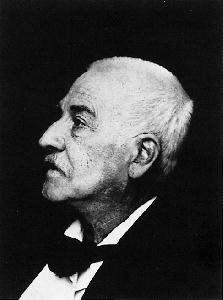
Jacob Burckhardt
(25 May 1818 – 8 August 1897)
Jacob Burckhardt was a Swiss historian of art and culture, specifically during the Italian Renaissance. He was born in Basel, Switzerland, and studied history in Germany, including under Leopold von Ranke, the chief founder of history as a discipline.
His defining works were The Civilization of the Renaissance in Italy (1860), an analysis of the politics and culture of the period in which Burckhardt identified the birth of modern Europe, and The History of the Renaissance in Italy (1867), which treated architecture but remained unfinished. These works helped to set the direction for future studies of cultural and art history.
http://www.theguardian.com/culture/2010/jul/10/jacob-burckhardt-civilization-renaissance-italy
An article published on the 150th anniversary of Burckhardt’s The Civilisation of the Renaissance in Italy
https://www.britannica.com/biography/Jacob-Burckhardt
Burckhardt’s entry in Britannica.
More info, including a list of selected works:
https://en.wikipedia.org/wiki/Jacob_Burckhardt
Sir Herbert Butterfield
(7 October 1900 – 20 July 1979)
Herbert Butterfield was born in Oxenhope, England and was educated the University of Cambridge, where he received his MA in 1926. Butterfield was a professor at Cambridge from 1928 until his death. There he held the prestigious position of Regius Professor of Modern History from 1963 to 1968. In 1968, Butterfield received a knighthood in recognition for his historical accomplishments.
Butterfield’s The Whig Interpretation of History, published early in his career in 1931, was his best-known work and was critical of the approach of some liberal historians who saw history as a straightforward narrative of progress leading to the present liberal order. Doing so presented a historically incomplete view of the past, argued Butterfield. His arguments were influential and his criticism of teleological (or goal-directed) histories has been applied to other areas, such as the history of science.
Aside from his most famous work, Butterfield also wrote about the development of science in his The Origins of Modern Science, 1300-1800 (1949) and – influenced by his devout Christian views – the history of Christianity, in his Christianity and History (1949).
More info, including a list of selected works:
https://en.wikipedia.org/wiki/Herbert_Butterfield
William Camden
(2 May 1551 – 9 November 1623)
William Camden was an English historian and antiquarian. His first great work was Britannia, a topographical and historical account of Britain and Ireland, first published in 1586 and going through many subsequent editions. In 1597, Camden was tapped to write a history of Elizabeth I’s reign. He was given access to the State Papers and wrote the history in two parts, the first part appearing in 1615 and the second in 1625. This work gives an important insight into Elizabeth’s reign, even as later historians have criticised it for being favourably biased toward the queen.
https://www.britannica.com/biography/William-Camden
Camden’s entry in Britannica
http://www.visionofbritain.org.uk/travellers/Camden
Camden’s Britannia, translated into English from the Latin, from 1610
More info:
https://en.wikipedia.org/wiki/William_Camden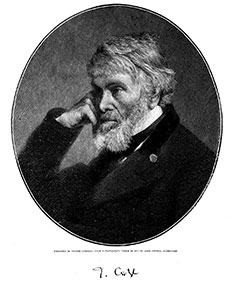
Thomas Carlyle
(4 December 1795 – 5 February 1881)
Thomas Carlyle was a Scottish philosopher and historian. He was born in Dumfriesshire, Scotland, and was educated at the University of Edinburgh. He lived for a time in Scotland, where he began his first important work, Sartor Resartus (later published in 1836), which was influenced by German idealism. In 1834, he relocated south to London, where he moved in a circle of prominent intellectuals of the era.
His work, The French Revolution: A History (1837), gained him renown. This work would also inspire Charles Dickens’s account of the revolution in his novel, A Tale of Two Cities. In Carlyle’s On Heroes, Hero-Worship, and the Heroic in History (1841), he put forth a ‘great man’ theory of history, in which all history is essentially the history of great men. Putting this idea into practice on a grand scale, Carlyle composed a six-volume biography of the Prussian leader, Frederick the Great: History of Friedrich II of Prussia (1858-1865).
http://www.victorianweb.org/authors/carlyle/
Various resources on Carlyle
https://www.britannica.com/biography/Thomas-Carlyle
Britannica article on Carlyle
More info, including a list of selected works:
https://en.wikipedia.org/wiki/Thomas_Carlyle
E. H. Carr
(28 June 1892 – 3 November 1982)
Edward Hallett Carr was born in London and studied at Trinity College, Cambridge, where he graduated with a degree in Classics. Carr joined the British Foreign Office after his graduation in 1916. In this position, which he held for 20 years, Carr was able to see first-hand the end of the First World War, the emergence of the Soviet Union, and the rise of the Nazi Party in Germany. Over this time, Carr became increasingly fascinated with Russian culture and was impressed by what he saw in his visits to the Soviet Union.
In 1936, Carr left the Foreign Office to take up a position at Aberystwyth University in Wales as a professor of international politics. During the Second World War, Carr was an assistant editor with The Times and encouraged accommodation with the Soviet Union. After the war, Carr held positions at Oxford and later Cambridge, where he spent the remainder of his career.
His long-standing interest in the Soviet Union led to the fourteen-volume, A History of Soviet Russia (1950-1978). Carr’s other noted work, What is History? (1961), criticised recent trends in historiography: he disputed the supposed objectivity of historical facts, but also argued that history is deterministic and that counterfactual history is a futile exercise.
https://archives.history.ac.uk/history-in-focus/Whatishistory/evans10.html
Richard Evans’s reflections on Carr’s What is History?
More info, including a list of selected works:
https://en.wikipedia.org/wiki/E._H._CarrRichard Cobb
(20 May 1917 – 15 January 1996)
Richard Cobb was a British historian who studied French history, particularly the French Revolution, emphasising ‘history from below’.
http://www.independent.co.uk/news/people/obituary-richard-cobb-1324236.htmlCobb’s obituary in The Independent.
http://www.nytimes.com/1996/01/23/arts/richard-cobb-78-an-authority-on-the-french-revolution-dies.html?scp=1&sq=%22Richard%20Cobb%22&st=cseCobb’s obituary in The New York Times.
R. G. Collingwood
(22 February 1889 – 9 January 1943)
Robin George Collingwood was an English historian and philosopher. He was born in Lancashire and was educated at Oxford, where he would go on to teach for much of his life. Aside from his works on the philosophy of history, and philosophy more generally, he was a practising historian and archaeologist, specialising in Roman Britain. But he is most noted for his 1946 work, The Idea of History, published posthumously from collected notes. There he presented his idealist philosophy of history. Collingwood believed that history was primarily about the history of thought and that the goal of the historian should be to re-enact the mental processes of historical agents.
https://www.britannica.com/biography/R-G-Collingwood
Collingwood’s entry in Britannica
http://plato.stanford.edu/entries/collingwood/
Collingwood’s entry in the Stanford Encyclopedia of Philosophy
More info, including a list of selected works:
https://en.wikipedia.org/wiki/R._G._Collingwood
Sir Geoffrey Elton
(17 August 1921 – 3 December 1994)
Sir Geoffrey Elton was a German-born historian who focused on the constitutional and political history of Britain, especially the reigns of Henry VIII and Elizabeth I. Born Gottfried Rudolf Otto Ehrenberg to a Jewish family in Germany, the family moved to Czechoslovakia in 1929 and then fled to Britain in 1939. He took correspondence courses from the University of London, earning a degree in ancient history, and also served in the army, stationed in Italy, during World War Two. During this time, he began anglicising his name to Geoffrey Elton. After the war, Elton earned his PhD from University College London.
Elton taught at the University of Glasgow and later the University of Cambridge, where he was named Regius Professor of Modern History from 1983 to 1988. In The Tudor Revolution in Government (1953), Elton argued that the political reforms of Thomas Cromwell, under Henry VIII, broke with medieval forms of government by establishing a modern bureaucratic state. Elton also countered E.H. Carr’s What is History? – which he took to be dangerously relativist – with his own The Practice of History (1967). There he defended traditional, empirical history in the mould of Leopold von Ranke, and gave an important role to individuals in the making of history.
http://www.independent.co.uk/news/people/obituaries--professor-sir-geoffrey-elton-1390129.html
Elton’s obituary in the Independent
Elton’s obituary in the New York Times
http://xml.ucc.ie/chronicon/elton.htm
A reflection on Elton’s historical philosophy in the journal Chronicon
More info, including a list of selected works:
https://en.wikipedia.org/wiki/Geoffrey_Elton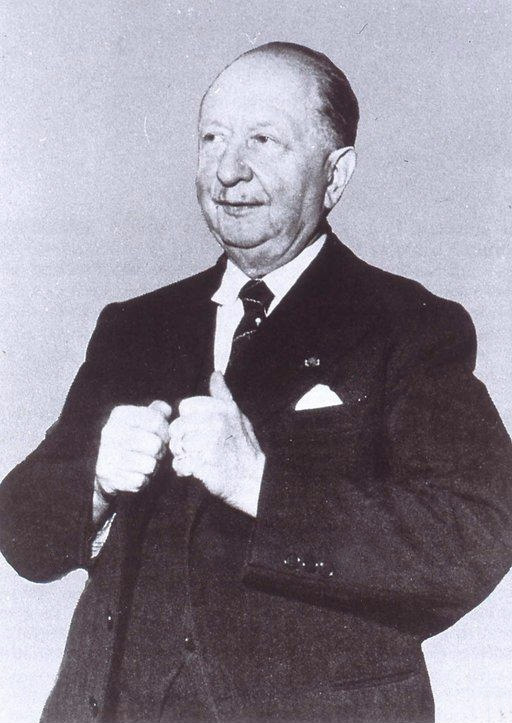
Lucien Febvre
(22 July 1878 – 11 September 1956)
Lucien Febvre was a French historian who co-founded the influential Annales school with Marc Bloch. Born in northeast France, Febvre was educated in Paris. He served in the First World War and afterward took up a post at the University of Strasbourg. There he became acquainted with Marc Bloch, with whom he shared a historical approach. Febvre focused on the geography, psychology and culture of a region over long sweeps of time, characterizing the Annales approach.
With Bloch, he would found the journal, Annales d'histoire économique et sociale, in 1929. In 1933, he was appointed a chair of the Collège de France, where he would publish among other things, his important work, The Problem of Unbelief in the Sixteenth Century: The Religion of Rabelais (1937). Under Febvre’s influence, the second generation of Annales scholars, particularly Ferdinand Braudel, came of age.
https://www.britannica.com/biography/Lucien-Paul-Victor-Febvre
Febvre’s entry in Britannica
More info, including a list of selected works:
https://en.wikipedia.org/wiki/Lucien_Febvre
Michel Foucault
(15 October 1926 – 25 June 1984)
Michel Foucault was a French philosopher and historian whose works critically examined the idea of modernity as well as questioned the formation of knowledge and its relation to power and control. At the height of his career, Foucault was considered the most important living French intellectual.
Born in Poitiers, France, Foucault’s father was a surgeon and his mother was the daughter of a surgeon – helping to explain Foucault’s later interest in medical practices. He was trained in psychology and philosophy and, after teaching at a number of universities in France and elsewhere in Europe and North Africa, he joined the prestigious Collège de France in 1969 where he would be a professor until his death.
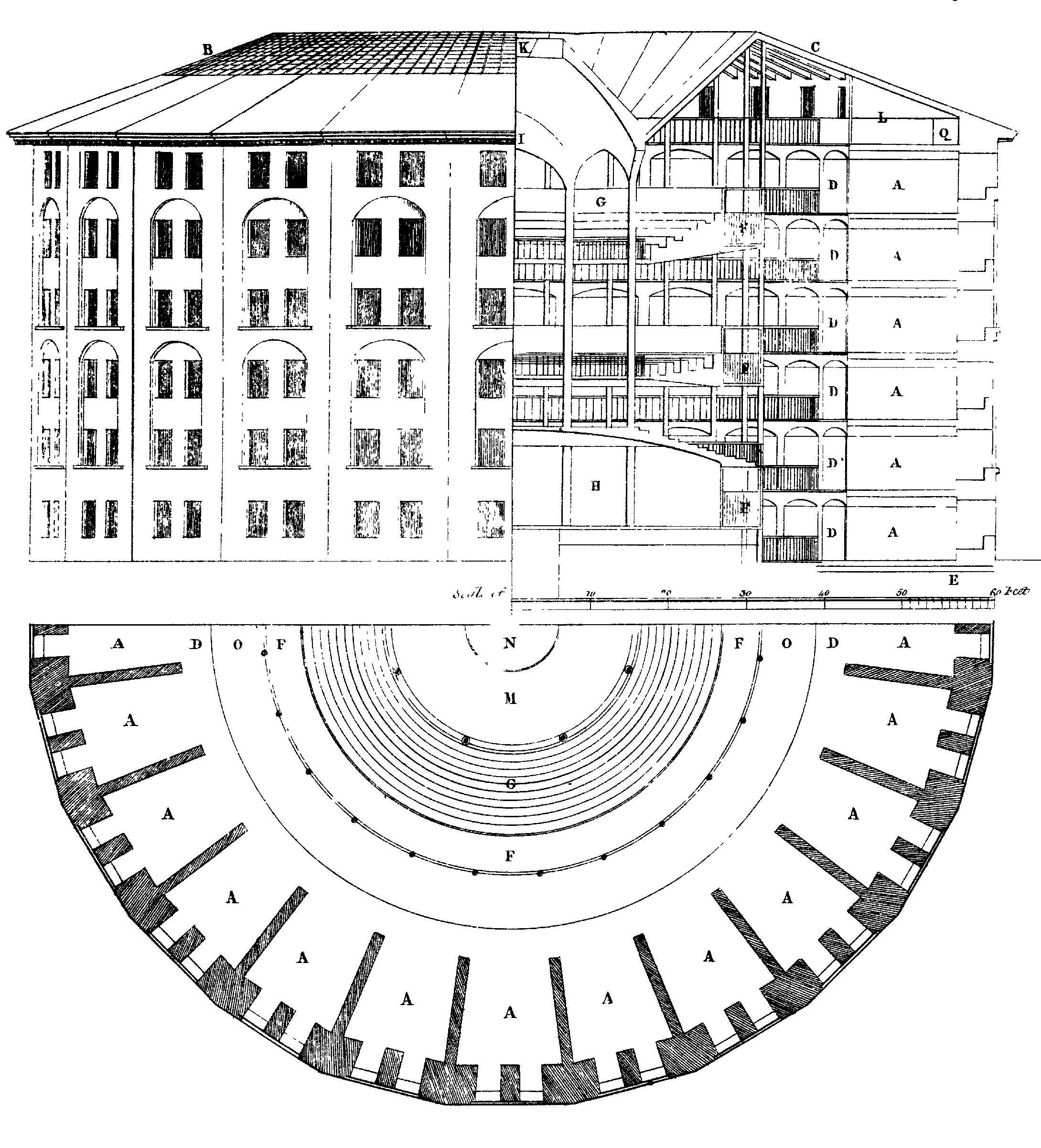
His first book, Madness and Civilization (1961), examined the ways that the psychiatric concept of insanity and institutions like insane asylums could be used as tools of social exclusion. The Order of Things (1966) examined the history of western knowledge and the fundamental breaks between different periods. Discipline and Punish (1975) meanwhile explored the emergence of the prison system and its aim of producing ‘docile bodies’. His 4-volume History of Sexuality (1976, 1978, 1984, 2018) showed how discourses around sexuality were linked with structures of power.
Foucault was politically active through much of his life, aiming to reform prisons and advocating for gay rights and the rights of other marginalised groups.
http://www.iep.utm.edu/foucault/
Foucault’s entry in the Internet Encyclopedia of Philosophy
http://plato.stanford.edu/entries/foucault/
Foucault’s entry in the Stanford Encyclopedia of Philosophy
http://www.bbc.co.uk/programmes/b038hg73
A BBC4 Radio programme on Foucault’s life and work
https://archive.nytimes.com/www.nytimes.com/books/00/12/17/specials/foucault-obit.html
Foucault’s obituary in The New York Times
For more info:
https://en.wikipedia.org/wiki/Michel_Foucault
[Image 25 here]

V. H. Galbraith
(15 December 1889 – 25 November 1976)
Vivian Hunter Galbraith was an English historian who studied mediaeval English history. He was born in Sheffield and attended Manchester University and later Oxford. He joined Manchester University as a fellow and later lecturer following a break for service in the army during the First World War. He would become the Regius Professor of Modern History at Oxford from 1947 to 1957. Galbraith believed historians were best tasked with the preparation and contextualisation of primary documents. To this end, he is best known for his work on the mediaeval source, the Domesday Book, in his work, Domesday Book: Its Place in Administrative History (1975).
https://archives.history.ac.uk/makinghistory/historians/galbraith_vivian.html
Information from the Institute for Historical Research
More info, including a list of selected works:
https://en.wikipedia.org/wiki/Vivian_Hunter_Galbraith
Edward Gibbon
(8 May (Old Style: 27 April) 1737 – 16 January 1794)
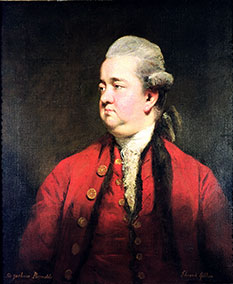
Edward Gibbon was an English historian and Member of Parliament. His masterwork was the six-volume, The History of the Decline and Fall of the Roman Empire, published between 1776 and 1788.
Gibbon was born in Putney, Surrey, and while his formal education was sporadic, he was an avid reader as a young man. Works in the 1760s and 1770s gained him minor literary fame and embarking on the Grand Tour – a trek across Europe that many wealthy people undertook – inspired him to one day write on the history of Rome. He was elected a Member of Parliament, but was mostly an inactive member, focusing his time instead on his writing.
Gibbon’s Decline and Fall quickly made him a major figure of the Enlightenment, even as his criticism of Christianity in the book’s pages won him many detractors. His use of primary sources made him one of the first modern historians, though some of his conclusions are no longer accepted.
A talk by the historian John Pocock on Gibbon’s work
More info:
https://en.wikipedia.org/wiki/Edward_Gibbon
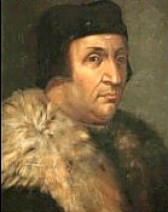
Francesco Guicciardini
(6 March 1483 – 22 May 1540)
Francesco Guicciardini was an Italian historian and statesman during the Renaissance. He was born in Florence, Italy to an aristocratic family. He trained for a career in law and soon became an administrator of newly acquired papal states in Italy, during which time he also wrote works on politics. He served the papacy for nearly two decades as warfare and political instability engulfed Italy.
He wrote his History of Italy, covering the period 1494 to 1534, towards the end of his life. This work marked a new direction in realistic historical writing by focusing on his personal experiences of the events and key figures, as well as on government records.
https://www.britannica.com/biography/Francesco-Guicciardini
Guicciardini’s entry in Britannica.
More info, including a list of selected works:
https://en.wikipedia.org/wiki/Francesco_Guicciardini
[Image 3 here]
Catherine Hall
(18 February 1946 – )
Catherine Hall is a British historian whose work analyses the intersections between gender, empire, class and race in the eighteenth and nineteenth centuries. She spent much of her career at University College London, where she is currently Emerita Professor of Modern British Social and Cultural History. She is best known for her monographs, Family fortunes: men and women of the English middle class, 1780-1850 (with Leonore Davidoff, Routledge, 2002 [first published 1987]), Civilising Subjects; metropole and colony in the English imagination 1830-1867 (University of Chicago Press, 2002), and Macaulay and Son: architects of imperial Britain (Yale University Press, 2012). She is also the chair of the Centre for the Study of the Legacies of British Slave-ownership.
http://www.theguardian.com/commentisfree/2013/feb/27/britain-debt-slavery-made-public
An article on Britain’s intimate relationship with slavery
https://www.lrb.co.uk/the-paper/v42/n02/catherine-hall/mother-country
An article on the notion and practice of a ‘hostile environment’ for immigrants to Britain
Centre for the Study of the Legacies of British Slave-ownership
More info, including a list of selected works:
https://en.wikipedia.org/wiki/Catherine_Hall
Christopher Hill
(6 February 1912 – 23 February 2003)
John Edward Christopher Hill was an English historian in the Marxist tradition. His work focused on seventeenth-century England, particularly applying a Marxist analysis to the English Revolution. He spent much of his career at Oxford University, where he helped to found the Communist Party Historians Group, as well as the journal Past and Present, which focuses on social history.
http://www.theguardian.com/news/2003/feb/26/guardianobituaries.obituaries
Hill’s obituary in The Guardian.
http://socialistreview.org.uk/272/obituary-turning-point-history
Hill’s obituary in The Socialist Review.
More info, including a list of selected works:
https://en.wikipedia.org/wiki/Christopher_Hill_(historian)
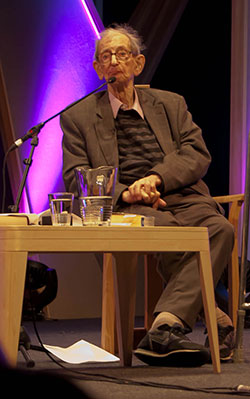
hello
Eric Hobsbawm
(9 June 1917 – 1 October 2012)
Eric John Hobsbawm was born in Alexandria, Egypt to a Jewish family. In his youth, Hobsbawm and his family lived in Austria and Germany, and moved to England in 1933, when Hitler came to power. He received his PhD from Cambridge University for his dissertation on the Fabian Society and, after serving in the engineer corps during the Second World War, Hobsbawm went on to work primarily at Birbeck, University of London. Hobsbawm was active in left-wing politics throughout his life, remaining a member of the Communist Party until just before the fall of the Soviet Union in 1991, when he opted not to renew his membership.
Hobsbawm’s most famous works are his trilogy about the long nineteenth century (1789-1914): The Age of Revolution (1962), The Age of Capital (1975), and The Age of Empire (1987), and his work on the short twentieth century (1914-1991): The Age of Extremes. His Marxist approach to history led to one of his key innovations, the idea that the French Revolution and the Industrial Revolution (in Britain) should be treated as the political and economic halves of a ‘dual revolution’, making way for the rise of liberal capitalism in the nineteenth century. Hobsbawm was also a cultural critic and coined the term ‘invented traditions’ – traditional or national myths supposedly of ancient origin but actually quite recent – in his 1983 work, co-edited with T.O. Ranger, The Invention of Tradition.
http://www.theguardian.com/books/2002/sep/14/biography.history
A profile of Hobsbawm in The Guardian
More info, including a list of selected works:
https://en.wikipedia.org/wiki/Eric_Hobsbawm
[Image 1 here]
Peter Laslett
(18 December 1915 – 8 November 2001)
Peter Laslett was an English historian who studied the history of political theory and, later, historical demography and the history of the family. He was born in Bedford, England. He studied at Cambridge, with an interruption during World War Two in which he served in naval intelligence. He returned to Cambridge after the war and studied with Herbert Butterfield. At Cambridge, Laslett provided influential interpretations on the seventeenth-century philosophers, Robert Filmer and John Locke. In the 1960s, Laslett turned his analysis toward social structures, resulting in perhaps his best known for his book, The World We Have Lost: England Before the Industrial Age (1965). Laslett also helped to establish the Open University.
http://www.theguardian.com/news/2001/nov/17/guardianobituaries.highereducation
Laslett’s obituary in The Guardian
More info, including a list of selected works:
https://en.wikipedia.org/wiki/Peter_Laslett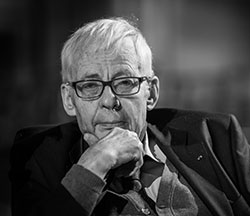
Emmanuel Le Roy Ladurie
(19 July 1929 –)
Emmanuel Le Roy Ladurie is a French social historian in the tradition of the Annales School. Le Roy Ladurie’s work examines French rural life during the ancien régime (the period in France from the middle ages to the French Revolution in 1789), often using the microhistory approach.
His work, Les paysans de Languedoc (1966; published in English as The Peasants of Languedoc in 1974), established his scholarly reputation. The book analysed the peasantry in the Languedoc region in the south of France from the fifteenth to the eighteenth century. Le Roy Ladurie turned again to this region in his most famous work, Montaillou (1975), which focused on the village of Montaillou in Languedoc. He examined Inquisition records to gain insight into peasant life in the village from 1294 to 1324, a time when Inquisitors sought to root out the heretical Cathar movement in the region. Other works by Le Roy Ladurie studied rural understandings of witchcraft and the political history of the ancien régime.
A communist early in his life, Le Roy Ladurie broke with the communists after the Soviet crackdown in Hungary in 1956. Later he would become a member of the anti-communist group called the Committee of Intellectuals for a Europe of Liberties.
More info, including a list of selected works:
https://en.wikipedia.org/wiki/Emmanuel_Le_Roy_Ladurie
[Image 2 here]
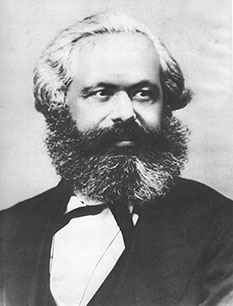
Karl Marx
(5 May 1818 – 14 March 1883)
Karl Heinrich Marx was born in Trier, Prussia (Germany). Marx was born into a wealthy, middle-class family and attended the University of Bonn and the University of Berlin. At university, Marx became interested in G.W.F. Hegel’s theory of dialectical materialism and established himself among German radicals, most importantly Friedrich Engels. He was awarded a PhD from the University of Jena in 1841, but was unable to secure a position given his political and anti-religious views. Due to his radicalism, he was forced to leave Germany and he sought refuge in various European countries, eventually settling in England in 1849, where he continued his advocacy for communism.
Marx wrote one of his most important works, The Communist Manifesto, in 1848 in Belgium with Engels. This work laid out Marx’s theory of history as a series of class struggles, which would eventually culminate with the victory of the proletariat (the working classes) and the creation of socialism. He published the first volume of his masterwork, Capital, in 1867, which further analysed and critiqued the capitalist system. The remaining two volumes would be assembled from Marx’s notes by Engels after his friend’s death. Marx’s theory of history would be hugely influential and many historians have seen it as a useful way to think about the driving forces behind historical change and the links between culture, society and the economy.
Important works:
The Communist Manifesto (1848)
The Eighteenth Brumaire of Louis Napoleon (1852)
Capital, Volume 1 (1867)
Capital, Volume 2 (1885)
Capital, Volume 3 (1894)
https://www.marxists.org/archive/marx/
Many of Marx’s works, including letters, are available here
More info, including a list of selected works:
https://en.wikipedia.org/wiki/Karl_Marx
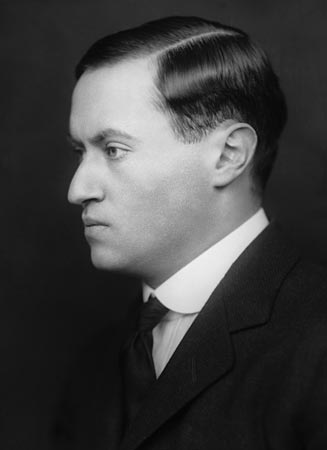
Sir Lewis Namier
(27 June 1888 – 19 August 1960)
Sir Lewis Bernstein Namier was born Ludwik Niemirowski in what was then the Russian Empire, now Poland, to a secular Jewish family. Namier was educated at the University of Lvov (in what is now Ukraine), the University of Lausanne (in Switzerland), the London School of Economics, and Balliol College, Oxford. He immigrated to Britain in 1907 and anglicised his name in 1913, at the same time as he became a British subject. Namier fought in the First World War, but was discharged due to his poor eyesight. He continued to serve in a variety of capacities throughout the war and was a member of the British delegation to the Paris Peace Conference in 1919. After the war, Namier taught briefly at Balliol College, and later at the University of Manchester from 1931 to 1953. He was knighted in 1952.
Namier’s most important work concerns his use of prosopography, or collective biography, to uncover the workings of the eighteenth-century British Parliament. This is seen in The Structure of Politics at the Accession of George III (1929). By examining the biography of every Member of Parliament during the eighteenth century, Namier analysed their motivations and interests to uncover that the Tory and Whig Parties were far from monolithic groups, but rather were shifting coalitions on various issues. Namier also examined wills, tax records, and memberships of various MPs to further understand their goals.
Important Works:
The Structure of Politics at the Accession of George III (1929)
England in the Age of the American Revolution (1930)
1848: The Revolution of the Intellectuals (1946)
Diplomatic Prelude, 1938-39 (1948)
The House of Commons, 1754-1790 (3 volumes) (1964, co-edited with John Brooke)
https://slate.com/news-and-politics/2007/03/lewis-namier-the-historian-as-poet.html
A reflection on Namier’s influence by Clive James
More info, including a list of selected works:
https://en.wikipedia.org/wiki/Lewis_Namier
[Image 14 here]
Sir J. H. Plumb
(20 August 1911 – 21 October 2001)
J.H. Plumb was a British historian who wrote mainly on the social and political history of eighteenth-century Britain, both for an academic audience and for the general public.
He came from a working-class family in Leicester, England, and studied at University College Leicester. He gained his PhD from the University of Cambridge – the only student to do so under the supervision of G.M. Trevelyan. During the Second World War, he worked for the Foreign Office as a codebreaker.
After the war, he returned to Cambridge where he was based for the rest of his career. Perhaps his best-known works were England in the Eighteenth Century (1950) and his two-volume work Sir Robert Walpole (1956-1960). He also acted as editor for many series including the History of Human Society series. His influence and encouragement extended to many future historians, among them David Cannadine, Linda Colley, Niall Ferguson, Roy Porter, Simon Schama, and Quentin Skinner. He was knighted in 1982.
http://www.theguardian.com/news/2001/oct/22/guardianobituaries.books
Plumb’s obituary in The Guardian
http://www.independent.co.uk/news/obituaries/professor-sir-john-plumb-9272798.html
Plumb’s obituary in The Independent
More info, including a list of selected works:
https://en.wikipedia.org/wiki/John_H._Plumb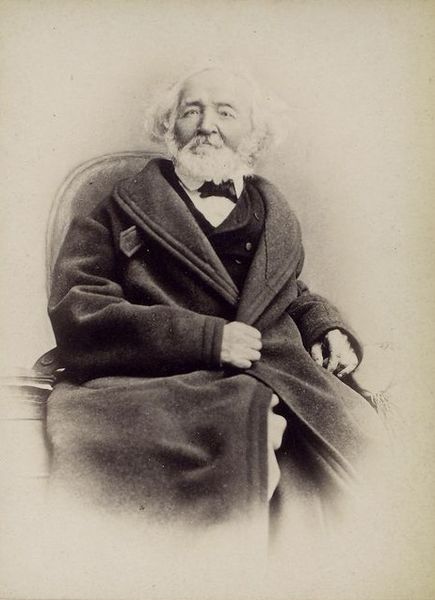
Leopold von Ranke
(21 December 1795 – 23 May 1886)
Leopold von Ranke was born in Wiehe, Saxony (in modern Germany). Ranke, born into a devout Lutheran family, studied theology and ancient history at the University of Leipzig. His historical studies aimed at uncovering the working of God in great historical events. On the strength of his 1824 book, History of the Latin and Teutonic Nations from 1494 to 1514 (which contained his famous maxim that history writing was to show ‘how things actually were’), and after eight years of teaching Classics at a secondary school, Ranke became a professor at the University of Berlin in 1825.
It was at Berlin where Ranke developed the seminar method of teaching and disseminated his ideas about the objective study of history through careful evaluation of primary sources. He wrote a number of multi-volume histories of large topics over long time periods, including the history of the papacy during the sixteenth and seventeenth centuries, the Reformation in Germany, and his final work, a six-volume history of the world, which was left incomplete at his death.
Ranke was also a conservative thinker. He wrote various works defending the established order in the German states and rejected any talk of revolution. In 1865, having won fame as the most important German historian, Ranke received the noble title of ‘von’ to his name.
Important works:
History of the Latin and Teutonic Nations from 1494 to 1514 (1824)
History of the Popes during the 16th and 17th Centuries (1834-6)
History of the Reformation in Germany (1839-47)
Civil Wars and Monarchy in France (1852-61)
World History (1886)
https://www.britannica.com/biography/Leopold-von-Ranke
Ranke’s entry in Britannica
More info, including a list of selected works:
https://en.wikipedia.org/wiki/Leopold_von_Ranke
Edward Said
(1 November 1935 – 25 September 2003)
Edward Said was a Palestinian-American literary theorist. Born in Jerusalem, in then British Palestine, Said gained American citizenship through his father, who had served in the American forces during World War One. Said was educated in Egypt and later the United States where he would earn degrees from Princeton and Harvard. He joined Columbia University as a professor of English and Comparative Literature in 1963 and held the position for four decades.
Following the Israeli victory against its Arab neighbours during the Six Day War in 1967, he became more vocal in his politics. Said was an advocate for Palestinian self-determination, while also being a frequent critic of Palestinian leadership and recognizing Israel’s right to exist. Said was also a critic of American foreign policy.
Said’s most famous work, Orientalism (1978), analysed Western cultural representations of the Middle East. Said argued that, for centuries, the production of ‘knowledge’ about the East, subtly or not, went hand-in-hand with Western imperialism. This work, along with his Culture and Imperialism (1993), became cornerstones of postcolonial studies.
http://palestine.mei.columbia.edu/edward-said-archive
A list of resources about Said, including lectures and interviews, from the Center for Palestine Studies at Columbia University
http://www.theguardian.com/news/2003/sep/26/guardianobituaries.highereducation
Said’s obituary in The Guardian
Said’s obituary in The New York Times
More info:
https://en.wikipedia.org/wiki/Edward_Said
Raphael Samuel
(26 December 1934 – 9 December 1996)
Raphael Elkin Samuel was born in London to a Jewish and communist family. As a teenager, Samuel joined the Communist Party (but left the party in 1956 over the Soviet Union’s invasion of Hungary). He studied history at Balliol College, Oxford, where he was involved in the Communist Party Historians’ Group, which included a number of prominent Marxist historians. In 1962, he became a tutor at Ruskin College, Oxford, and taught there until his death in 1996. He established the East London History Centre (since renamed the Raphael Samuel Centre) at the University of East London in 1995.
Samuel was keenly interested in social history and in 1967 established the History Workshop movement at Ruskin that emphasised ‘history from below’ and a democratic approach to history which flouted academic distinctions and encouraged collaboration between professional and amateur historians. He also played an important role in launching the History Workshop Journal in 1975. Samuel’s historical work focused on the experience of working people in Britain and left-wing politics.
Important works:
Village Life and Labour (1975)
Theatres of Memory, Volume 1: Past and Present in Contemporary Culture (1994)
Island Stories: Unravelling Britain: Theatres of Memory, Volume 2 (1998)
The Lost World of British Communism (2006)
https://www.independent.co.uk/incoming/obituary-raphael-samuel-5588939.html
Samuel’s obituary in the Independent
https://www.radicalphilosophy.com/obituary/raphael-samuel-1934-1996
Samuel’s obituary in Radical Philosophy
More info, including a list of selected works:
https://en.wikipedia.org/wiki/Raphael_Samuel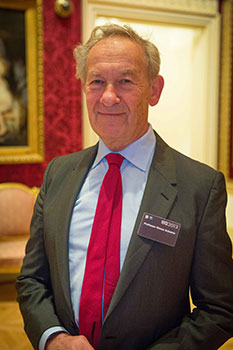
Simon Schama
(13 February 1945 – )
Sir Simon Schama is an English historian who focuses on art history and European history, particularly Dutch, French, British and Jewish history. Schama was born in London and studied at Cambridge under John Plumb. He has since taught at Cambridge, Oxford, Harvard and is presently at Columbia University in New York City. He was knighted in 2018.
He is perhaps best known for his Citizens: A Chronicle of the French Revolution (1989), written for the bicentenary of the beginning of the French Revolution. The work gives a narrative account of the revolution, placing individuals at the centre of the story. Schama has also focused on public history, most notably hosting a 15-part BBC series, A History of Britain from 2000 to 2002 and writing in the popular press.
https://www.theguardian.com/profile/simonschama
A list of articles written by Schama in the Guardian
https://www.c-span.org/person/?simonschama
A list of talks given by Schama on C-SPAN
http://www.columbia.edu/cu/arthistory/faculty/Schama.html
Schama’s faculty page at Columbia University
More info, including a list of selected works:
https://en.wikipedia.org/wiki/Simon_Schama
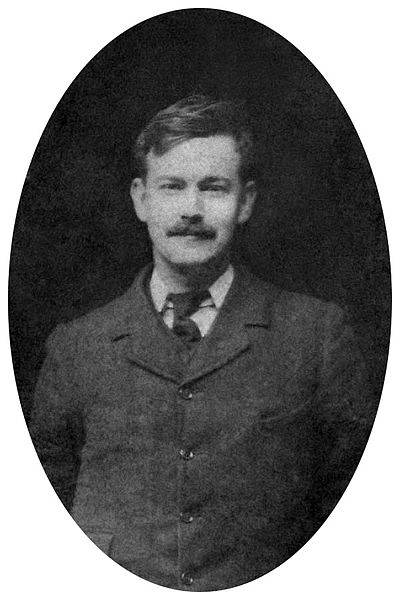
R .H. Tawney
(30 November 1880 – 16 January 1962)
Richard Henry Tawney was born in Kolkata (Calcutta), India, then still part of the British Empire. Tawney was educated at Rugby School and then Balliol College, Oxford University, where he studied modern history. Following his graduation in 1903, Tawney lived at Toynbee Hall, a centre for social outreach to the working classes and home to the Workers’ Educational Association. There he combined his strong Christian faith with a growing belief that simple philanthropy was inadequate and that deeper social change was required to assist the poor. As a Christian Socialist, Tawney was active in various left-wing political causes and ran three times (all unsuccessfully) for a seat in Parliament as a member of the Labour Party.
Tawney was a lecturer and later professor at the London School of Economics from 1917 until 1949, after which time he was a Professor Emeritus. His works reflected his interest in the rise of capitalism and his advocacy for social change. Religion and the Rise of Capitalism (1926), perhaps his most important work, decried how the growth of capitalism in the sixteenth and seventeenth centuries seemed to put the pursuit of material wealth ahead of Christian social morality. This concern is also reflected in other works, which critiqued the selfishness Tawney saw as inherent in capitalism and provided a framework for greater social equality.
Important works:
The Agrarian Problem in the Sixteenth Century (1912)
The Acquisitive Society (1920)
Secondary Education for All (1922)
Religion and the Rise of Capitalism (1926)
Equality (1931)
More info, including a list of selected works:
https://en.wikipedia.org/wiki/R._H._Tawney
E. P. Thompson
(3 February 1924 – 28 August 1993)
Edward Palmer Thompson was born in Oxford and, leaving school early in 1941, enlisted to fight in the Second World War, serving in the Italian campaign. After the war, Thompson went to study at Corpus Christi College, Cambridge, where – as a member of the Communist Party – he would help to form the Communist Party Historians Group, which included other important historians like Christopher Hill and Eric Hobsbawm. The group would launch the influential journal, Past and Present, in 1952. Like many other communists, Thompson broke with the party over the Soviet Union’s invasion of Hungary in 1956.
Thompson’s most important contribution, The Making of the English Working Class, was published in 1963. In this work, Thompson sought to uncover voices previously overlooked by historians. He examined the English working class from 1780 to 1832 and investigated their development of a class-consciousness. Far from a deterministic process, Thompson emphasised the agency of individuals in shaping this consciousness. Thompson taught at Warwick University until 1971, when he broke with the university for what he saw as the commercialisation of higher education. He worked mainly as a freelance writer from that time and was also at the forefront of the peace movement and the campaign for nuclear disarmament in Britain.
http://edwardanddorothythompson.com/index.html
A site providing resources on Edward Thompson and his wife and fellow historian, Dorothy Thompson
https://www.nytimes.com/1993/08/30/obituaries/e-p-thompson-69-british-leftist-scholar.html
Thompson’s obituary in the New York Times
More info, including a list of selected works:
https://en.wikipedia.org/wiki/E._P._Thompson
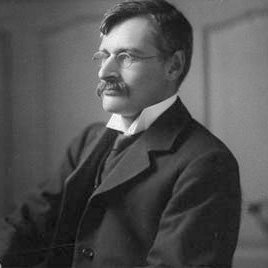
G. M. Trevelyan
(16 February 1876 – 21 July 1962)
George Macaulay Trevelyan was an English historian whose work examined modern British and European politics. Trevelyan came from a famous political lineage; among others, his great-uncle was Thomas Babington Macaulay, the nineteenth-century historian and Whig politician. Trevelyan studied at Cambridge and after graduating, he lectured there, before taking a hiatus of twenty years to focus on writing. He returned to Cambridge to become Regius Professor of Modern History and later Master of Trinity Hall. Trevelyan wrote from a self-admittedly liberal or Whig perspective. His crowning work was his three-volume biography (1907-1911) of the Italian nationalist Giuseppe Garibaldi, whom he portrayed as a hero in the mould of British liberalism. Trevelyan’s other works focused on modern British history.
https://www.britannica.com/biography/G-M-Trevelyan
Trevelyan’s entry in Britannica
https://www.historytoday.com/archive/george-macaulay-trevelyan-1876-1962
Trevelyan’s obituary in History Today
More info, including a list of selected works:
https://en.wikipedia.org/wiki/G._M._Trevelyan
[Image 4 here]
Hugh Trevor-Roper
(15 January 1914 – 26 January 2003)
Hugh Trevor-Roper, Baron Dacre of Glanton, was an English historian who studied early modern Britain and Nazi Germany. During his life, he was regarded as one of the leading historians of his generation and held the post of Regius Professor of Modern History at Oxford from 1957 to 1980
Following studies at Oxford, he was a research fellow there briefly before the start of the Second World War. During the war, he served with the Radio Security Service of the Secret Intelligence Service trying to intercept and decipher German code messages. In the last days of the war, he was tasked with investigating whether Hitler was still alive. The first-hand experience led him to write The Last Days of Hitler (1947).
After the war, he returned to Oxford and to early modern history, particularly the English Civil War. Other books and essays covered a diversity of subjects including the middle ages, the Renaissance, European painting, Nazi Germany, and eighteenth- and nineteenth-century historians. His reputation suffered in 1983 when diaries purportedly from Hitler – the so-called “Hitler Diaries” – appeared and Trevor-Roper prematurely deemed them authentic when they were in fact fraudulent.
http://news.bbc.co.uk/1/hi/uk/2696001.stm
Trevor-Roper’s obituary on the BBC website
http://www.theguardian.com/news/2003/jan/27/guardianobituaries.booksobituaries
Trevor-Roper’s obituary in The Guardian
More info, including a list of selected works:
https://en.wikipedia.org/wiki/Hugh_Trevor-Roper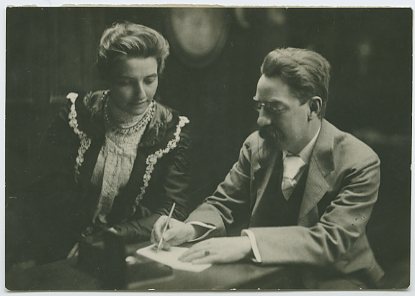
Sidney and Beatrice Webb
(13 July 1859 – 13 October 1947) (22 January 1858 – 30 April 1943)
Sidney and Beatrice Webb were socialists and historians of the labour movement in Britain, best known for their works, The History of Trade Unionism (1894) and Industrial Democracy (1897).
Beatrice was born into a wealthy family yet was interested in social questions from an early age. She desired to understand the structural nature of poverty from her own experiences working with the London poor. Sidney was born into a professional family in London and trained as a lawyer. The couple married in 1892 and would form a valuable partnership, with his writing complementing her research.
The Webbs were early members of the Fabian Society, a group which advocated for a gradual move to socialism. They also helped to found the London School of Economics in 1895 and the magazine the New Statesman in 1913. They were an important influence on the development of the Labour Party and Sidney was elected as a Labour MP in 1922. After he (and the Labour government) were defeated in 1931, the Webbs became interested in the Soviet Union and made a tour of the country. They painted a glowing portrait of the country, yet their trip was carefully managed by the Soviet government to prevent them from forming an accurate picture.
https://www.britannica.com/biography/Sidney-and-Beatrice-Webb
The Webbs’ entry in Britannica
http://webbs.library.lse.ac.uk/
The Webbs’ works at London School of Economics library
http://labourlist.org/2010/11/beatrice-webb-first-among-equals/
A profile of Beatrice Webb
More info, including lists of selected works:
https://en.wikipedia.org/wiki/Sidney_Webb,_1st_Baron_Passfield
https://en.wikipedia.org/wiki/Beatrice_Webb
[Image 12 here]
C. V. Wedgwood
(20 July 1910 – 9 March 1997)
Veronica Wedgwood was an English historian best known for her biographies and narrative histories about sixteenth- and seventeenth-century Europe. Born in Northumberland to an eminent family – her great-great-great grandfather was Josiah Wedgwood, the famed eighteenth-century potter and abolitionist – Wedgwood was educated privately and later earned her degree from Lady Margaret Hall, Oxford.
Her biographies, for example of Oliver Cromwell and Cardinal Richelieu, and histories of the Thirty Years War and the English Civil War attracted both academic acclaim as well as a popular readership. She published under the initials “C. V.” to disguise her gender, given the prejudice against women as historians during the first part of the twentieth century.
https://www.economist.com/obituary/1997/03/20/cv-wedgwood
Wedgwood’s obituary in The Economist
http://www.independent.co.uk/news/people/obituary-dame-veronica-wedgwood-1272253.html
Wedgwood’s obituary in The Independent
More info, including a list of selected works:
https://en.wikipedia.org/wiki/Veronica_Wedgwood
Theodore Zeldin
(22 August 1933 – )
Theodore Zeldin is an English historian and thinker. He holds degrees from Birkbeck, University of London, and Oxford University, where he has been a fellow at St Antony’s College since 1957. His unorthodox work has examined the history of emotions and everyday life, in particular in his 5-volume History of French Passions (1973-77) and An Intimate History of Humanity (1994). He also founded the Future of Work project and the Oxford Muse foundation.
http://www.oxfordmuse.com/?q=theodore-zeldin
A brief biography of Zeldin
A BBC interview with Zeldin
A review of Zeldin’s An Intimate History of Humanity
More info, including a list of selected works:
https://en.wikipedia.org/wiki/Theodore_Zeldin
Natalie Zemon Davis
(8 November 1928 – )
Natalie Zemon Davis was born in Detroit, Michigan. She studied at Harvard University and the University of Michigan, where she received her doctorate. In the 1950s, Davis and her husband both encountered difficulties because of their left-wing political activities, and had their passports confiscated for a time. Davis has taught at Brown University, University of California, Berkeley, Princeton University and currently is a professor at the University of Toronto. She was the second female president of the American Historical Association.
Davis incorporated the techniques of various disciplines, including anthropology and literary theory, into her works on social and cultural history, often using new ways to highlight marginalised voices. Her best-known work, The Return of Martin Guerre (1983), came from her experience working as a historical consultant on a French film of the same name in 1982. It examined a case of identity theft in a sixteenth-century French village as a window into wider conceptions of personal identity. For her innovative work, Davis has received numerous awards including the National Humanities Medal, awarded in 2012 by President Barack Obama, and she became a Companion of the Order of Canada in 2010.
Important Works:
Society and Culture in Early Modern France (1975)
The Return of Martin Guerre (1983)
Fiction in the Archives: Pardon Tales and their Tellers in Sixteenth-Century France (1987)
Women on the Margins: Three Seventh-Century Lives (1995)
Slaves on Screen: Film and Historical Vision (2002)
Trickster Travels: A Sixteenth-Century Muslim between Worlds (2006)
https://www.medievalists.net/2008/09/interview-with-natalie-zemon-davis/
An interview with Davis from 2008
More info, including a list of selected works:
https://en.wikipedia.org/wiki/Natalie_Zemon_Davis