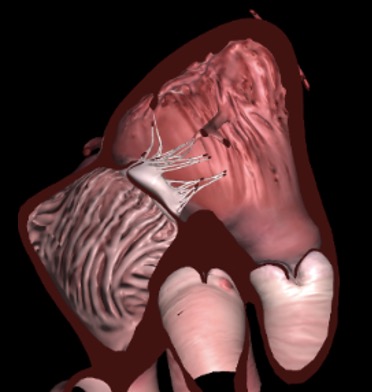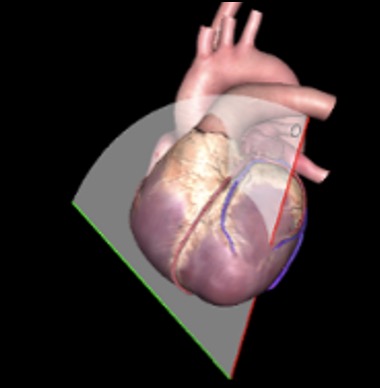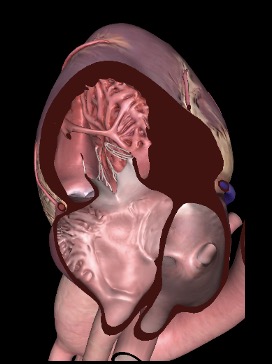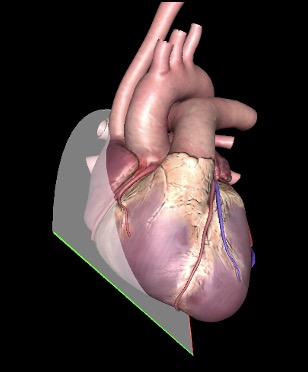
Chapter 18: Tricuspid Valve

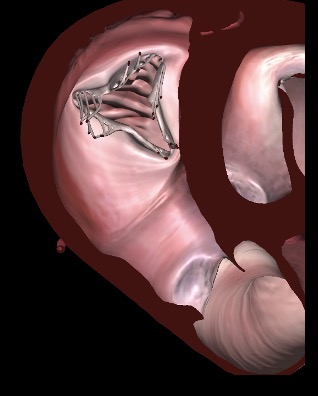
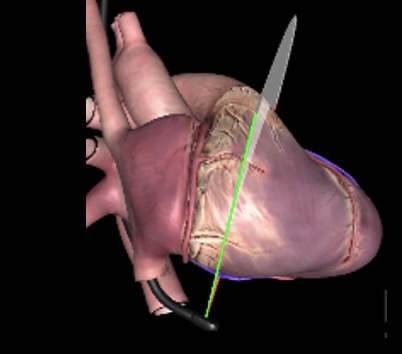
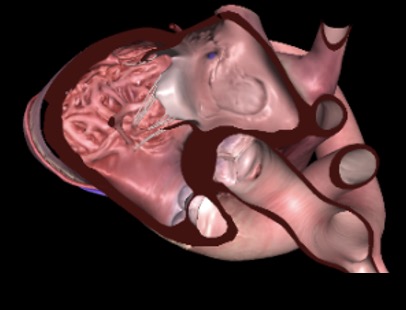
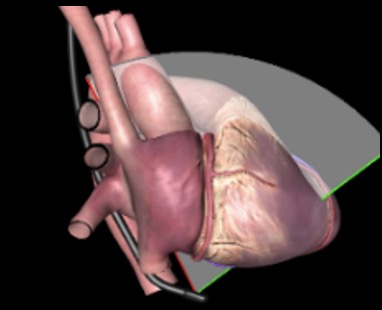
This chapter discusses the echocardiographic assessment of the tricuspid valve, with emphasis on new percutaneous techniques. Video walkthroughs of 2D and 3D imaging views will accompany this chapter.

1

Figures

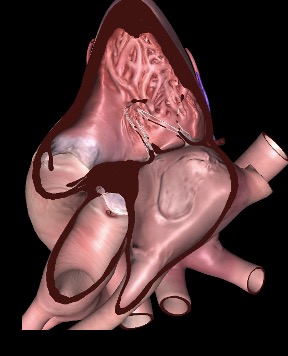
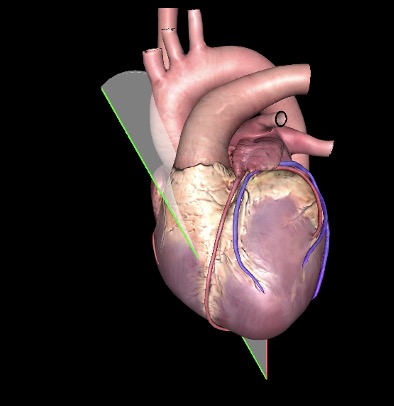
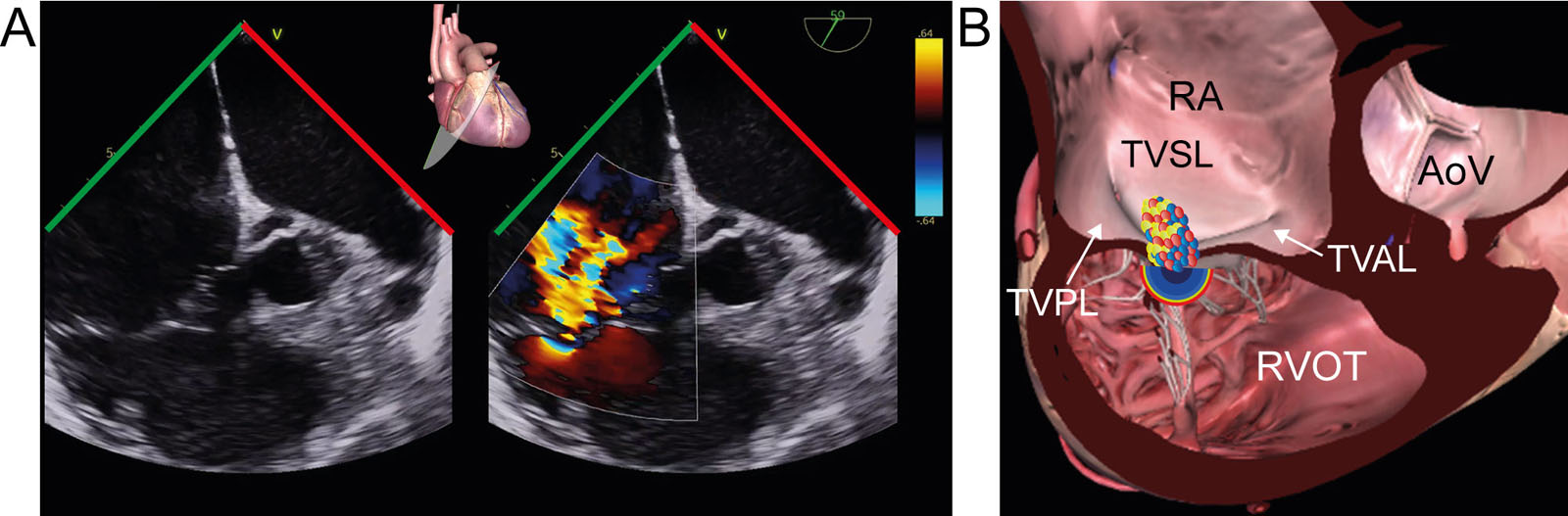
DE right ventricular inflow/outflow view of the TV. (A,B) This color compare DE view shows both the TVPL and TVAL with and without CFI. (C) This is a diagram of the TV from the RA perspective in the surgeon’s orientation, showing the plane.<em> Abbreviations</em>: AoV, aortic valve; CFI, color flow imaging; DE, deep esophageal; RA, right atrium; RVOT, right ventricular outflow tract; TV, tricuspid valve; TVAL, tricuspid valve anterior leaflet; TVPL, tricuspid valve posterior leaflet; TVSL, tricuspid valve septal leaflet.<i class='fa fa-video-camera' aria-hidden='true'></i>

eFigure 18.9

DE right ventricular inflow/outflow view of the TV. (A,B) This color compare DE view shows both the TVPL and TVAL with and without CFI. (C) This is a diagram of the TV from the RA perspective in the surgeon’s orientation, showing the plane. Abbreviations: AoV, aortic valve; CFI, color flow imaging; DE, deep esophageal; RA, right atrium; RVOT, right ventricular outflow tract; TV, tricuspid valve; TVAL, tricuspid valve anterior leaflet; TVPL, tricuspid valve posterior leaflet; TVSL, tricuspid valve septal leaflet.
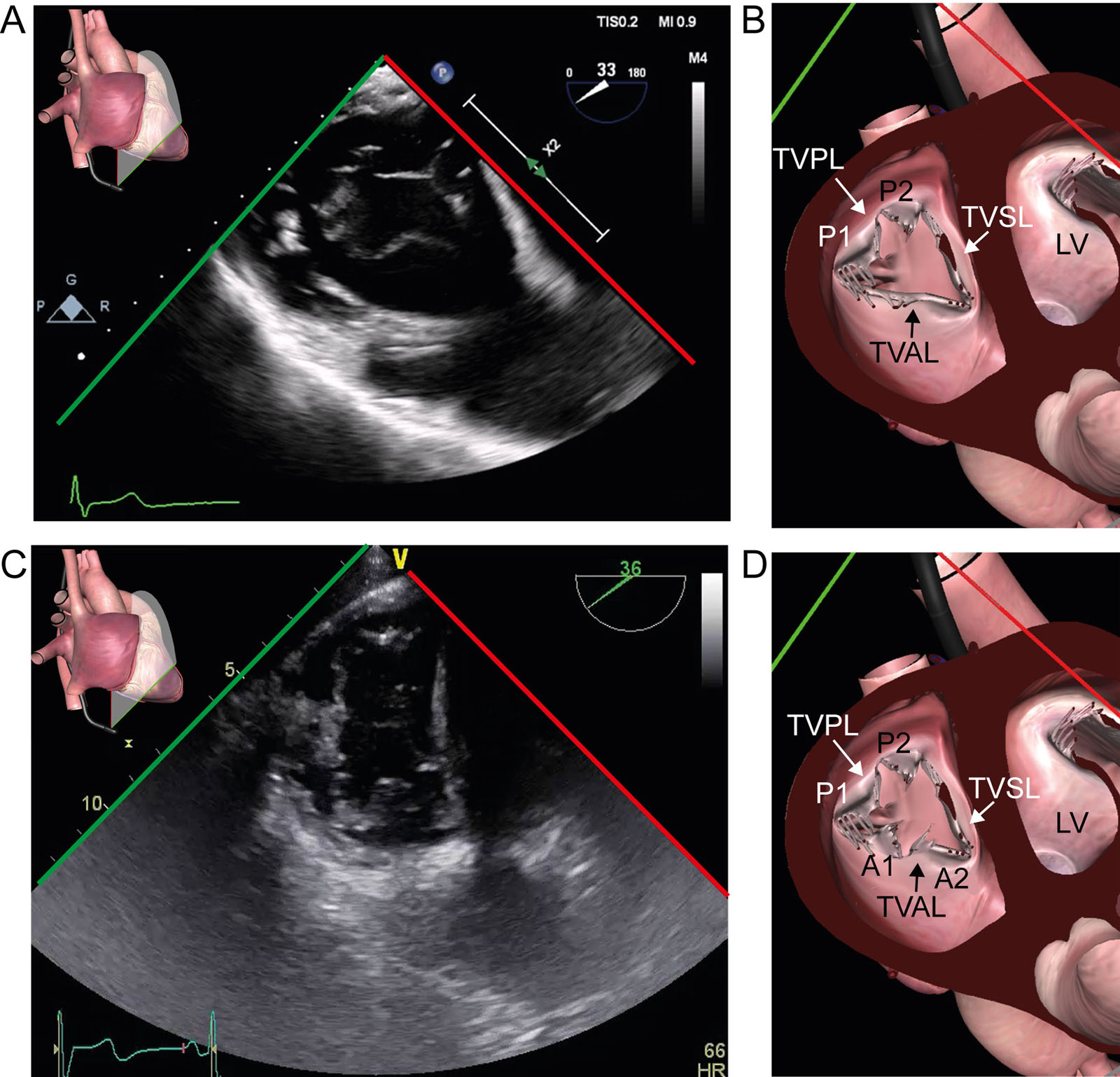
TV anatomic variants. (A-D) These TG basal views of the TV show (A, B) type IIIB with two posterior leaflets and (C, D) type IV with 2 anterior and 2 posterior leaflets.<em> Abbreviations</em>: A, anterior; LV, left ventricle; P, posterior; TG, transgastric; TV, tricuspid valve; TVAL, tricuspid valve anterior leaflet; TVPL, tricuspid valve posterior leaflet; TVSL, tricuspid valve septal leaflet. <i class='fa fa-video-camera' aria-hidden='true'></i>

eFigure 18.12

TV anatomic variants. (A-D) These TG basal views of the TV show (A, B) type IIIB with two posterior leaflets and (C, D) type IV with 2 anterior and 2 posterior leaflets. Abbreviations: A, anterior; LV, left ventricle; P, posterior; TG, transgastric; TV, tricuspid valve; TVAL, tricuspid valve anterior leaflet; TVPL, tricuspid valve posterior leaflet; TVSL, tricuspid valve septal leaflet.
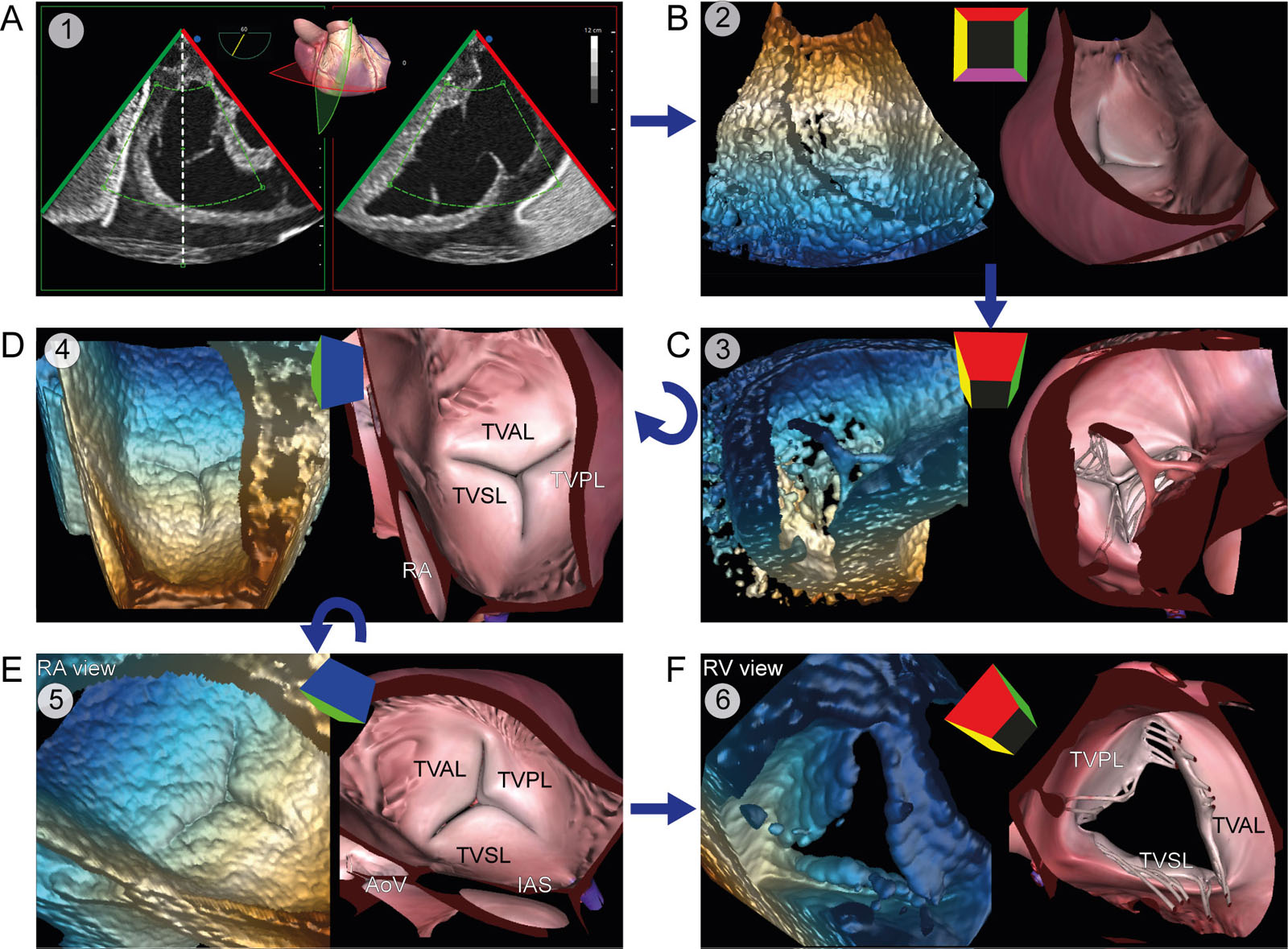
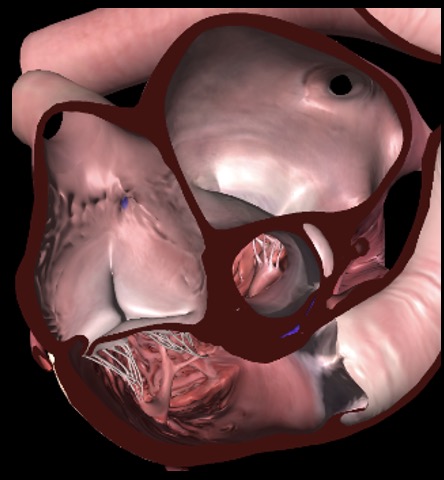
TV 3D zoom acquisition. (A) 3D zoom acquisition should include all three TV leaflets, the TA, and part of the AoV. (B) The acquired 3D frustrum undergoes (C) rotation to (D) display the TV from the RA perspective. (E) Rotation of the RA perspective displays the TV in the surgeon’s orientation. (F) A 180° rotation allows the visualization of an RV view of the TV.<em> Abbreviations</em>: 3D, three-dimensional, AoV, aortic valve; IAS, interatrial septum; RA, right atrium; RV, right ventricle; TA, tricuspid annulus; TV, tricuspid valve; TVAL. Tricuspid valve anterior leaflet; TVPL, tricuspid valve posterior leaflet; TVSL, tricuspid valve septal leaflet. <i class='fa fa-video-camera' aria-hidden='true'></i>

eFigure 18.17

TV 3D zoom acquisition. (A) 3D zoom acquisition should include all three TV leaflets, the TA, and part of the AoV. (B) The acquired 3D frustrum undergoes (C) rotation to (D) display the TV from the RA perspective. (E) Rotation of the RA perspective displays the TV in the surgeon’s orientation. (F) A 180° rotation allows the visualization of an RV view of the TV. Abbreviations: 3D, three-dimensional, AoV, aortic valve; IAS, interatrial septum; RA, right atrium; RV, right ventricle; TA, tricuspid annulus; TV, tricuspid valve; TVAL. Tricuspid valve anterior leaflet; TVPL, tricuspid valve posterior leaflet; TVSL, tricuspid valve septal leaflet.
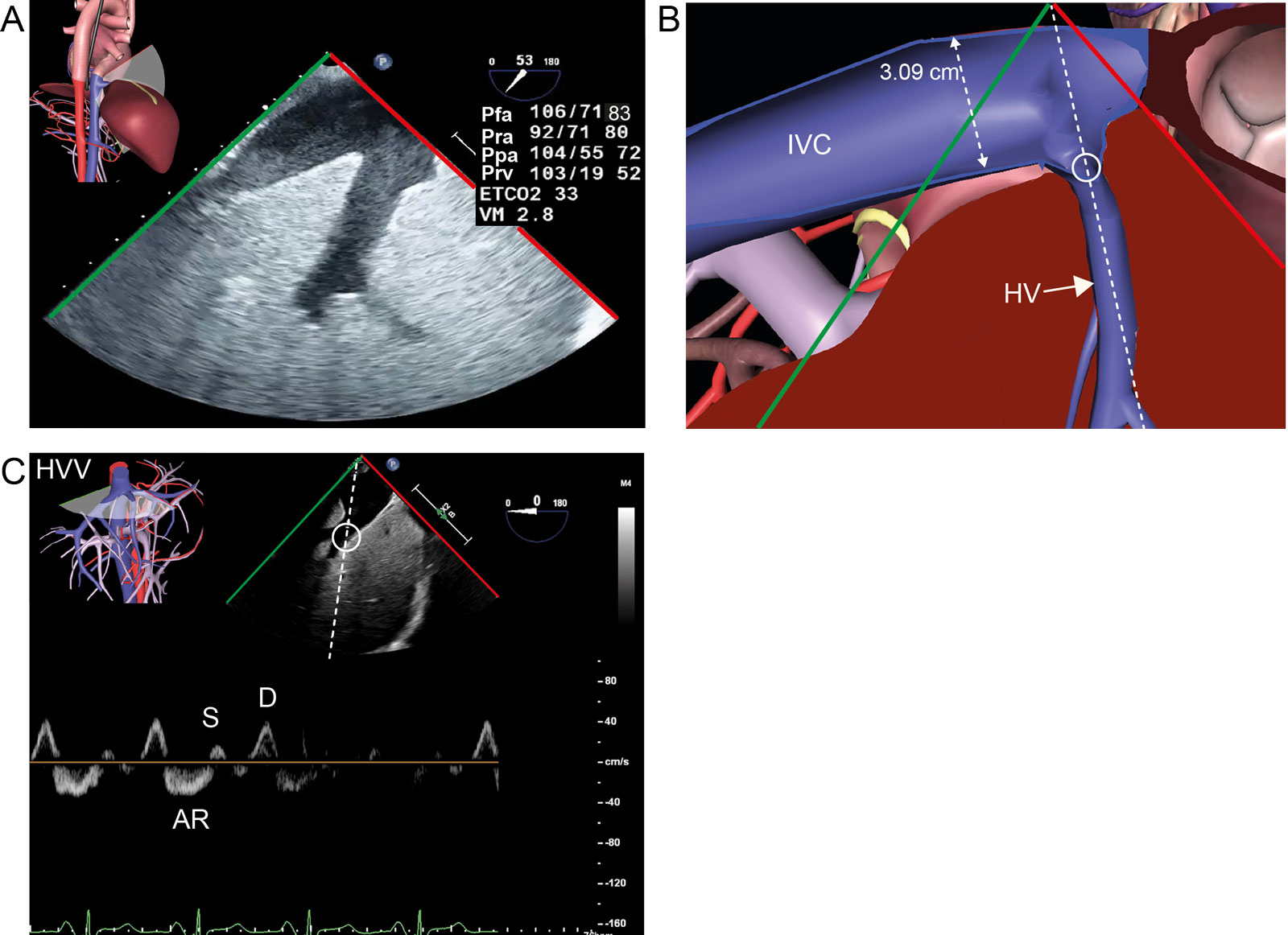
Quantification of TR severity. This is a 76-year-old patient with a history of severe MR. (A,B) TGAUS longitudinal IVC view shows a dilated IVC. (C) The HVV PWD interrogation has systolic blunting with a smaller S compared to D and pronounced AR. TR was moderate in this case.<em> Abbreviations</em>: AR, atrial reversal HVV; D, diastolic HVV; ETCO2, end-tidal CO2; HV, hepatic vein; HVV, hepatic vein velocity; IVC, inferior vena cava; MR, mitral regurgitation; MV, minute ventilation; Pfa, femoral arterial pressure; Ppa, pulmonary artery pressure; Pra, right atrial pressure; Prv, right ventricular pressure; PWD, pulsed-wave Doppler; S, systolic HVV; TGAUS, transgastric abdominal ultrasound; TR, tricuspid regurgitation. <i class='fa fa-video-camera' aria-hidden='true'></i>

eFigure 18.26

Quantification of TR severity. This is a 76-year-old patient with a history of severe MR. (A,B) TGAUS longitudinal IVC view shows a dilated IVC. (C) The HVV PWD interrogation has systolic blunting with a smaller S compared to D and pronounced AR. TR was moderate in this case. Abbreviations: AR, atrial reversal HVV; D, diastolic HVV; ETCO2, end-tidal CO2; HV, hepatic vein; HVV, hepatic vein velocity; IVC, inferior vena cava; MR, mitral regurgitation; MV, minute ventilation; Pfa, femoral arterial pressure; Ppa, pulmonary artery pressure; Pra, right atrial pressure; Prv, right ventricular pressure; PWD, pulsed-wave Doppler; S, systolic HVV; TGAUS, transgastric abdominal ultrasound; TR, tricuspid regurgitation.
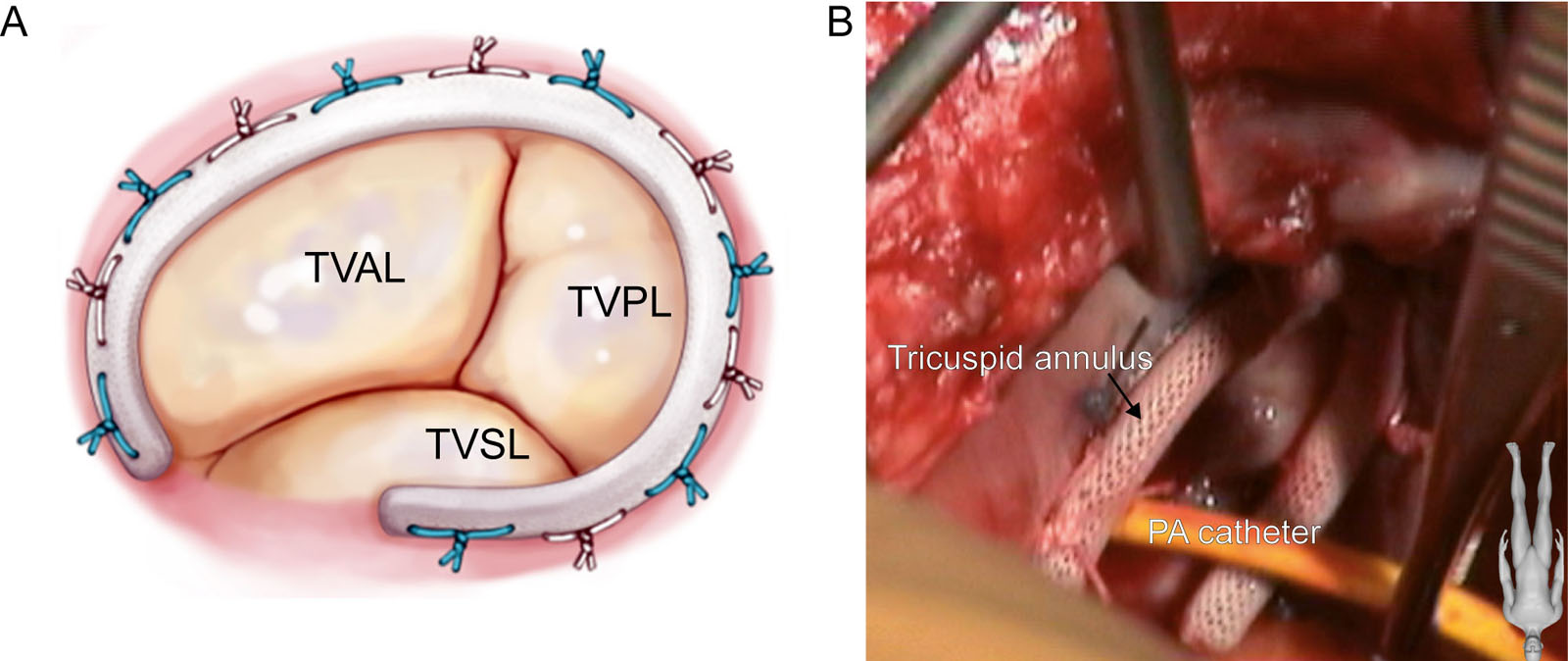
Annuloplasty ring. This is an Edwards® M3C tricuspid annuloplasty ring during implantation in (A) diagram of the TV and (B) an intraoperative photo from the RA.<em> Abbreviations</em>: PA, pulmonary artery; RA, right atrium; TV, tricuspid valve; TVAL, tricuspid valve anterior leaflet, TVPL, tricuspid valve posterior leaflet, TVSL, tricuspid valve septal leaflet. <i class='fa fa-video-camera' aria-hidden='true'></i>

eFigure 18.32

Annuloplasty ring. This is an Edwards® M3C tricuspid annuloplasty ring during implantation in (A) diagram of the TV and (B) an intraoperative photo from the RA. Abbreviations: PA, pulmonary artery; RA, right atrium; TV, tricuspid valve; TVAL, tricuspid valve anterior leaflet, TVPL, tricuspid valve posterior leaflet, TVSL, tricuspid valve septal leaflet.
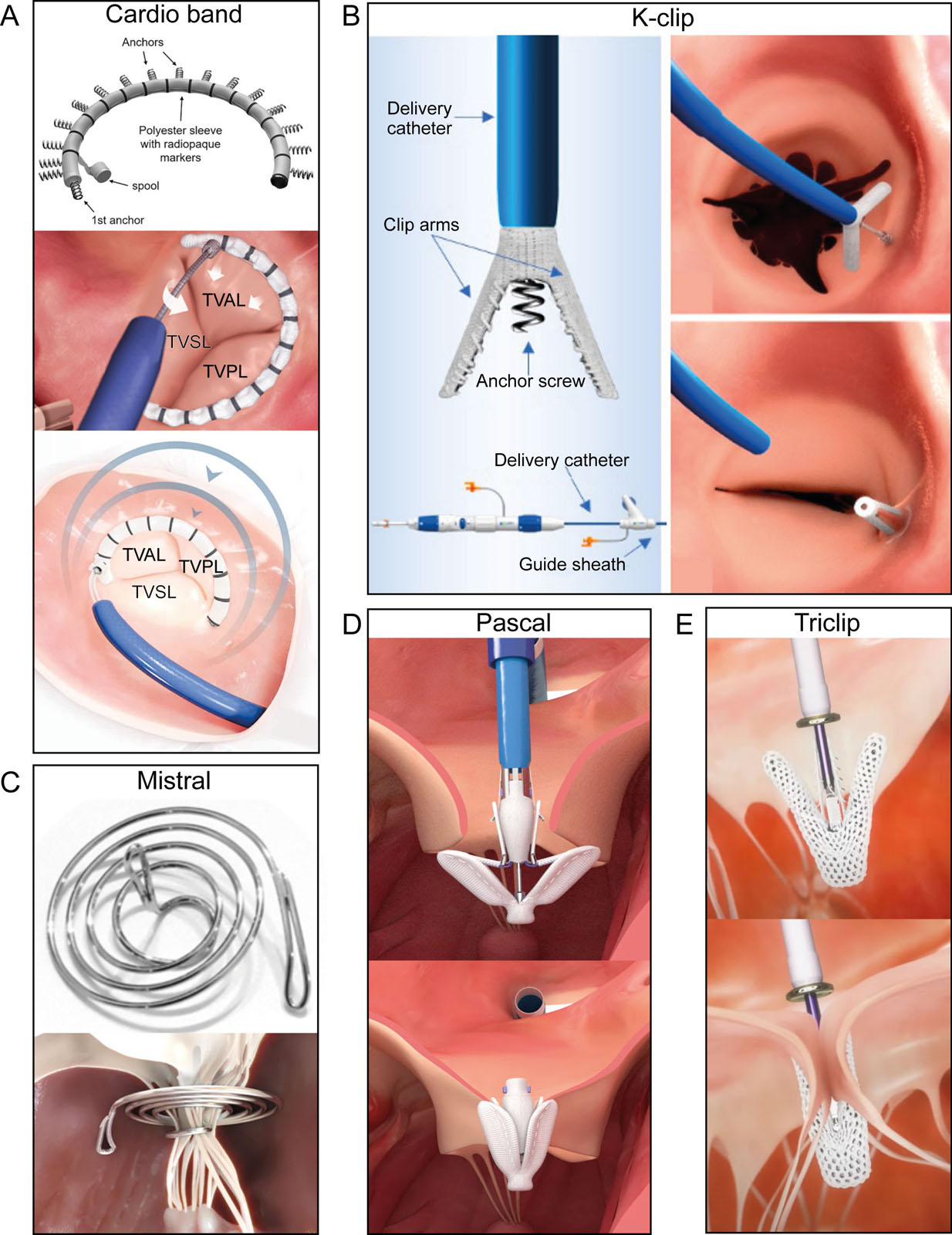
Transcatheter TV repair systems. These are examples of transcatheter TV repair systems, including annuloplasty devices such as the (A) Cardioband (Edwards Lifesciences, Irvine CA, USA) and (B) K-ClipTM (Huihe Co, China)<sup>82</sup>; subvalvular chordae tendinae approximation devices like the (C) Mistral (Mitralix, Israël) and clip devices (D) Pascal (Edwards Lifesciences, Irvine CA, USA)<sup>83</sup> and (E) Triclip (Abbott Vascular, Santa Clara, CA, USA).<em> Abbreviations</em>: TV,tricuspid valve; TVAL, tricuspid valve anterior leaflet; TVPL, tricuspid valve posterior leaflet; TVSL, tricuspid valve septal leaflet. <i class='fa fa-video-camera' aria-hidden='true'></i>

eFigure 18.36

Transcatheter TV repair systems. These are examples of transcatheter TV repair systems, including annuloplasty devices such as the (A) Cardioband (Edwards Lifesciences, Irvine CA, USA) and (B) K-ClipTM (Huihe Co, China)82; subvalvular chordae tendinae approximation devices like the (C) Mistral (Mitralix, Israël) and clip devices (D) Pascal (Edwards Lifesciences, Irvine CA, USA)83 and (E) Triclip (Abbott Vascular, Santa Clara, CA, USA). Abbreviations: TV,tricuspid valve; TVAL, tricuspid valve anterior leaflet; TVPL, tricuspid valve posterior leaflet; TVSL, tricuspid valve septal leaflet.
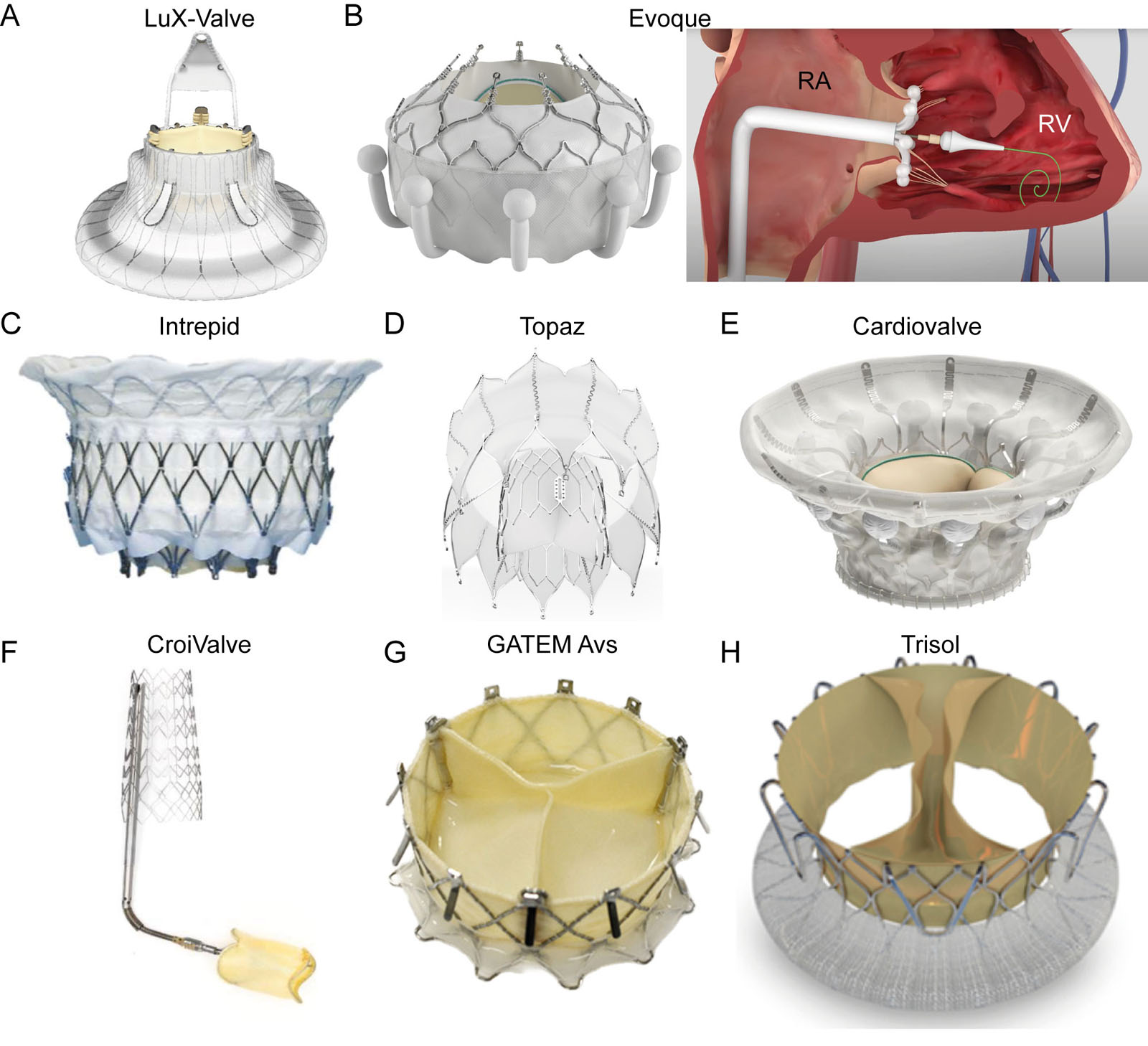
Transcatheter TV orthotopic bioprosthesis. These valves require transfemoral access for implantation, including the (A) LuX-Valve (Jenscare Scientific Co, Ningbo, PRC)<sup>84</sup>, (B) EVOQUE (Edwards Lifesciences, Irvine, CA, USA), (C) Intrepid (Medtronic, Minneapolis, MN USA), (D) Topaz (TRiCares GmbH, Munich, Germany) and (E) Cardiovalve (Venus Medtech, Hangzhou, PRC) These valves require transjugular access for implantation, including the (F) Duo tricuspid coaptation valve system (CroiValve, Dublin, Ireland)<sup>55</sup>, (G) GATETM Avs–atrioventricular valved stent (NaviGate Cardiac Structures Inc., Lake Forest, CA, USA) and the (H) Trisol (Trisol Medical, Yokneam, Israel).<em> Abbreviations</em>: RA, right atrium; RV, right ventricle; TV, tricuspid valve. <i class='fa fa-video-camera' aria-hidden='true'></i>

eFigure 18.37

Transcatheter TV orthotopic bioprosthesis. These valves require transfemoral access for implantation, including the (A) LuX-Valve (Jenscare Scientific Co, Ningbo, PRC)84, (B) EVOQUE (Edwards Lifesciences, Irvine, CA, USA), (C) Intrepid (Medtronic, Minneapolis, MN USA), (D) Topaz (TRiCares GmbH, Munich, Germany) and (E) Cardiovalve (Venus Medtech, Hangzhou, PRC) These valves require transjugular access for implantation, including the (F) Duo tricuspid coaptation valve system (CroiValve, Dublin, Ireland)55, (G) GATETM Avs–atrioventricular valved stent (NaviGate Cardiac Structures Inc., Lake Forest, CA, USA) and the (H) Trisol (Trisol Medical, Yokneam, Israel). Abbreviations: RA, right atrium; RV, right ventricle; TV, tricuspid valve.
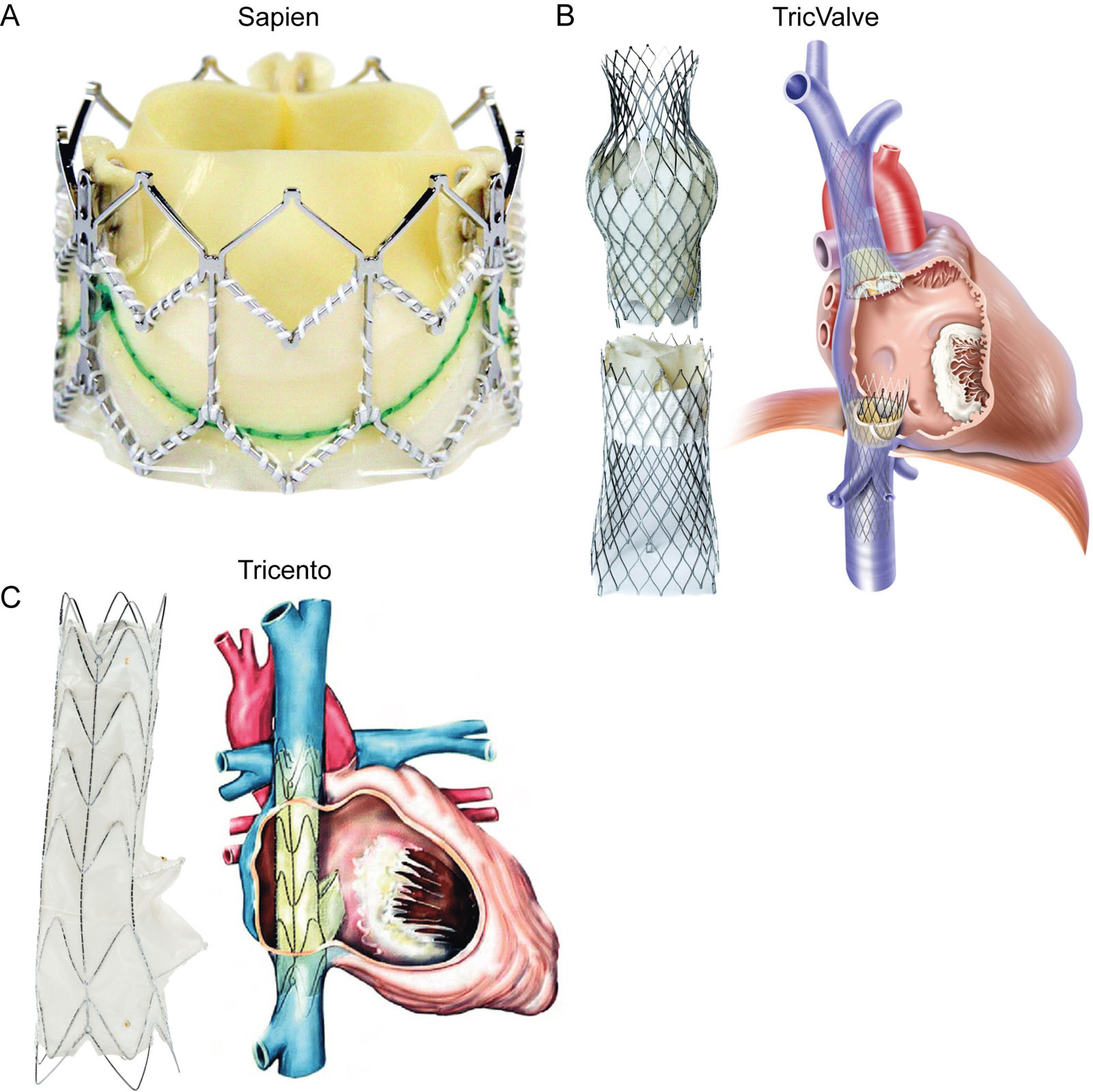
Transcatheter heterotopic bioprosthesis for TR. These are examples of bioprosthetic valves implanted into the IVC and SVC to treat severe TR, including the (A) Sapien XT–Sapien 3 IVC or bicaval IVC+SVC implants (Edwards Lifesciences, Irvine, CA USA). (B) TricValve<sup>R</sup> Transcatheter bicaval valves system (P+F Products + Features, Vienna, Austria. (C) Tricento (New Valve Technology NVT GmbH, Hechingen, Germany).<em> Abbreviations</em> : IVC, inferior vena cava; SVC, superior vena cava; TR, tricuspid regurgitation. <i class='fa fa-video-camera' aria-hidden='true'></i>

eFigure 18.38

Transcatheter heterotopic bioprosthesis for TR. These are examples of bioprosthetic valves implanted into the IVC and SVC to treat severe TR, including the (A) Sapien XT–Sapien 3 IVC or bicaval IVC+SVC implants (Edwards Lifesciences, Irvine, CA USA). (B) TricValveR Transcatheter bicaval valves system (P+F Products + Features, Vienna, Austria. (C) Tricento (New Valve Technology NVT GmbH, Hechingen, Germany). Abbreviations : IVC, inferior vena cava; SVC, superior vena cava; TR, tricuspid regurgitation.
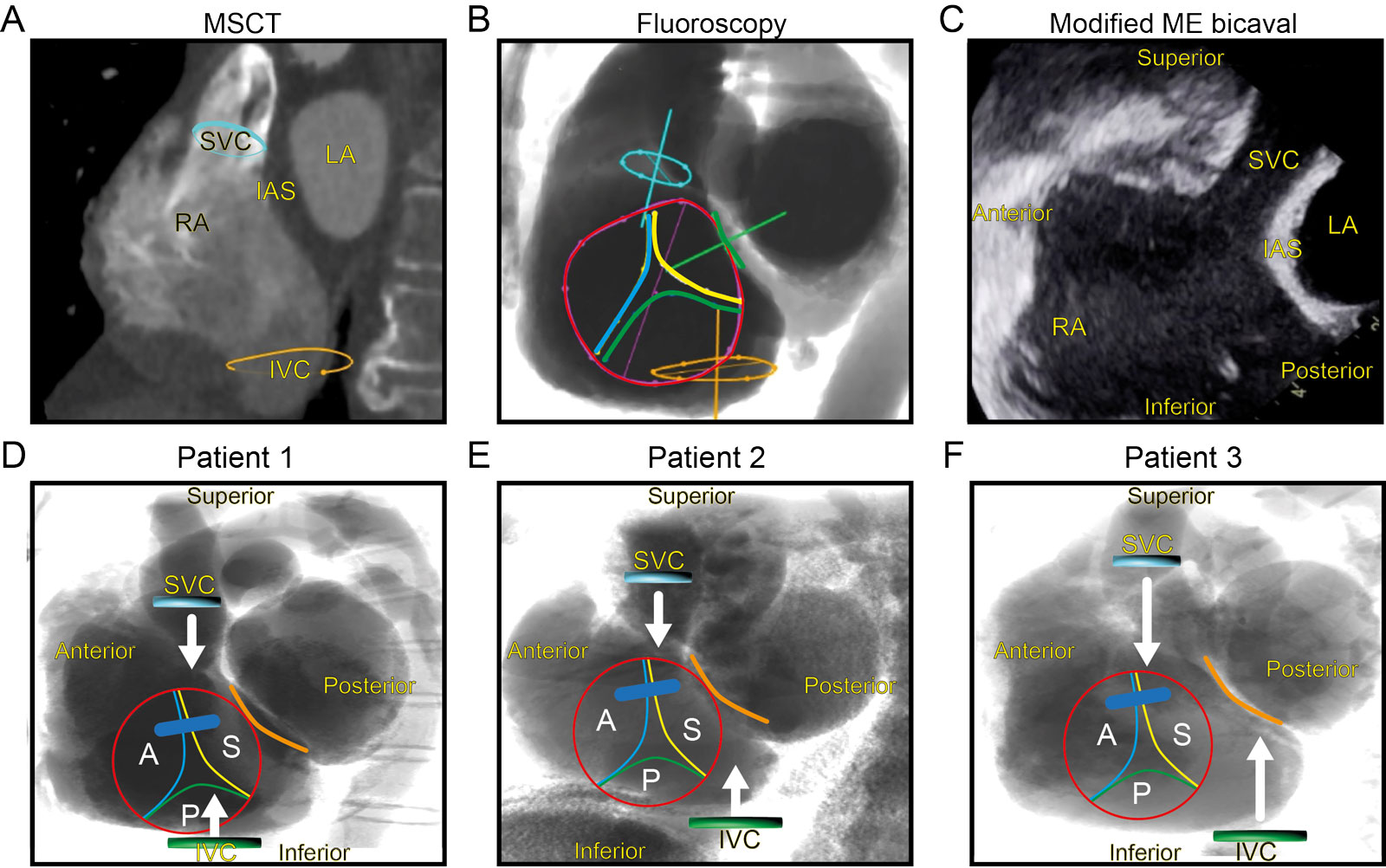
Preprocedural imaging for tricuspid intervention. This is the (A) preprocedural cardiac CTA and (B) corresponding fluoroscopic view with projection of the TV leaflets. (C) From the corresponding TEE bicaval view, the image display would need counterclockwise rotation and then left-right inversion to match the fluoroscopic view. (D) The lower row shows similar fluoroscopic LAO caudal one-chamber en-face views of the TV in three different patients, revealing a variable degree of TV position offset (red circle) from the SVC (blue) and the IVC (green) orifices. This explains how the alignment between the SVC, IVC and TV varies between patients. In patient #3, the catheter arriving from the IVC will encounter the septum.<em> Abbreviations</em>: A, anterior; CTA, computed tomography angiography; IAS, interatrial septum; IVC, inferior vena cava; LA, left atrium; LAO, left anterior oblique; ME, mid-esophageal; MSCT, multi-slice computed tomography; P, posterior; RA, right atrium; S, septal; SVC, superior vena cava; TEE, transesophageal echocardiography; TV, tricuspid valve.

eFigure 18.40

Preprocedural imaging for tricuspid intervention. This is the (A) preprocedural cardiac CTA and (B) corresponding fluoroscopic view with projection of the TV leaflets. (C) From the corresponding TEE bicaval view, the image display would need counterclockwise rotation and then left-right inversion to match the fluoroscopic view. (D) The lower row shows similar fluoroscopic LAO caudal one-chamber en-face views of the TV in three different patients, revealing a variable degree of TV position offset (red circle) from the SVC (blue) and the IVC (green) orifices. This explains how the alignment between the SVC, IVC and TV varies between patients. In patient #3, the catheter arriving from the IVC will encounter the septum. Abbreviations: A, anterior; CTA, computed tomography angiography; IAS, interatrial septum; IVC, inferior vena cava; LA, left atrium; LAO, left anterior oblique; ME, mid-esophageal; MSCT, multi-slice computed tomography; P, posterior; RA, right atrium; S, septal; SVC, superior vena cava; TEE, transesophageal echocardiography; TV, tricuspid valve.

2

Videos

Chapter 18 Fig01A

Chapter 18 Fig01B

Chapter 18 Fig05CD

Chapter 18 Fig06A

Chapter 18 Fig07A

Chapter 18 Fig08A

Chapter 18 Fig09A

Chapter 18 Fig10A

Chapter 18 Fig11A

Chapter 18 Fig11D

Chapter 18 Fig12A

Chapter 18 Fig12C

Chapter 18 Fig13A

Chapter 18 Fig13F

Chapter 18 Fig14A

Chapter 18 Fig15A

Chapter 18 Fig16A1

Chapter 18 Fig16A2

Chapter 18 Fig16A3

Chapter 18 Fig16B1

Chapter 18 Fig16B2

Chapter 18 Fig16B3

Chapter 18 Fig16C1

Chapter 18 Fig16C2

Chapter 18 Fig16D

Chapter 18 Fig16E1

Chapter 18 Fig16E2

Chapter 18 Fig16E3

Chapter 18 Fig17ABCDEF

Chapter 18 Fig18A

Chapter 18 Fig18C

Chapter 18 Fig19A

Chapter 18 Fig20AB

Chapter 18 Fig20C

Chapter 18 Fig21A

Chapter 18 Fig21B

Chapter 18 Fig22A

Chapter 18 Fig22C

Chapter 18 Fig22EF

Chapter 18 Fig23AD

Chapter 18 Fig24C

Chapter 18 Fig24DE

Chapter 18 Fig26A

Chapter 18 Fig27A

Chapter 18 Fig27B

Chapter 18 Fig27D

Chapter 18 Fig28A

Chapter 18 Fig32B

Chapter 18 Fig34A

Chapter 18 Fig34B

Chapter 18 Fig34E

Chapter 18 Fig35A

Chapter 18 Fig35B

Chapter 18 Fig35D

Chapter 18 Fig35E

Chapter 18 Fig36A

Chapter 18 Fig36C

Chapter 18 Fig36D

Chapter 18 Fig36E

Chapter 18 Fig37B

Chapter 18 Fig37D

Chapter 18 Fig37E

Chapter 18 Fig37F

Chapter 18 Fig37H

Chapter 18 Fig38B

Chapter 18 Fig39A

Chapter 18 Fig39C

Chapter 18 Fig39E

Chapter 18 Fig39FG

Chapter 18 Fig41A

Chapter 18 Fig41D

Chapter 18 Fig42A

Chapter 18 Fig42C

Chapter 18 Fig43A

Chapter 18 Fig44A

Chapter 18 Fig45A

Chapter 18 Fig46A

Chapter 18 Fig46D

3

Tables

eTable 18.1 TEE views for assessing the tricuspid valve

TEE View

Icon

View-Technique

Utility/disadvantages

ME 4C RV focus
Angle: 0-10°
(Figure 18.6)

  • Easily acquired view for leaflet assessment
  • CFI assessment of turbulence and regurgitation
  • TVAL and TVSL identified
  • Perpendicular alignment precludes PWD or CWD gradient interrogation
  • May require reflection to 165° to optimize RV view
  • TV annulus underestimated in this view. 69

ME RV Inflow-Outflow
Angle: 50-70°
(Figure 18.8)

  • TVPL and TVAL, but in some case the TVSL appears with medial scan rotation
  • TVAL is largest
  • Does not align the true LAX or SAX of the TV
  • Also called ME TV commissural view

ME Modified Bicaval TV
Angle: 90-120°
(Figure 18.10)

  • TVSL and TVAL
  • Best angle perspective for TV annular diameter

DE 2C TV
Angle: 0-10°
(Figure 18.7)

  • TVSL and TVPL

DE Coronary sinus LAX
Angle: 100-140°
(Figure 18.11)

  • TVSL and TVAL with left-sided rotation
  • TVPL and TVAL with right side rotation
  • Optimal alignment for TV annular diameter and CWD interrogation for TR jet
  • No IAS seen

DE RV inflow-outflow
Angle: 60-90°
(eFigure 18.9)

  • TVPL and TVAL
  • Allow alignment of Doppler beam with TR jet

TG RV basal
Angle: 0-20°
(eFigure 18.12)

  • Shows SAX of all 3 leaflets with central coaptation point and commissure between leaflets
  • 60±10° rotation shows the ovoid TV annulus, leaflets and commissure

TG RV inflow
Angle: 90-110°
(Figure 18.13)

  • TVAL and TVPL

TG RV Inflow outflow
Angle: 0-20°
(See Figure 4.20)

  • TVAL and TVPL

DTG RV inflow
Angle: 0-10°
(Figure 18.14)

  • TVPL and TVSL

DTG RV inflow-outflow
Angle: 90-110°
(Figure 18.15)

  • All 3 leaflets may appear
  • TVSL and TVAL with left-sided rotation
  • TVPL and TVAL with right side rotation
  • View possible only if the stomach lies left to heart axis

eTable 18.3 Grading TR severity

 TR severity classes
MildModerateSevereMassiveTorrential
Structural and qualitative parameters
RA, RV sizeaUsually normalNormal or mild dilatationUsually dilated
IVC size (cm)Normal (< 2)Normal or mildly dilated (2.1- 2.5)Dilated (> 2.5)
TV morphologyNormal or mild leaflet abnormalityModerate leaflet abnormalitySevere valve lesions/flail/large coaptation defect//severe tenting
CFI TR jet areabSmall, narrow, centralModerate, centralLarge central jet or eccentric wall impinging jet of variable size (> 10 cm²)
CFI convergence zoneNot visible, transient or smallIntermediate in size and durationLarge throughout systole
CWD signal of TR jetFaint/partial/parabolicDense, parabolic, or triangularDense/often triangular with early peaking (peak <2 m/s in massive TR)
Semi-quantitative parameters
PWD HVVcSystolic dominanceSystolic bluntingSystolic flow reversal
PWD TTVcA-wave dominantbVariableE-wave dominant (Peak E ≥ 1 m/s)
PISA radius (mm²)d≤56-9>9
VC width (mm)e< 33-6.97-1314-20≥21
VC area 3D(mm²)fNot defined50-7475-9495-114≥115
Quantitative Parameters i,jk
EROATR (mm²)< 2020 – 3940-5960-79≥80
RVol (ml)< 3030 - 4445-5960-74≥75
RF (%)g< 25 (30)25-44 (30-49)≥ 45 (50)
Other modalities
CMR RF (%)g≤ 25 (30)25-44 (30-49)≥ 45 (50)
In the absence of other causes of elevated RA pressure. Unless for other reasons, the RA and RV size and IVC are usually normal in patients with mild TR. An end-systolic RV eccentricity index >2 is in favour of severe TR. In acute severe TR, the RV size is often normal. In chronic severe TR, the RV is classically dilated. Accepted cut-off values for non-significant right-sided chambers enlargement (measurements obtained from the ME 4C): mild RV dimension ≤ 33 mm, RVEDA ≤ 28 cm², RVESA ≤ 16 cm², RVFAC >32%, maximal 2D RA volume ≤ 33 mL/m². b At a Nyquist limit of 50 to 70 cm/s. Cut-off area not defined for mild and moderate. c Signs are nonspecific and influenced by many other factors (RV diastolic function, atrial fibrillation, elevated RA pressure). d With baseline Nyquist limit shift of 25-30 cm/sec. e At a Nyquist limit of 50–60 cm/s. When VC width is assessed as an average of measurements performed biplane the threshold value for severe TR is > 9 mm. f Measured with PISA or quantitative Doppler g 3D Echo cutoffs from Muraru et al.72 and MRI cutoffs from Zhan et al.73
Abbreviations: 2D, two-dimensional; 3D, three-dimensional; 4C, four-chamber; A, atrial late filling TTV; CFI, color flow imaging; CMR, cardiac magnetic resonance; CWD, continuous wave Doppler; E, early filling TTV; EROATR, TR effective regurgitant orifice area; HVV, hepatic venous velocity; IVC, inferior vena cava; ME, mid-esophageal; PISA, proximal isovelocity surface area; PWD, pulsed wave Doppler; RA, right atrium; RF, regurgitant fraction; RV, right ventricle; RVEDA, right ventricular end-diastolic area; RVESA, right ventricular end-systolic area; RVFAC, right ventricular fractional area change; RVol, regurgitant volume; TR, tricuspid regurgitation; TTV, transtricuspid velocity; TV, tricuspid valve; VC, vena contracta. Adapted from Zoghbi70, Lancelotti71 Hahn et al.21 and Vahanian et al.14