Chapter 20: TEE for Minimally Invasive Cardiac Surgery

TEE's role in robotic and minimally invasive surgery is reviewed. Emphasis is placed on probe positioning and visualization through limited access. Instructional videos will showcase real surgical applications.

1

Figures

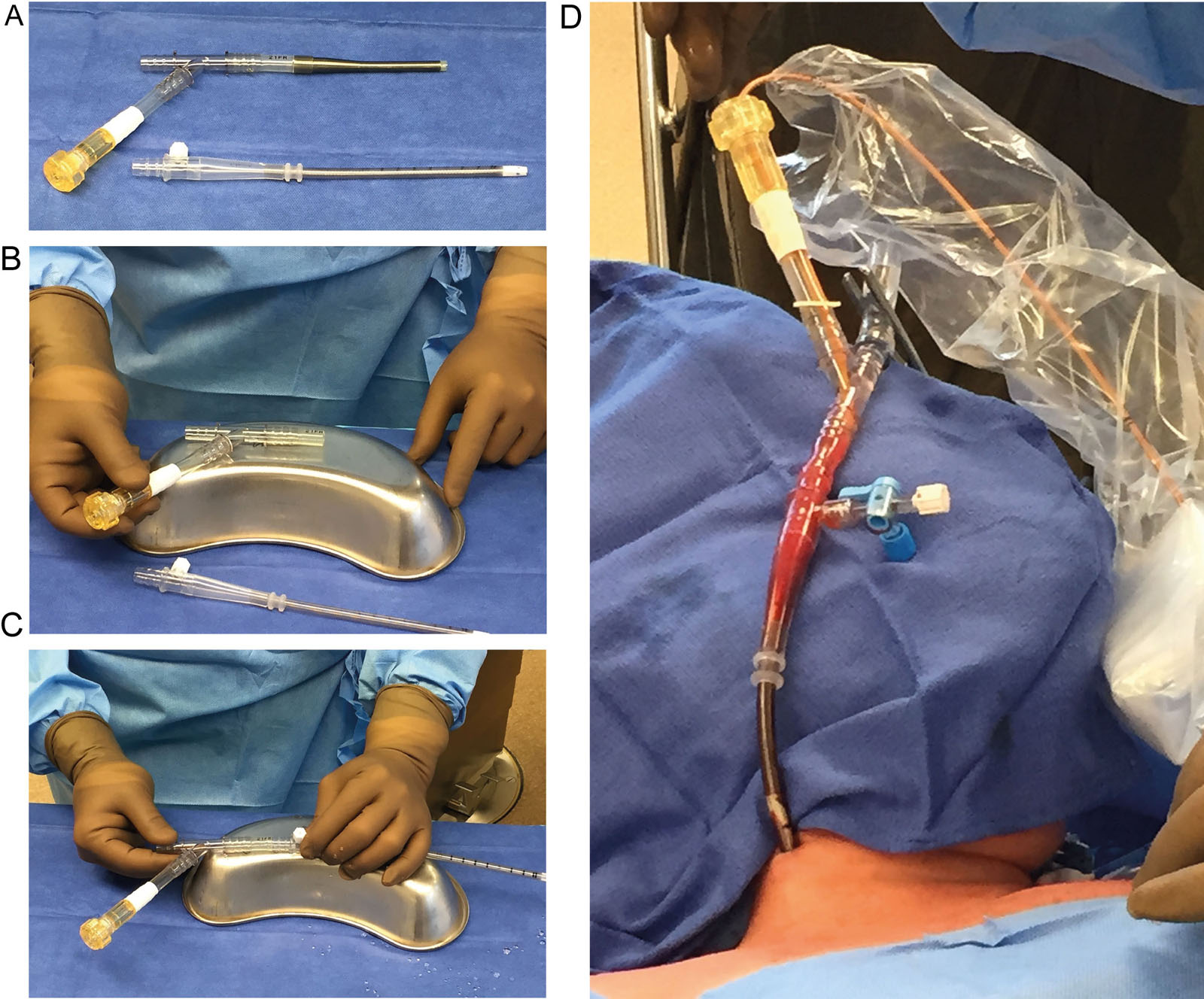
Endovascular vena cavae occlusion technique. (A) Arterial Y-shaped cannula and arterial cannula used as a venous cannula. (B) The anesthesiologist cuts the arterial cannula portion and keeps the EndoReturn hemostasis valve portion. (C) The modified venous cannula for right internal jugular vein cannulation with the EndoReturn hemostatic valve portion connected to the arterial cannula. (D) CODA balloon catheter introduced into the modified venous cannula. The CODA catheter inserts into a sterile sheath. Adapted from Yamani et al.<sup>52</sup>

eFigure 20.19

Endovascular vena cavae occlusion technique. (A) Arterial Y-shaped cannula and arterial cannula used as a venous cannula. (B) The anesthesiologist cuts the arterial cannula portion and keeps the EndoReturn hemostasis valve portion. (C) The modified venous cannula for right internal jugular vein cannulation with the EndoReturn hemostatic valve portion connected to the arterial cannula. (D) CODA balloon catheter introduced into the modified venous cannula. The CODA catheter inserts into a sterile sheath. Adapted from Yamani et al.52
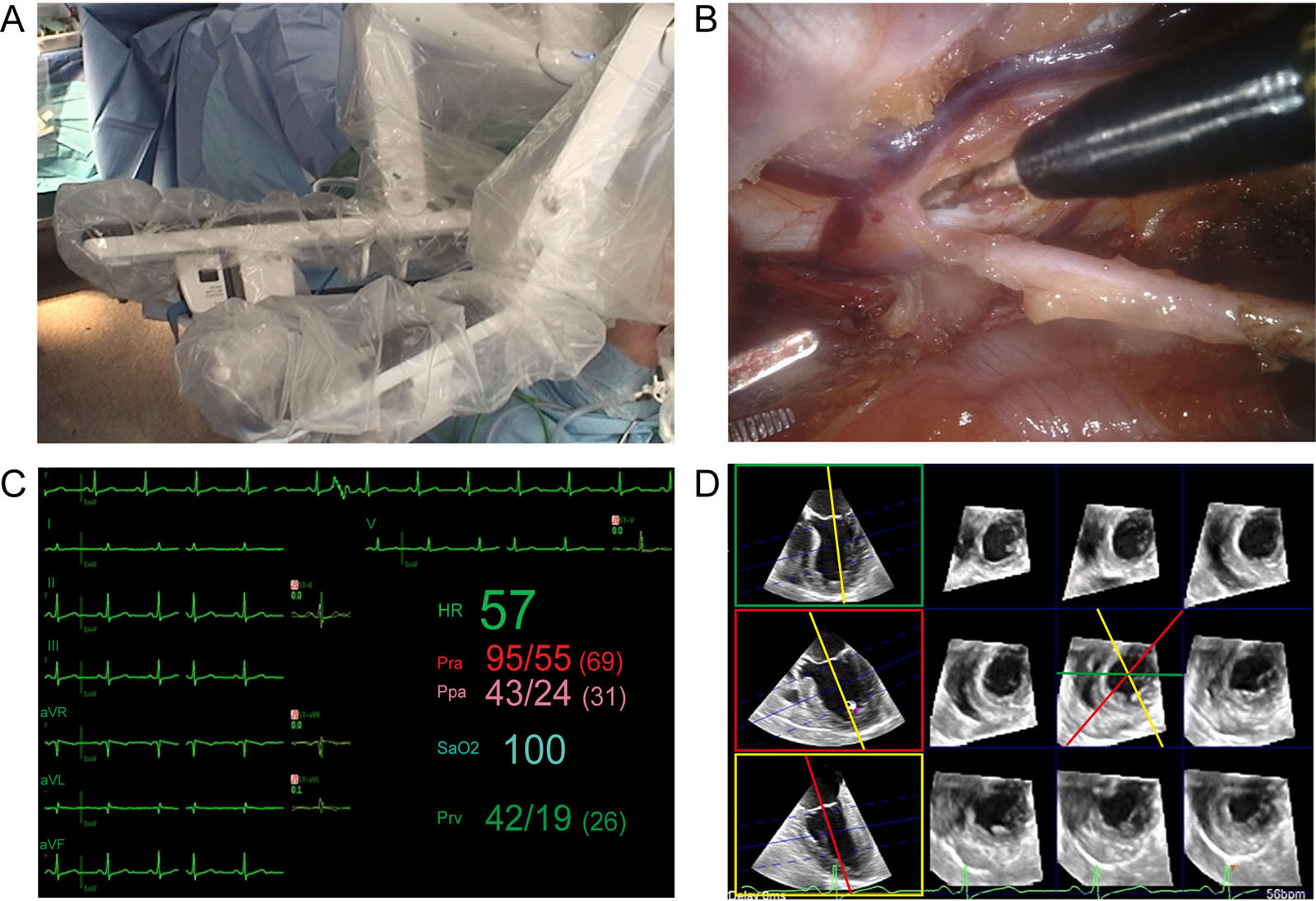
Robotic surgery monitoring. (A,B) External and internal view of the robotic system used to perform coronary revascularization. Lung isolation allows LIMA dissection. (C,D) Electrocardiographic (7 lead) and 3D multi-slice reconstruction monitoring of myocardial ischemia.<em> Abbreviations</em>: 3D, three-dimensional; HR, heart rate; LIMA, left internal mammary artery; Ppa, pulmonary artery pressure; Pra, radial arterial pressure; Prv, right ventricular pressure, SaO2, oxygen saturation. <i class='fa fa-video-camera' aria-hidden='true'></i>

eFigure 20.21

Robotic surgery monitoring. (A,B) External and internal view of the robotic system used to perform coronary revascularization. Lung isolation allows LIMA dissection. (C,D) Electrocardiographic (7 lead) and 3D multi-slice reconstruction monitoring of myocardial ischemia. Abbreviations: 3D, three-dimensional; HR, heart rate; LIMA, left internal mammary artery; Ppa, pulmonary artery pressure; Pra, radial arterial pressure; Prv, right ventricular pressure, SaO2, oxygen saturation.
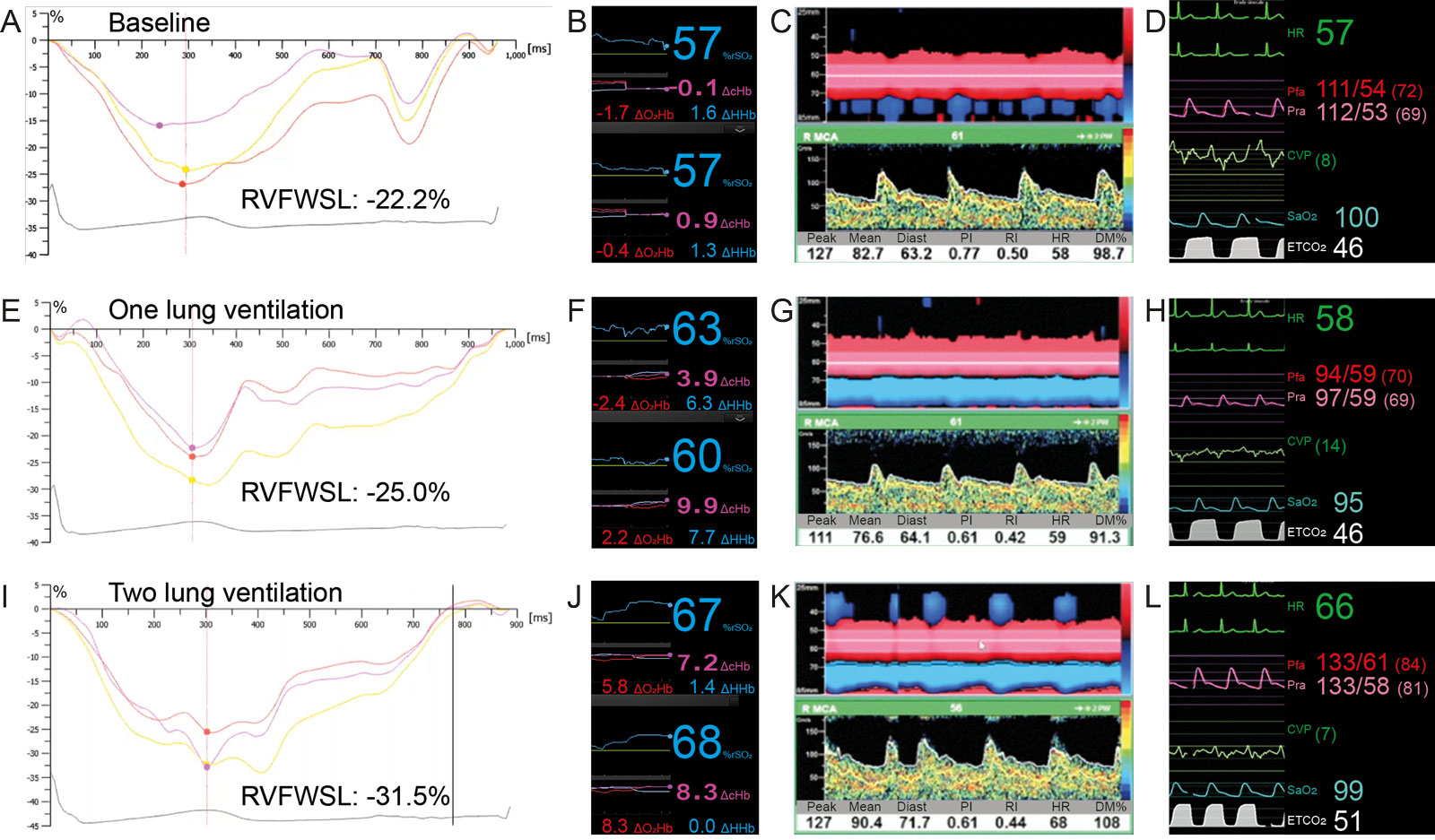
RV strain and Anrep effect. A 68-year-old man is undergoing robotic revascularization with single lung ventilation. Compare the RVFWSL, second generation cerebral rSO<sub>2,</sub> TCD on the RMCA, and hemodynamic parameters at (A-D) baseline, (E-H) during one lung ventilation and (I-L) back on two lung ventilation. There is an increase in RVFWSL during one lung ventilation associated with a parallel increase in rSO<sub>2</sub>, ETCO<sub>2</sub> and CVP, but transient reduction in TCD and both Pfa and Pra. The combination of a rise in carbon dioxide and an Anrep effect can explain the increase in strain and in rSO<sub>2</sub> values.<em> Abbreviations</em>: DcHbi, change in total hemoglobin index; DHhbi, change in deoxygenated hemoglobin index; DO<sub>2</sub>Hbi, change in oxygenated hemoglobin index; CVP, central venous pressure; Diast, diastolic; DM%, delta mean or % compared to baseline mean velocity; ETCO<sub>2</sub>, end-tidal carbon dioxide; HR, heart rate; Pfa, femoral arterial pressure;PI, pulsatility index; Pra, radial arterial pressure; RI, resistance index; RMCA, right middle cerebral artery; rSO<sub>2</sub>, regional oxygen saturation; RV, right ventricle; RVFWSL, right ventricular free wall strain longitudinal; SaO2, oxygen saturation; TCD, transcranial Doppler.

eFigure 20.24

RV strain and Anrep effect. A 68-year-old man is undergoing robotic revascularization with single lung ventilation. Compare the RVFWSL, second generation cerebral rSO2, TCD on the RMCA, and hemodynamic parameters at (A-D) baseline, (E-H) during one lung ventilation and (I-L) back on two lung ventilation. There is an increase in RVFWSL during one lung ventilation associated with a parallel increase in rSO2, ETCO2 and CVP, but transient reduction in TCD and both Pfa and Pra. The combination of a rise in carbon dioxide and an Anrep effect can explain the increase in strain and in rSO2 values. Abbreviations: DcHbi, change in total hemoglobin index; DHhbi, change in deoxygenated hemoglobin index; DO2Hbi, change in oxygenated hemoglobin index; CVP, central venous pressure; Diast, diastolic; DM%, delta mean or % compared to baseline mean velocity; ETCO2, end-tidal carbon dioxide; HR, heart rate; Pfa, femoral arterial pressure;PI, pulsatility index; Pra, radial arterial pressure; RI, resistance index; RMCA, right middle cerebral artery; rSO2, regional oxygen saturation; RV, right ventricle; RVFWSL, right ventricular free wall strain longitudinal; SaO2, oxygen saturation; TCD, transcranial Doppler.

2

Videos

Chapter 20 Fig04A

Chapter 20 Fig05A

Chapter 20 Fig07B

Chapter 20 Fig07F

Chapter 20 Fig08D

Chapter 20 Fig09A

Chapter 20 Fig09B

Chapter 20 Fig10A

Chapter 20 Fig11C

Chapter 20 Fig12A

Chapter 20 Fig12B

Chapter 20 Fig12E

Chapter 20 Fig13A

Chapter 20 Fig13C

Chapter 20 Fig14AC

Chapter 20 Fig14E

Chapter 20 Fig14G

Chapter 20 Fig16A

Chapter 20 Fig16D

Chapter 20 Fig16E

Chapter 20 Fig20D

Chapter 20 Fig20H

Chapter 20 Fig21ABCD

Chapter 20 Fig21D

Chapter 20 Fig22A

Chapter 20 Fig22E

Chapter 20 Fig22F

Chapter 20 Fig23AB

Chapter 20 Fig25AB

Chapter 20 Fig25CD

3

Tables

There is no tables for this chapter.