Chapter 34: Indications, Training, and Simulation

Training pathways, simulation tools, and competency guidelines are reviewed. Screenshots and simulator videos will support TEE education frameworks.

1

Figures

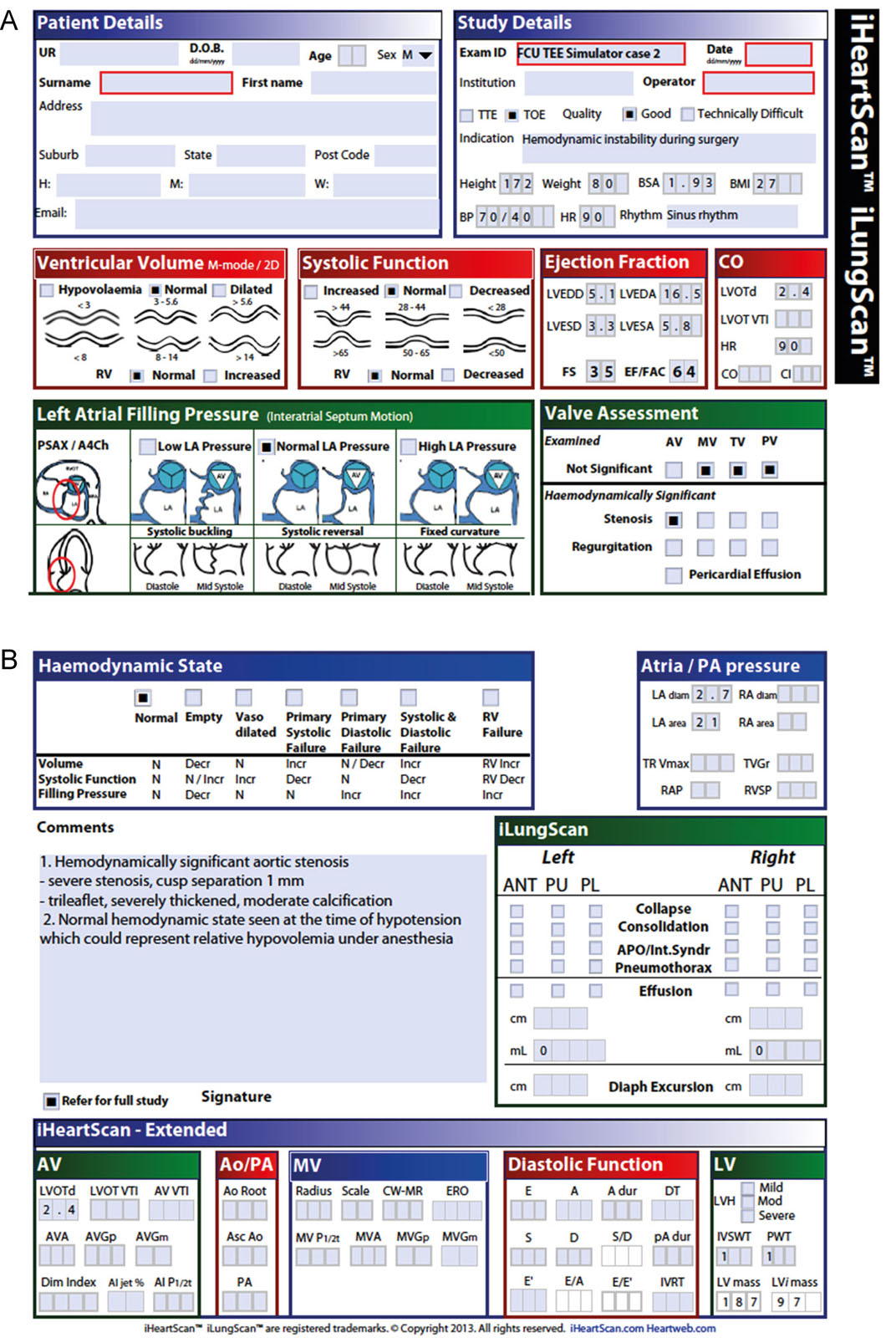
iTeachU Focused Cardiac Ultrasound TEE and TTE course. (A,B) Format of the interpretive report which includes the patients and study details, assessment of ventricular function, filling pressure, valves, hemodynamic state, lung scanning and extended iHeartScan. Courtesy of iEachU David Canty, Melbourne University, Australia.

eFigure 34.12

iTeachU Focused Cardiac Ultrasound TEE and TTE course. (A,B) Format of the interpretive report which includes the patients and study details, assessment of ventricular function, filling pressure, valves, hemodynamic state, lung scanning and extended iHeartScan. Courtesy of iEachU David Canty, Melbourne University, Australia.

2

Videos

Chapter 34 Fig03B

Chapter 34 Fig03E

Chapter 34 Fig03F

Chapter 34 Fig04A

Chapter 34 Fig06

Chapter 34 Fig07A

Chapter 34 Fig07C

Chapter 34 Fig07D

Chapter 34 Fig08CD

Chapter 34 Fig10A

Chapter 34 Fig10B

Chapter 34 Fig11

Chapter 34 Fig13

Chapter 34 Fig14

Chapter 34 Fig15A

Chapter 34 Fig15B

3

Tables

eTable 34.1 ASA and SCVA 2010 recommendations for using perioperative TEE

Cardiac and Thoracic Aortic Procedures

  • Cardiac and thoracic aortic surgery
  • For adult patients without contraindications, TEE should be used in all open heart (e.g., valvular procedures) and thoracic aortic surgical procedures and consider in CABG surgeries as well to
    • confirm and refine the preoperative diagnosis
    • detect new or unsuspected pathology
    • adjust the anesthetic and surgical plan accordingly
    • assess the results of the surgical intervention
  • In small children, the use of TEE should be considered on a case-by-case basis because of risks unique to these patients (e.g., bronchial obstruction)
  • Catheter-based intracardiac procedures
  • For patients undergoing transcatheter intracardiac procedures, TEE may be used

Noncardiac Surgery

  • TEE may be used when the nature of the planned surgery or the patient’s known or suspected cardiovascular pathology might result in severe hemodynamic, pulmonary, or neurologic compromise.
  • If equipment and expertise are available, TEE should be used when unexplained life-threatening circulatory instability persists despite corrective therapy.

Critical Care

  • For critical care patients, TEE should be used when diagnostic information that is expected to alter management cannot be obtained by transthoracic echocardiography or other modalities promptly.

Abbreviations: ASA, American Society of Echocardiography; CABG, coronary artery bypass graft; SCVA, Society of Cardiovascular Anesthesia; TEE, transesophageal echocardiography. Adapted from 7

eTable 34.3 Recommended training objectives for basic and advanced perioperative TEE

Basic Training

Cognitive Skills (Knowledge of)

  1. Physical principles of echocardiographic image formation and blood velocity measurement
  2. Operation of ultrasonography, including all controls that affect quality of data displayed
  3. Equipment handling, infection control, and electrical safety associated with the techniques of perioperative echocardiography
  4. Indications, contraindications, potential complications of perioperative echocardiography
  5. Appropriate alternative diagnostic techniques
  6. Normal tomographic anatomy as revealed by perioperative echocardiographic techniques
  7. Common blood flow velocity profiles as measured by Doppler echocardiography
  8. Echocardiographic manifestations of native valvular lesions and dysfunction
  9. Echocardiographic manifestations of cardiac masses, thrombi, cardiomyopathies, pericardial effusions, and lesions of the great vessels
  10. Echocardiographic presentations of myocardial ischemia and infarction
  11. Echocardiographic presentations of normal and abnormal ventricular function
  12. Echocardiographic presentations of air embolization

Technical Skills (Ability to)

  1. Operate ultrasonography, including the primary controls affecting quality of displayed data
  2. Insert a TEE probe safely in the anesthetized, mechanically ventilated patient
  3. Perform a comprehensive TEE examination and differentiate normal from markedly abnormal cardiac structures and function
  4. Recognize marked changes in segmental ventricular contraction indicative of myocardial ischemia or infarction
  5. Recognize marked changes in global ventricular filling and ejection
  6. Recognize air embolization
  7. Identify native and prosthetic valvular lesions or dysfunctions that would require consultation with a physician having an advanced level of training. (Ability to recognize gross valvular lesions and dysfunctions)
  8. Detect intracardiac masses and thrombus (Ability to recognize large intracardiac masses and thrombi)
  9. Detect pericardial effusions (Ability to detect large pericardial effusions)
  10. Recognize common echocardiographic artifacts
  11. Communicate echocardiographic results effectively to healthcare professionals, the medical record, and patients
  12. Recognize complications of perioperative echocardiography

Advanced Training

Cognitive Skills (Knowledge of)

  1. All the cognitive skills defined under basic training
  2. Principles and methodologies of qualitative and quantitative echocardiography
  3. Native and prosthetic valvular function, including valvular lesions and dysfunction
  4. Congenital heart disease (if congenital practice, then this knowledge must be detailed)
  5. All other diseases of the heart and great vessels that is relevant in the perioperative period (if pediatric practice, then this knowledge may be more general than detailed)
  6. Techniques, advantages, disadvantages, and potential complications of commonly used cardiac surgical procedures for treatment of acquired and congenital heart disease
  7. Other diagnostic methods appropriate for correlation with perioperative echocardiography

Cognitive Skills

Technical Skills (Ability to)

  1. All the technical skills defined under basic training
  2. Acquire or direct the acquisition of all necessary echocardiographic data, including epicardial and epiaortic imaging
  3. Recognize subtle changes in segmental ventricular contraction indicative of myocardial ischemia or infarction
  4. Quantify systolic and diastolic ventricular function and to estimate other relevant hemodynamic parameters
  5. Quantify normal and abnormal native and prosthetic valvular function
  6. Assess the appropriateness of cardiac surgical plans
  7. Identify inadequacies in cardiac surgical interventions and the underlying reasons for the inadequacies
  8. Aid in clinical decision -making in the operating room

Modified from the American Society of Echocardiography and Society of Cardiovascular Anesthesiologists Task Force Guidelines for Training in Perioperative Echocardiography 2002. 12
Abbreviation: TEE, transesophageal echocardiography.

eTable 34.4 Echocardiography training guidelines

GuidelinesBasicAdvancedDirector
Total ExamsTEE ExamsTotal ExamsTEE ExamsTotal ExamsTEE Exams
American Society of Echocardiography and Society of Cardiovascular Anesthesiology guidelines for training in perioperative echocardiography (2002 and 2006)
Number of studies15050 performed300150 performed450300
Training durationNot specifiedNot specifiedNot specified
Total CME hours2050Not specified
MOC: CME hours15 within 3 years15 within 3 years15 within 3 years
MOC: # TEE/ year50 interpreted 25 performed50 interpreted 25 performed50 interpreted 25 performed
American College of Cardiology/American Heart Association guidelines for training in TTE and TEE (2003) and COCATS 3 (2008)
Number of studies150 interpreted; 75 performed300 interpreted150 performed750 interpreted 300 performedNot specified
Training duration (months)3612
Total CME hoursNot specifiedNot specifiedNot specified
MOC: CME hours55>5
MOC: # TEE/ yearNA20-50Not specifies
Canadian Anesthesiologists’ Society and Canadian Society of Echocardiography (2006 and 2023)
Number of studies150100 performed300200 performed450300
Training duration (months)369
Total CME hours50 within 2 years50 within 2 years75 within 2 years
MOC: CME hours50 within 4 years50 within 4 years75 within 4 years
MOC: # TEE/year505050 (75)
European Society of Echocardiography (2010)
Number of studies250/15075/125NSNS
MOC: CME hours30 within 5 years30 within 5 years30 within 5 years
MOC: # TEE/year505050
Abbreviations: CME, continuing medical education; MOC, maintenance of certification; NA, not applicable; NS, not specified;  NS: not specified; TEE, transesophageal echocardiography; TTE, transthoracic echocardiography. Adapted from Hahn et al. 12

eTable 34.5 Intraoperative echocardiography report

Basic components of an intra-operative transesophageal echo report should include the following basic demographics. The content of the report should address the indications for the study and may include some or all of the following components.

  • Patient identification
  • Study indication
  • Surgical procedure
  • General study information includes:
  • Study date
  • Referring physician identification
  • Interpreting physician(s) identification
  • Location of media storage (e.g. disk or tape number, server)
  • Location of study (e.g. OR, PACU, ER, ICU)
  • Study technical quality (e.g. teaching quality, good, fair, poor, incomplete)

Reporting the following structures as normal implies a complete examination.

  • Evaluation of the structure and function of the following anatomic components of the examination: (The minimum evaluation for each, and the implied meaning of a “normal” report is detailed in the next section). In patients undergoing CABG, the focus may be on the evaluation of ventricular systolic and diastolic function. In patients who are undergoing cardiac surgery other than CABG, perform quantitative and Doppler measurements of the surgical pathology when appropriate. However, a qualitative assessment of the other cardiac components may be sufficient in a patient with a complete pre-operative TTE assessment. A more comprehensive evaluation may be required in patients without a preoperative TTE assessment or when clinically indicated
    • Left Ventricle
    • Right Ventricle
    • Left atrium
    • Left atrial appendage
    • Pulmonary veins
    • Right atrium
    • Inferior vena cava
    • Superior vena cava
    • Coronary sinus
    • Aortic Valve
    • Mitral Valve
    • Tricuspid Valve
    • Pulmonic Valve
    • Aorta
    • Pulmonary Artery
    • Interventricular septum
    • Interatrial septum
    • Pericardium
  • Specific evaluation directed at the presenting problem and detected significant pathology

The study should incorporate a final assessment of the patient based on the intra-operative findings and include the following.

  • Conclusions and summary 
    • Overall interpretation/summary of findings
    • Assessment of the presenting issue
    • Relevant comparisons to prior studies or reports as available
    • Study limitations
    • Recommendations regarding alternative or additional investigations and consultation where appropriate

The above constitutes a basic examination. Specific indications or pathology require further targeted imaging and/or hemodynamic assessment. Abbreviations: CABG, coronary artery bypass grafting; ER, emergency room; ICU, intensive care unit; OR, operating room; PACU, postoperative anesthesia care unit; TTE, transthoracic echocardiography. Reproduced from the Canadian guidelines for training in adult perioperative transesophageal echocardiography.19