Chapter 7: Imaging Artifacts and Pitfalls

A review of common echocardiographic artifacts and strategies to distinguish them from pathology. The role of image optimization is highlighted. Artifacts will be demonstrated through side-by-side imaging comparisons and explanatory video clips.

1

Figures

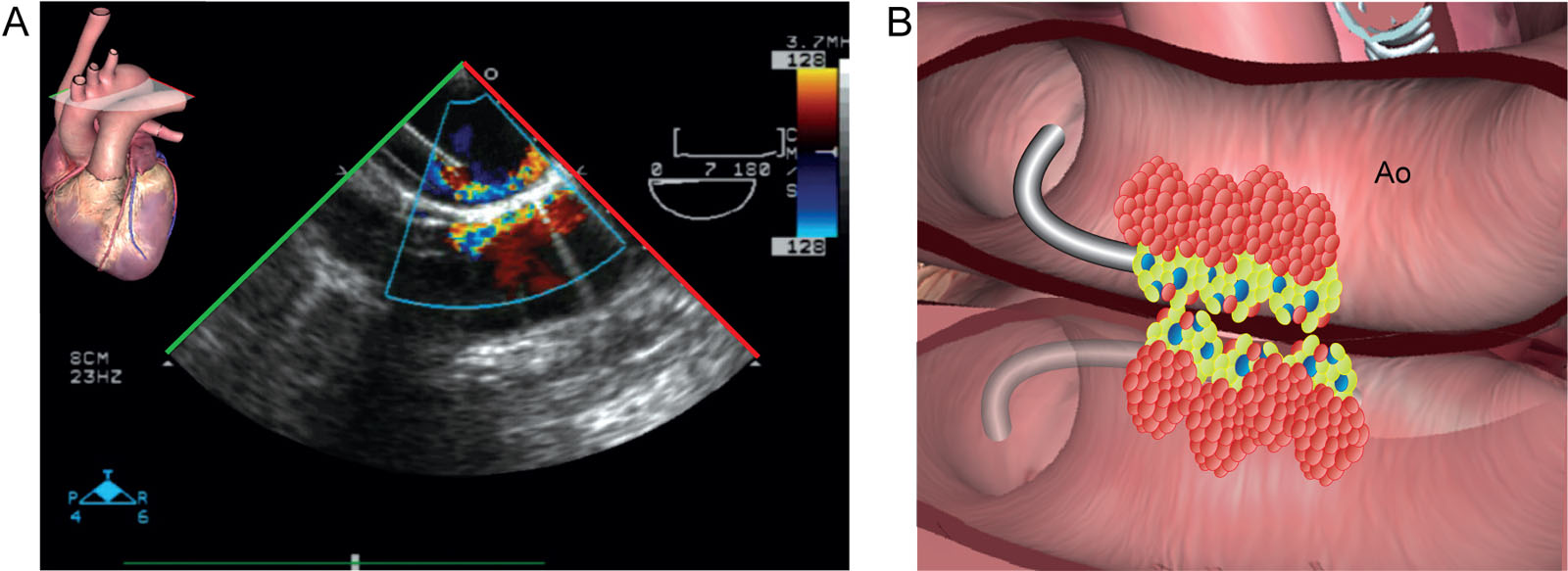
Reverberation. (A, B) This UE aortic arch LAX view at 7° shows reverberation artifacts in both 2D and CFI of the aorta and the aortic cannula.<em> Abbreviations</em>: 2D, two-dimensional; Ao, aorta; CFI, color flow imaging; LAX, long-axis; UE, upper-esophageal.<i class='fa fa-video-camera' aria-hidden='true'></i>

eFigure 7.2

Reverberation. (A, B) This UE aortic arch LAX view at 7° shows reverberation artifacts in both 2D and CFI of the aorta and the aortic cannula. Abbreviations: 2D, two-dimensional; Ao, aorta; CFI, color flow imaging; LAX, long-axis; UE, upper-esophageal.
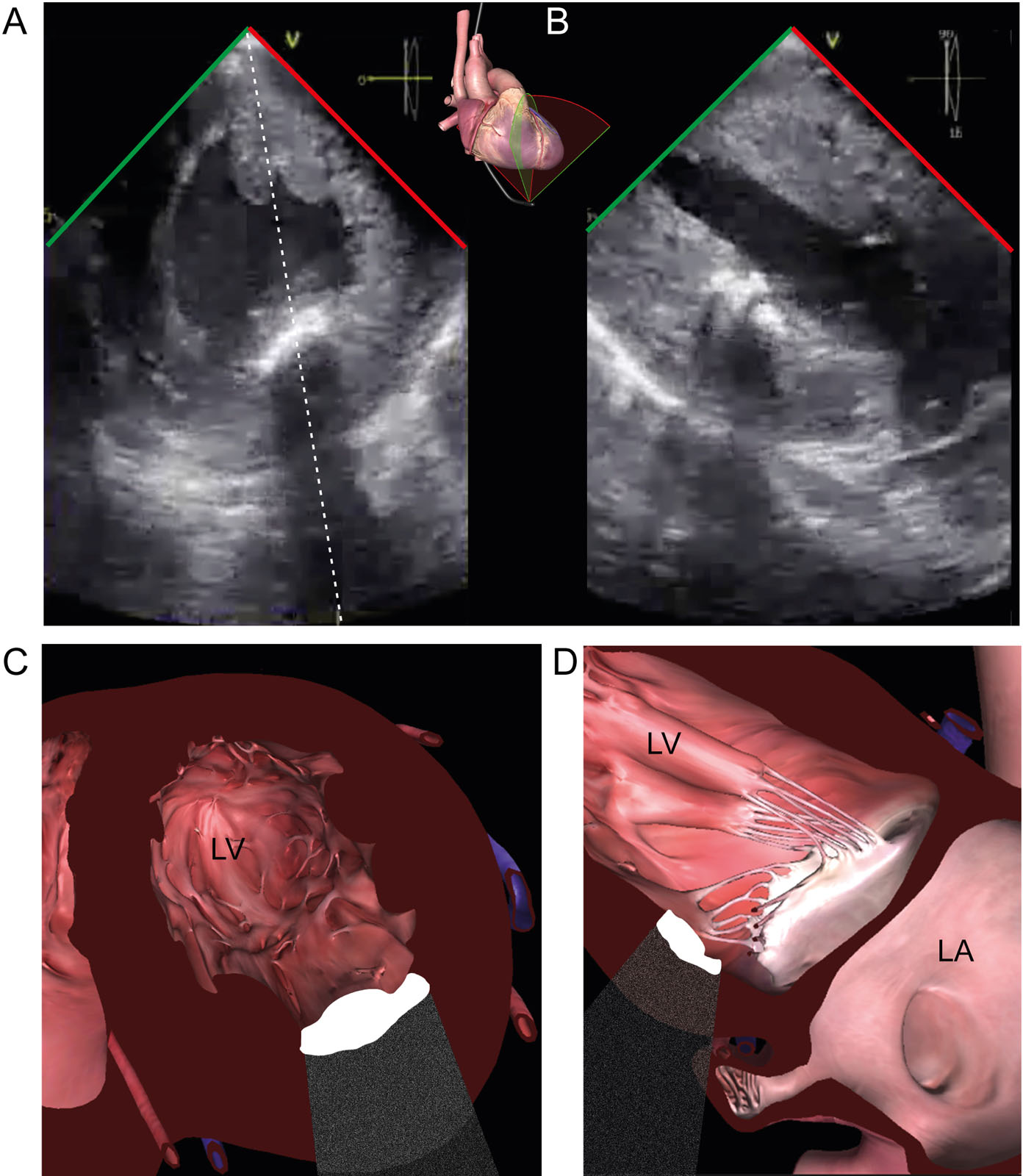
Acoustic shadowing. (A, B) This TG biplane view of the LV shows a calcified antero-lateral papillary muscle which causes acoustic shadowing obscuring the far field in both views.<em> Abbreviations</em>: LA, left atrium; LV, left ventricle; TG, transgastric.<i class='fa fa-video-camera' aria-hidden='true'></i>

eFigure 7.8

Acoustic shadowing. (A, B) This TG biplane view of the LV shows a calcified antero-lateral papillary muscle which causes acoustic shadowing obscuring the far field in both views. Abbreviations: LA, left atrium; LV, left ventricle; TG, transgastric.
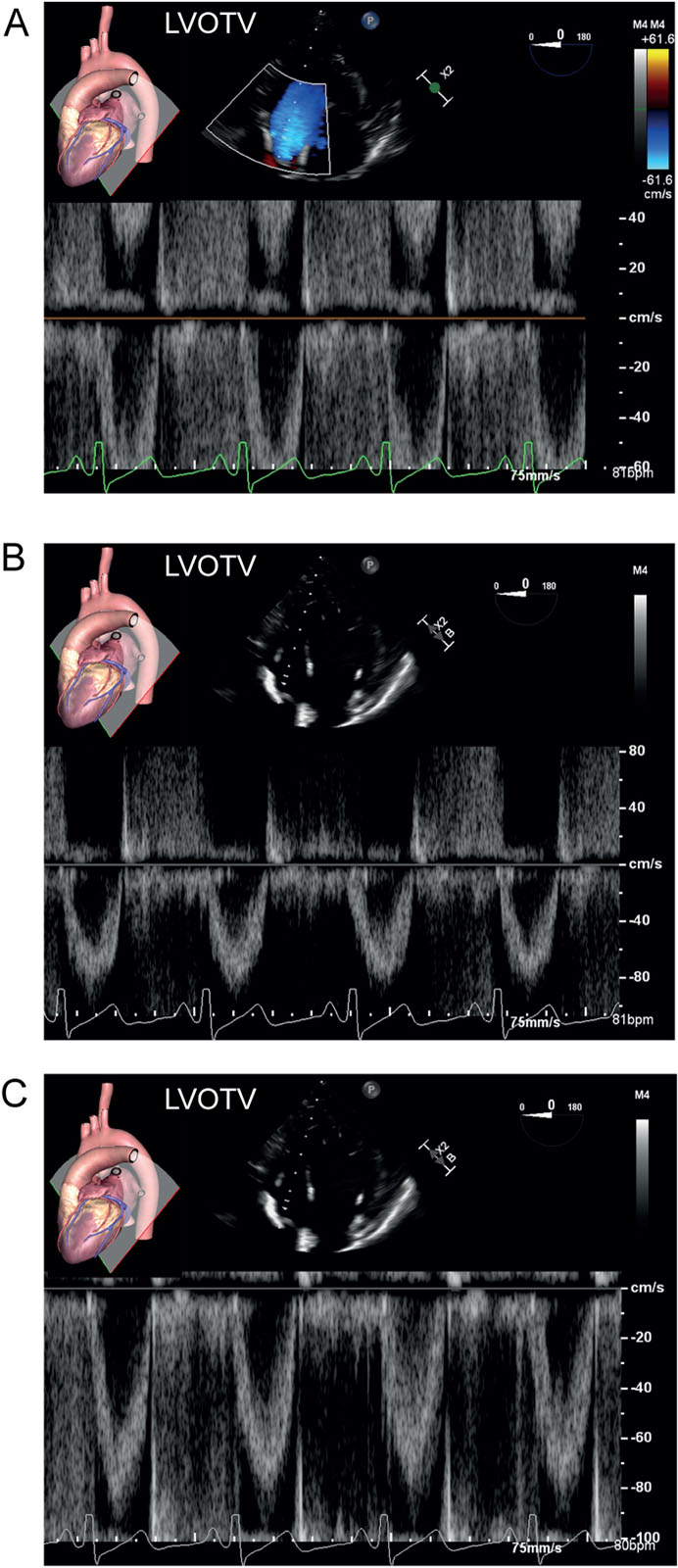
Spectral Doppler aliasing. (A-C) These are PWD signals of the LVOT from a DTG view. (A) The peak negative LVOT velocity (<0 cm/s or baseline) exceeds the upper limit of the velocity scale, and a simultaneous aliasing signal appears on the opposite side of the baseline at the top of the display. (B) Altering the scale peak velocity from –60 to –110 cm/s or (C) shifting the baseline up to a maximum velocity of –100 cm/s eliminates the aliasing artifact.<em> Abbreviations</em>: DTG, deep transgastric; LVOT, left ventricular outflow tract; LVOTV, left ventricular outflow tract velocity; PWD, pulsed-wave Doppler.
eFigure 7.15

Spectral Doppler aliasing. (A-C) These are PWD signals of the LVOT from a DTG view. (A) The peak negative LVOT velocity (<0 cm/s or baseline) exceeds the upper limit of the velocity scale, and a simultaneous aliasing signal appears on the opposite side of the baseline at the top of the display. (B) Altering the scale peak velocity from –60 to –110 cm/s or (C) shifting the baseline up to a maximum velocity of –100 cm/s eliminates the aliasing artifact. Abbreviations: DTG, deep transgastric; LVOT, left ventricular outflow tract; LVOTV, left ventricular outflow tract velocity; PWD, pulsed-wave Doppler.

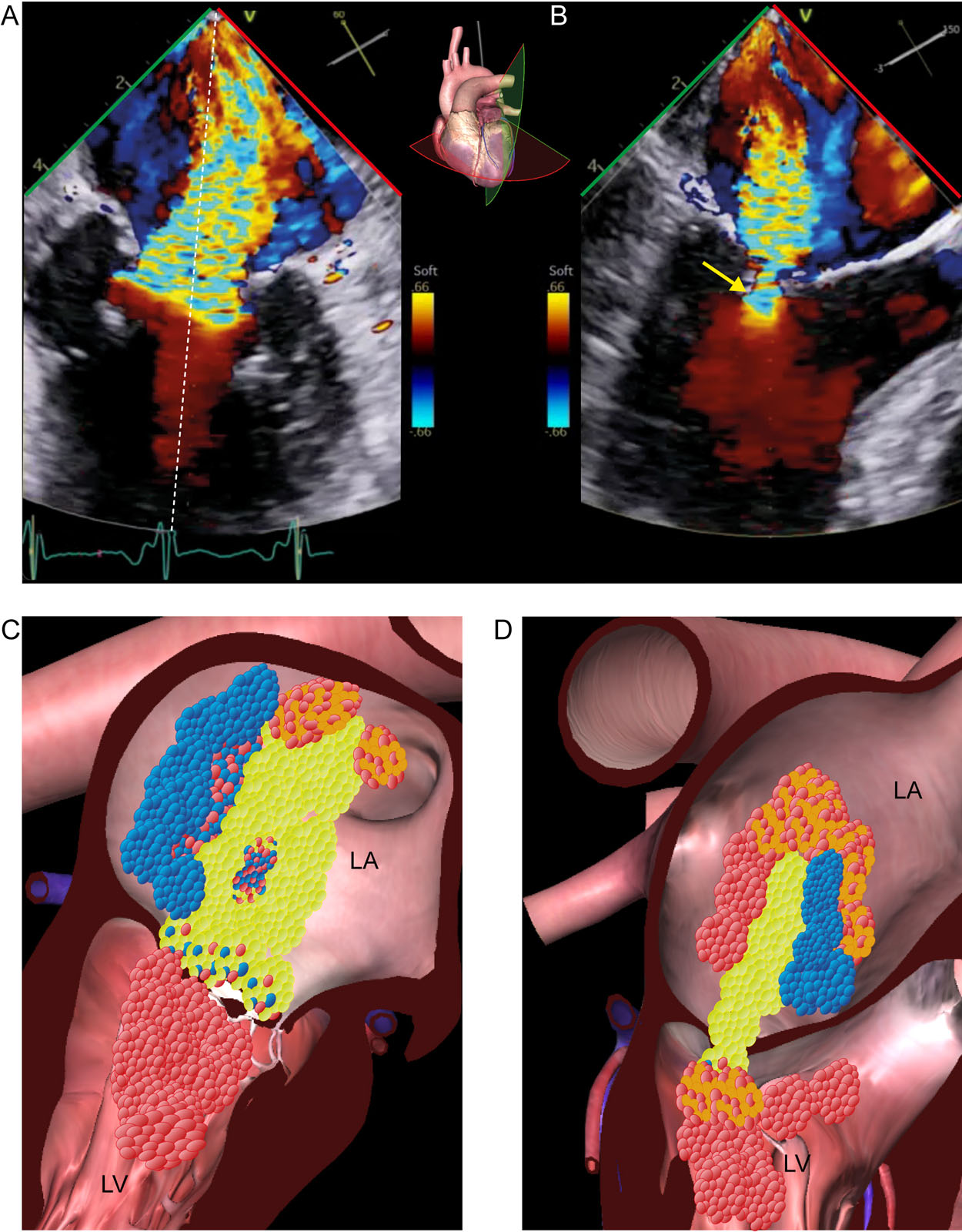
Color Doppler aliasing. (A-D) This is a ME MC biplane view with CFI of the MV. CFI shows mitral regurgitation with blood flow acceleration as aliasing in the LV below the MV. Aliasing appears as an abrupt change in color from red to yellow to light blue (arrow) as velocities exceed the upper limit of the velocity scale. The blue suggest blood flow is going in the opposite direction even when it is still going from LV to LA.<em> Abbreviations</em>: CFI, color flow imaging; LA, left atrium; LV, left ventricle; MC, mitral commissural; ME, mid-esophageal; MV, mitral valve.<i class='fa fa-video-camera' aria-hidden='true'></i>

eFigure 7.16

Color Doppler aliasing. (A-D) This is a ME MC biplane view with CFI of the MV. CFI shows mitral regurgitation with blood flow acceleration as aliasing in the LV below the MV. Aliasing appears as an abrupt change in color from red to yellow to light blue (arrow) as velocities exceed the upper limit of the velocity scale. The blue suggest blood flow is going in the opposite direction even when it is still going from LV to LA. Abbreviations: CFI, color flow imaging; LA, left atrium; LV, left ventricle; MC, mitral commissural; ME, mid-esophageal; MV, mitral valve.
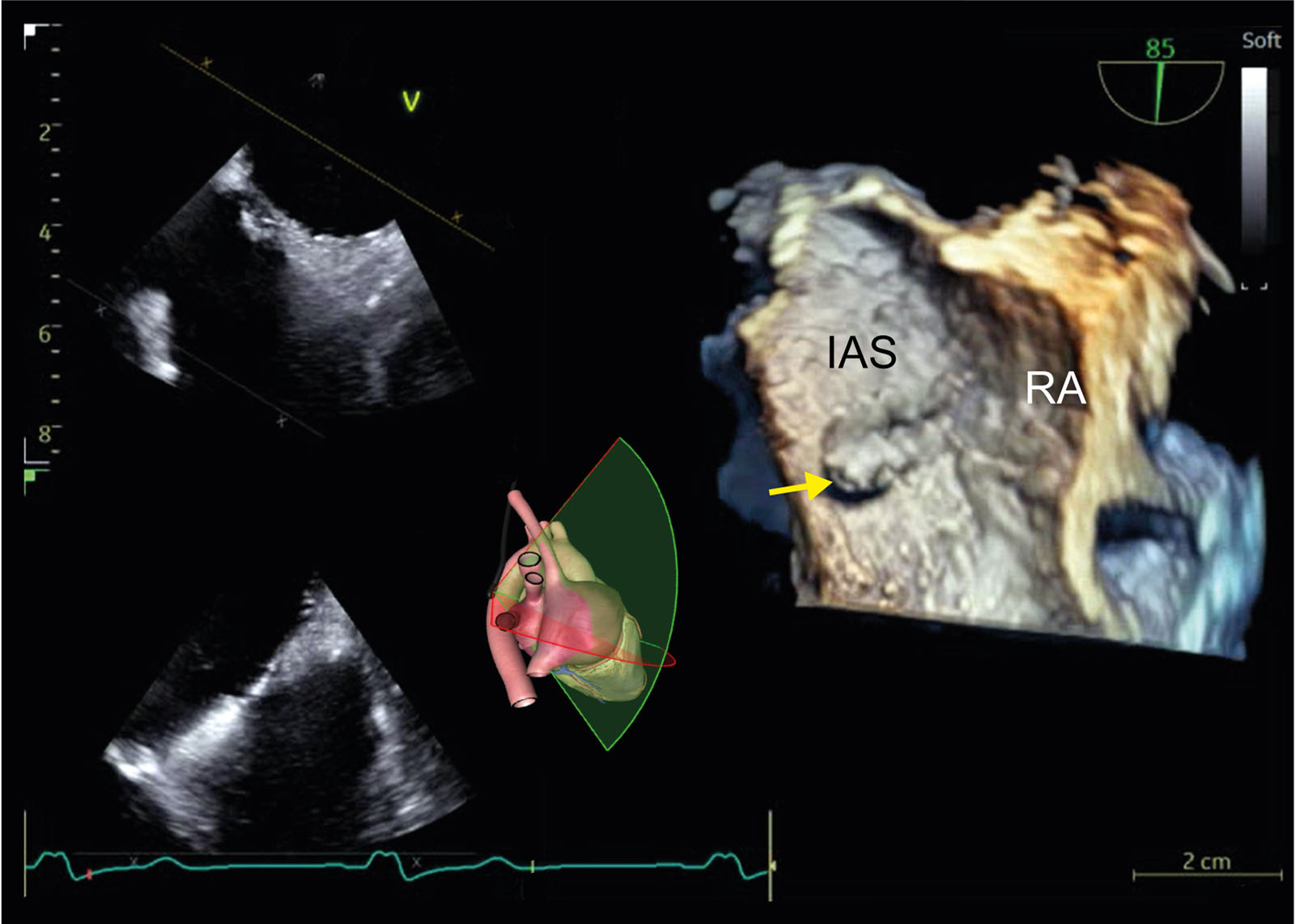
Dropout. These are ME biplane and 3D views of the IAS in a single display. There is a false appearance of tissue deficiency in the fossa ovalis (arrow) because of dropout artifact in the 3D image from the RA perspective. When the structure alignment is not completely perpendicular to the US beam, some reflected echo signals reflect away from the transducer, resulting in the loss of image.<em> Abbreviations</em>: 3D, three-dimensional; IAS, interatrial septum; ME, mid-esophageal; RA, right atrium; US, ultrasound.<i class='fa fa-video-camera' aria-hidden='true'></i>

eFigure 7.21

Dropout. These are ME biplane and 3D views of the IAS in a single display. There is a false appearance of tissue deficiency in the fossa ovalis (arrow) because of dropout artifact in the 3D image from the RA perspective. When the structure alignment is not completely perpendicular to the US beam, some reflected echo signals reflect away from the transducer, resulting in the loss of image. Abbreviations: 3D, three-dimensional; IAS, interatrial septum; ME, mid-esophageal; RA, right atrium; US, ultrasound.
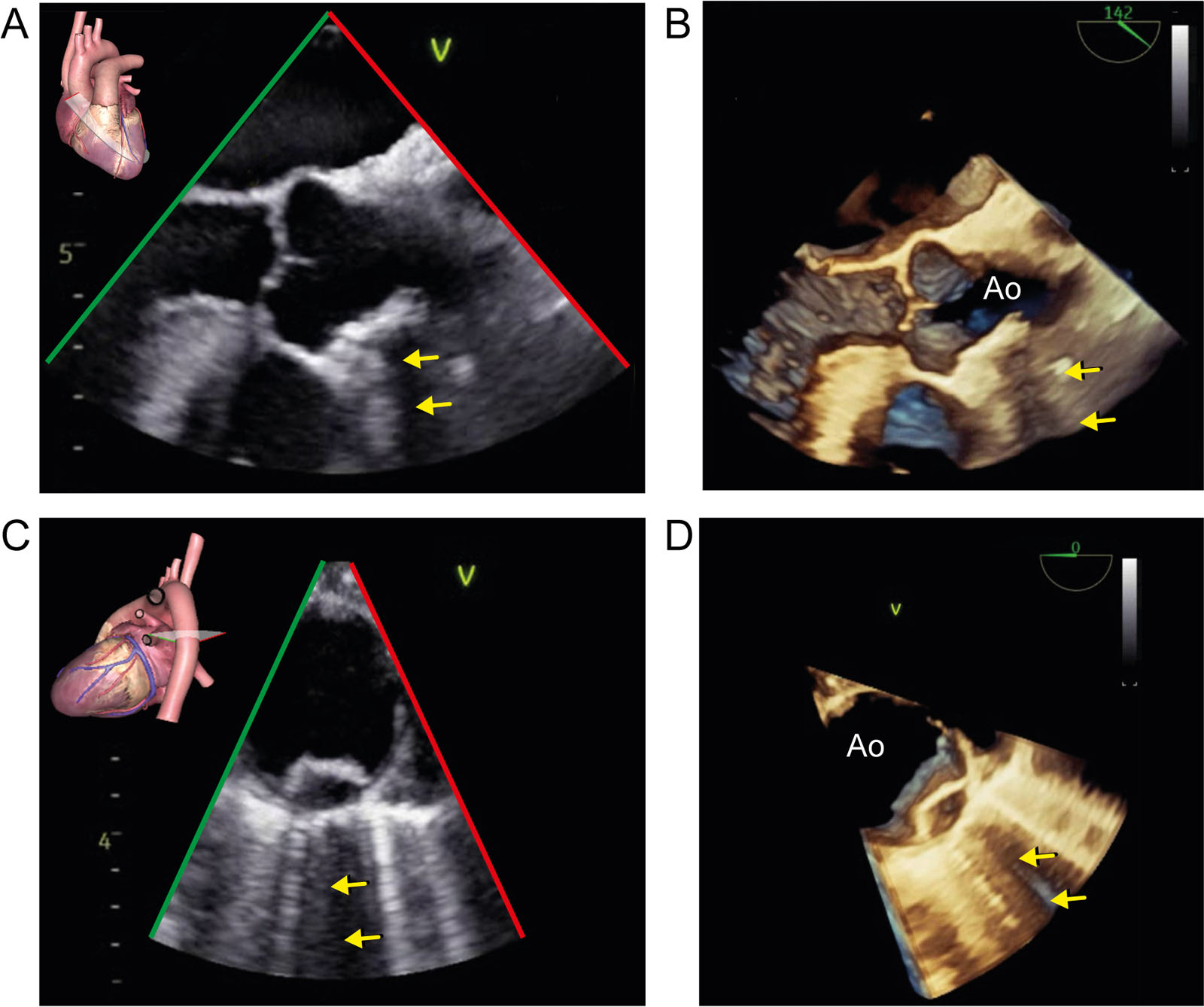
Acoustic Shadowing. (A, B) These 2D and 3D ME AoV LAX views show a large calcified atheromatous plaque from the sinus tubular junction into the ascending aorta causing acoustic shadowing (arrow) in both images. (C, D) These 2D and 3D ME SAX views of the descending thoracic aorta show an atheromatous plaque in the descending thoracic aorta, also causing acoustic shadowing (arrows) in both images. Note also the ring-down or B lines in the lung on both sides of the acoustic shadowing.<em> Abbreviations</em>: 2D, two-dimensional; 3D, three-dimensional; Ao, aorta; AoV, aortic valve LAX, long-axis; ME, mid-esophageal; SAX, short-axis.<i class='fa fa-video-camera' aria-hidden='true'></i>

eFigure 7.27

Acoustic Shadowing. (A, B) These 2D and 3D ME AoV LAX views show a large calcified atheromatous plaque from the sinus tubular junction into the ascending aorta causing acoustic shadowing (arrow) in both images. (C, D) These 2D and 3D ME SAX views of the descending thoracic aorta show an atheromatous plaque in the descending thoracic aorta, also causing acoustic shadowing (arrows) in both images. Note also the ring-down or B lines in the lung on both sides of the acoustic shadowing. Abbreviations: 2D, two-dimensional; 3D, three-dimensional; Ao, aorta; AoV, aortic valve LAX, long-axis; ME, mid-esophageal; SAX, short-axis.
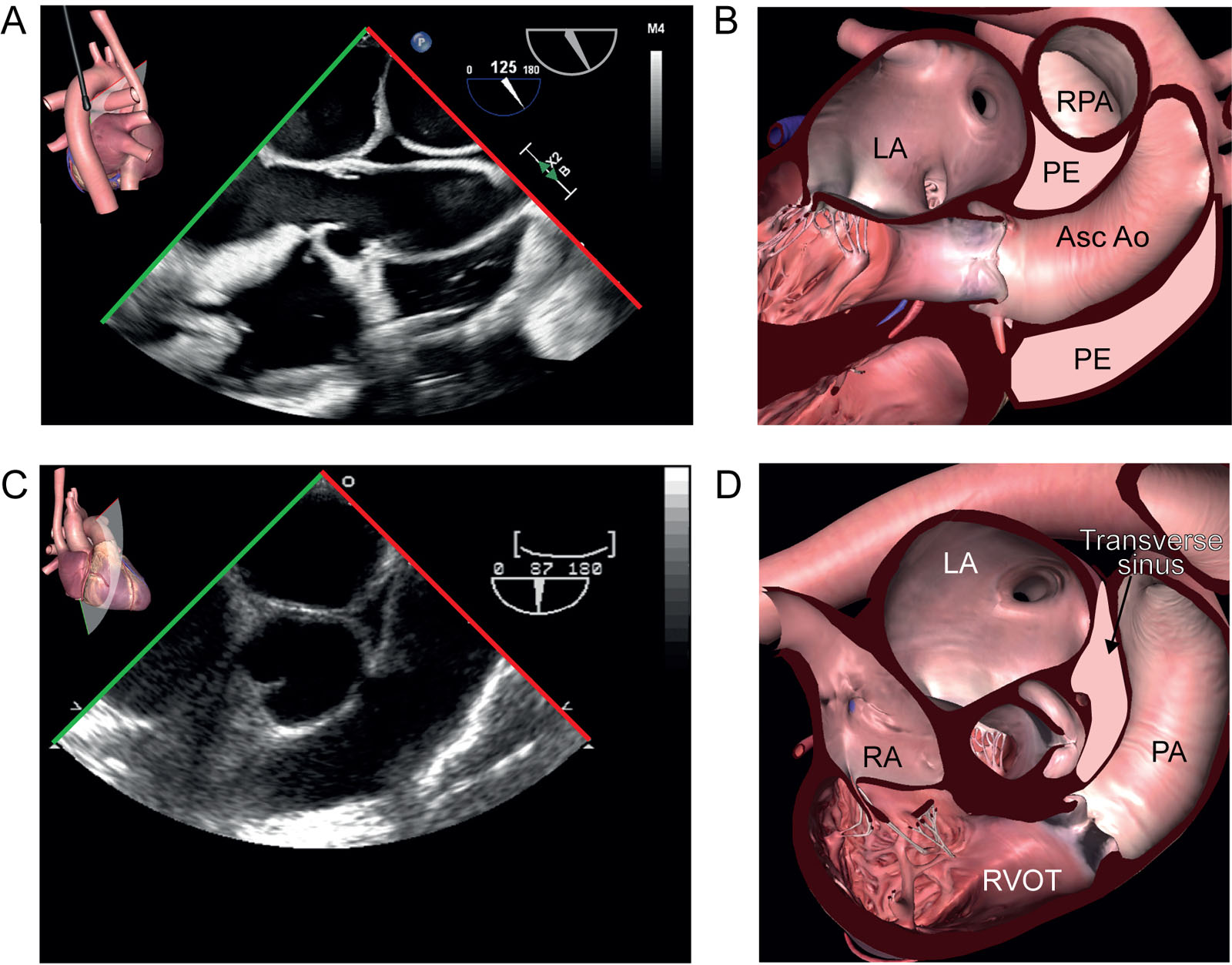
Transverse pericardial sinus. (A, B) The transverse pericardial sinus in this ME ascending Ao LAX view at 120° appears as a small triangular echo-free space between the ascending Ao and RPA. (C, D) This ME RV inflow/outflow view shows the transverse sinus just beside the Ao.<em> Abbreviations</em>: Ao, aorta; Asc, ascending; LA, left atrium; LAX, long-axis; ME, mid-esophageal; PA, pulmonary artery; PE, pericardial effusions; RA, right atrium; RPA, right pulmonary artery; RV, right ventricle; RVOT, right ventricular outflow tract.<i class='fa fa-video-camera' aria-hidden='true'></i>

eFigure 7.43

Transverse pericardial sinus. (A, B) The transverse pericardial sinus in this ME ascending Ao LAX view at 120° appears as a small triangular echo-free space between the ascending Ao and RPA. (C, D) This ME RV inflow/outflow view shows the transverse sinus just beside the Ao. Abbreviations: Ao, aorta; Asc, ascending; LA, left atrium; LAX, long-axis; ME, mid-esophageal; PA, pulmonary artery; PE, pericardial effusions; RA, right atrium; RPA, right pulmonary artery; RV, right ventricle; RVOT, right ventricular outflow tract.

2

Videos

Chapter 07 Fig01A

Chapter 07 Fig02A

Chapter 07 Fig03AB

Chapter 07 Fig04ABC

Chapter 07 Fig05A

Chapter 07 Fig05C

Chapter 07 Fig06A

Chapter 07 Fig07A

Chapter 07 Fig08AB

Chapter 07 Fig09A

Chapter 07 Fig10A

Chapter 07 Fig13AC

Chapter 07 Fig13E

Chapter 07 Fig14A

Chapter 07 Fig14B

Chapter 07 Fig16AB

Chapter 07 Fig18A

Chapter 07 Fig19A

Chapter 07 Fig20A

Chapter 07 Fig21

Chapter 07 Fig22

Chapter 07 Fig23A

Chapter 07 Fig23B

Chapter 07 Fig24A

Chapter 07 Fig24B

Chapter 07 Fig25A

Chapter 07 Fig25C

Chapter 07 Fig25D

Chapter 07 Fig26A

Chapter 07 Fig26B

Chapter 07 Fig26C

Chapter 07 Fig26D

Chapter 07 Fig27AB

Chapter 07 Fig27CD

Chapter 07 Fig28AB

Chapter 07 Fig28E

Chapter 07 Fig28F

Chapter 07 Fig29A

Chapter 07 Fig29C

Chapter 07 Fig29D

Chapter 07 Fig30A

Chapter 07 Fig30C

Chapter 07 Fig30E

Chapter 07 Fig31A

Chapter 07 Fig32A

Chapter 07 Fig32E

Chapter 07 Fig33A

Chapter 07 Fig33C

Chapter 07 Fig33I

Chapter 07 Fig34A

Chapter 07 Fig35A

Chapter 07 Fig35C

Chapter 07 Fig36A

Chapter 07 Fig36C

Chapter 07 Fig36E

Chapter 07 Fig37A

Chapter 07 Fig38C

Chapter 07 Fig38D

Chapter 07 Fig38F

Chapter 07 Fig39A

Chapter 07 Fig39C

Chapter 07 Fig40A

Chapter 07 Fig41A

Chapter 07 Fig41CD

Chapter 07 Fig42A

Chapter 07 Fig42B

Chapter 07 Fig43A

Chapter 07 Fig43C

Chapter 07 Fig44A

Chapter 07 Fig44C

3

Tables

eTable 7.1 Overview of echocardiographic artifacts

1) US assumption violation1

1A: Axial or depth direction (artifact below the actual structure)


Characteristics features

How to avoid

Reverberation

  • More distant than true object
  • Parallel motion
  • Distal fading
  • Include comet tail artifact in this group
  • Decrease gain
  • Alternative imaging planes or modalities2
  • M-mode to differentiate intimal flap from reverberation

Ring-down

  • Equivalent to B lines (from pleural line)
  • Straight line through probe center
  • No fading
  • Pathological in lung if ≥ 3
  • Physiological B lines change with position

Mirror-image artifacts

  • More distant than true object
  • Opposite motion
  • Can occur with 2D, PWD and CFI
  • Decrease gain
  • Change scanning plane and incident angle

Acoustic shadowing

  • Pie-like hypo- or anechogenic segment
  • Distal to strong reflector, on straight line
  • Alternative imaging planes


Acoustic enhancement

  • Posterior enhance in fluid filled organs
  • Alternative imaging planes and angles

1B: Lateral direction (artifact located to the side of the actual structure)

Refraction artifacts

  • Double image
  • Same distance from probe
  • Change transducer angle and position
  • Alternative imaging planes
  • Avoid « refracting » structure

Beam width artifacts

  • Same distance from probe
  • True object/Doppler signal outside of imaging plane
  • Adjust focal zone and reduce gain
  • Alternative imaging planes

Side lobe artifacts

  • Linear artifact from a strong reflector in side lobes, interpret as from central beam
  • Symmetric at both sides of the object
  • Same distance from probe (‘‘arc-like’’ in radial direction)
  • Adjust focal zone
  • Use harmonic imaging
  • Alternative imaging planes


2) Interference by external equipment and devices

2A: External equipment

Unshielded electrical equip

  • Appears only during electrocautery
  • Newer US machines remove these

Aliasing

  • Occurs when velocity of blood or tissue surpasses the maximum Nyquist limit
  • Decreasing transducer frequency and depth
  • Choose an anatomic structure with a velocity that does not exceed Nyquist limit

Click

  • Normal component of a PWD or CWD image as valve open and close


Quadrature-Channel Cross Talk

  • Two identical spectral Doppler signals on opposite sides of the baseline
  • The real signal is the strongest

2D-Devices

US interference

  • Presence of another US source 
  • Removing extra ultrasound device

Near-field clutter

  • Noise (‘‘clutter’’) in near field
  • No relation with anatomic structures
  • Apply CFI, reducing scale
  • Alternative imaging planes

VAD

  • Wave like artefact from the electromagnetic motor
  • Removal of device when indicated

3) 3D artifacts

Stitching

  • Incorrect juxtaposition at the interface of sequential subvolumes
  • Hold respiration and motion
  • Switch to single-beat acquisition

Dropout

  • Poor echocardiographic signal strength from weak echoes
  • Can interpret as holes or tears 20
  • Over set the gain
  • Image surfaces perpendicular to US beam
  • Adjust gain and use multiple plane

Blurring

  • Indistinct edges of structures which appear thicker
  • Use perspectives in which the 3D image is created using mostly the axial resolution

Blooming

  • Metallic structures appear larger when intersected by US produce fringes extending beyond the borders of metallic devices/catheters
  • Not correctable

Railroad-shaped

  • Catheters with wide lumens two surfaces are perpendicular to US beam, producing strong echoes, while other two are tangential, producing very weak echoes
  • Obtain most favorable perspective (i.e., ‘‘en face’’ view of the surface perpendicular to the beam), and increase compression to merge boundaries

Reverberation

  • Multiple reflections of metallic

component of catheters may appear to lengthen the catheter

  • Not correctable

Shadowing

  • Inability of US to pass through strong reflecting catheters/devices
  • Avoid shadowing by properly rotating/angulating the volumetric data set

Gain

  • Gain variation may produce significant variation in the size of structures, which may appear smaller or larger
  • Gain adjustment


1US system assumptions are:
1-Pulses and echoes travel along a straight path
2-Echoes return to the transducer after a single reflection
3-Echoes originate from the main beam
4-Echoes travel at a uniform speed (1540 m/s)
5-Pulses and echoes are attenuated uniformly by all tissues (at 0.5 dB/cm/MHz)
2 Alternative imaging modalities include ICE, CT scan, or CMR.

Abbreviations: 2D, two-dimensional; 3D, three-dimensional; CFI, color flow imaging; CMR, cardiac magnetic resonance; CT, computed tomography; CWD, continuous-wave Doppler; ICE intracardiac echocardiography; PWD pulsed-wave Doppler; TGC, time gain compensation; US, ultrasound; VAD, ventricular assist devices. Adapted from Bertrand44 Quien2 and Faletra et al.17