Students
Chapter Resources
Chapter 2
Chapter exercises
- Comment on any differences in meaning between the items in each of the following sets. The differences may relate to expressive or evoked meaning. For instance, some items may be register-specific or dialect-specific, others may be derogatory or neutral. If you are not familiar with a particular word or expression, consult a good dictionary of English before you comment on its meaning.
- car, auto, automobile, motor, limousine, limo, banger, jalopy
- comfortable, comfy, homely, cosy, snug (of a place)
- dad, daddy, pa, papa, pop, father, pater, sire, old man
- Translate the text below into your other working language using an online machine translation engine (Google Translate, DeepL, Baidu Translate, etc.). This text has been extracted from the homepage of the Birmingham tourist information website (https://visitbirmingham.com/ ) and aims to summarize the attractions of this British city for the benefit of potential visitors. To what extent is the software able to capture in its rendering the propositional, expressive and evoked meanings of the following lexical items: a) bab (a term of endearment used by speakers of the Birmingham dialect); b) hotbed; c) can-doers; d) down-to-earth; e) bunch.
- Make a list of some loan words that are used in your language, and comment on the types of text in which such loan words tend to be used freely (for instance in advertisements). Now consider how you might translate the main text in Figure 2.2, an advertisement by Trados which appeared in various magazines in 2001, and what loss of propositional, expressive and/or evoked meaning might be involved if you cannot render Dinero using a similar loan word in your target text.
- Think about the semantic field of FAMILY RELATIONS in the languages with which you are familiar. To what extent does each language make similar divisions in terms of the words used to refer to the members of an extended family?
- Watch a film that has recently been subtitled into another language that you speak, paying particular attention to the ways in which the translators have dealt with any swear words – however strong or mild – contained within the source text (e.g. when the character Ron Weasley repeatedly exclaims “Bloody Hell!” in the Harry Potter film franchise). To what extent have the translators attempted to reproduce the propositional meaning of the swear words? What are the expressive meanings associated with each instance of bad language? What factors do you think might have informed the translators’ decision-making in each case?
- Make a list of all the English words you can think of that end in -ism or -ist (such as racism/racist, sexism/sexist, ageism/ageist, extremism/extremist, fanaticism/fanaticist). Comment on what these words have in common and on the propositional and expressive meanings of the suffix. Now attempt to translate the screenshot in Figure 2.3, from a video released by the Sizism Awareness Campaign (www.youtube.com/watch?v=IOxbi53J5SU).
- Choose something that happened to you or that you did this week. Write out three different versions of it (max. 150 words each version), following the register conventions relevant to three of the scenarios below:
- As if you were telling a friend about it in a face-to-face conversation
- As if you were posting about it on social media
- As if you were telling a Student Support office about it in an email
- As if it were being written in a newspaper
- As if it were in a gritty thriller novel (even if the event itself is not suspenseful)
- As if it were in a children's book
- As if you had to explain your behaviour to a police officer
Now list all the words and expressions you can think of which are available in your target language for car, comfortable and father. Comment on any differences in meaning between (a) the individual items in each set, and (b) the English items above and the items in the corresponding sets in your target language.
Alright bab?
A city beating at the heart of the country with a quiet confidence like no other. We’re a hotbed of culture that's rich and diverse. Our identity is grounded in a history of can-doers and enriched by the innovators of today. We’re a welcoming home to new visitors and old, a down-to-earth bunch with our story ingrained in the spirit of our people, our heritage and our evolving skyline.
Come and enjoy our forward-thinking architecture or explore our majestic waterways, lined with history, culture & lifestyle and why not treat yourself by partaking in an indulgent shopping in Birmingham experience? There's no denying Birmingham has it all.
Look like your kinda place? It’s impossible for us to squeeze in all that we love and all that you love into our welcome, so why not come and discover the rest for yourselves?
What other examples of challenging lexical items can you identify in this text? Using the typology presented in 2.3.2.2, how might you categorize the solutions adopted by the software to attempt to resolve these challenges? If you were to try to improve the machine translation output, what alternative types of solution might you adopt?
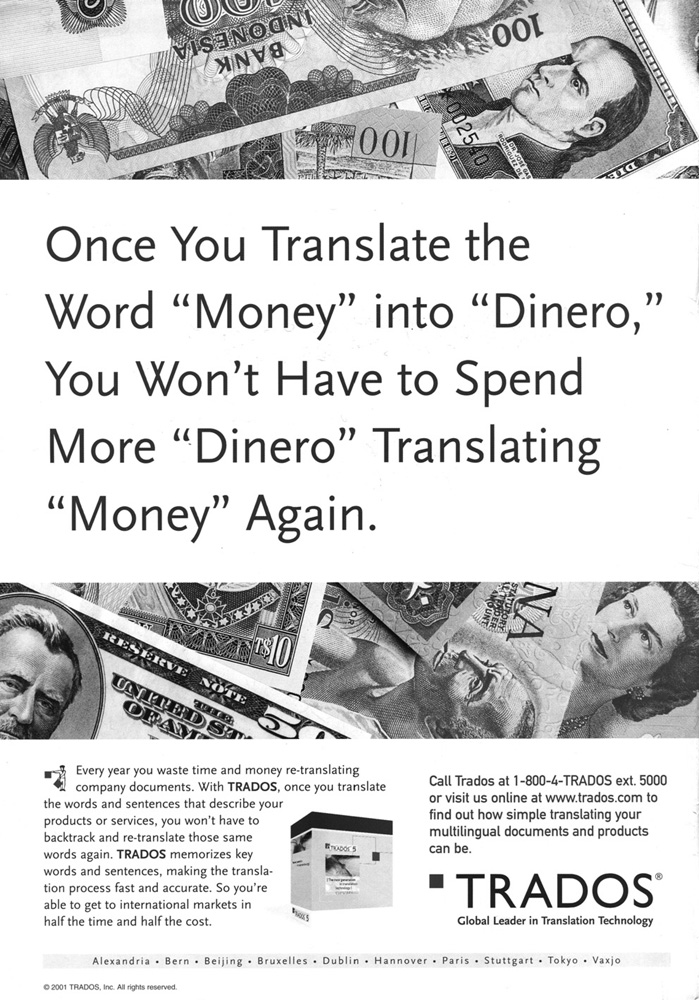
Figure 2.2 Trados advertisement
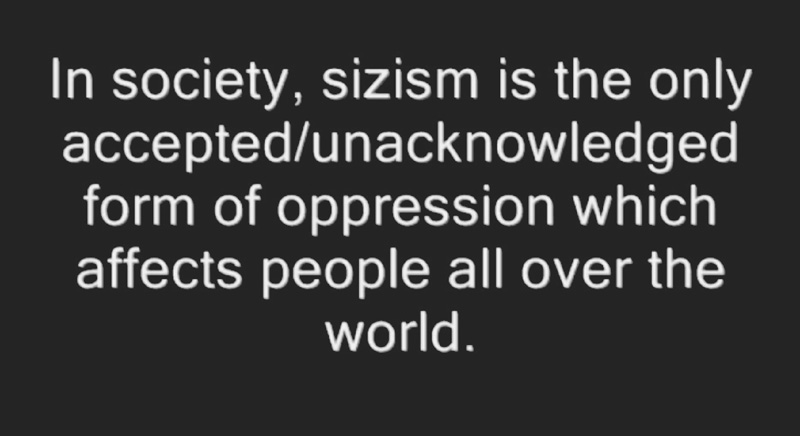
Figure 2.3 Screenshot from Sizism Awareness Campaign video
Think about what differences there are between your versions, particularly in terms of your word choices and the ways in which they may have been affected by the field, tenor and mode of the discourse. You might also like to consider the extent to which these register conventions might vary if you were writing in a language other than English.
Additional exercises
- Make a list of all the English verbs you can think of which have to do with speech, such as say, suggest, complain, mumble, mutter, murmur, whisper, speak, tell and so on. Try to group them into sets, starting with the more general ones.
- Consider the following extract from Culler (1976:21-22):
- Identify the culture-specific items and other word-level challenges in the British pub restaurant menu available for download here
- Translation by a superordinate
- Translation by cultural substitution
- Translation using a loan word with explanation
- Translation by omission
Now list all the verbs of speech you can think of in your target language, starting with the more general ones. Comment on the presence or absence of any semantic gaps in your target language vis-à-vis English.
Repeat this exercise using nouns which may come under the general heading of PUBLICATIONS. In English, this would include book, newspaper, magazine, newsletter, bulletin, journal, report, pamphlet, periodical and so on.
“If language were simply a nomenclature for a set of universal concepts, it would be easy to translate from one language to another. One would simply replace the French name for a concept with the English name. If language were like this the task of learning a new language would also be much easier than it is. But anyone who has attempted either of these tasks has acquired, alas, a vast amount of direct proof that languages are not nomenclatures, that the concepts … of one language may differ radically from those of another…. Each language articulates or organizes the world differently. Languages do not simply name existing categories, they articulate their own.”
Thinking about the language pair(s) with which you are most familiar, provide a series of examples which clearly illustrate Culler’s argument.
Source: Culler, Jonathan (1976) Saussure, Glasgow: Fontana/Collins.
In which cases would you use the following strategies to translate these words/expressions?
What other considerations must you take into account with this text?
Further resources
‘Untranslatables’
Veronica Esposito writes a fascinating column for the online magazine World Literature Today focusing on ‘untranslatables’, single lexical items which – due to an especially rich history of use within specific cultures – often pose particularly thorny challenges for translators trying to communicate their meanings for other audiences: https://www.worldliteraturetoday.org/author/veronica-esposito
As a starting point, you may like to read her 2023 article on the Tshilubà word Ilunga in which she considers its widespread reputation as “the most difficult word to translate”: https://www.worldliteraturetoday.org/blog/translation/just-what-most-untranslatable-word-world-veronica-esposito
The Meaning of Tingo
Adam Jacot de Boinod’s book The Meaning of Tingo and Other Extraordinary Words from Around the World (Penguin, 2006) provides a further set of examples of lexical items used in different languages around the world which have no straightforward equivalent in English.
You can listen to a radio interview with the author on the NPR website: https://www.npr.org/2006/05/13/5403332/tingo-tracks-words-without-equal-in-english
Recommended Reading
Fawcett, Peter (1997) Translation and Language, Manchester: St. Jerome Publishing. Chapter 3: ‘Semantics’.
Kroeger, Paul (2022) Analyzing Meaning: An introduction to semantics and pragmatics, third edition, Berlin: Language Science Press.
Suggestions for Further Reading
Hale, Sandra (1997) ‘The Treatment of Register Variation in Court Interpreting’, The Translator 3(1): 39–54.
Leech, Geoffrey (1990) Semantics: The study of meaning, second edition, London: Penguin. Chapter 2: ‘Seven Types of Meaning’.
Leppihalme, Ritva (2000) ‘The Two Faces of Standardization: On the Translation of Regionalisms in Literary Dialogue’, The Translator 6(2): 247–269.
Li, Chris Wen-Chao (2007) ‘Foreign Names Into Native Tongues: How to Transfer Sound Between Languages – Transliteration, Phonological Translation, Nativization, and Implications for Translation Theory’, Target 19(1): 45–68.
Neumann, Stella (2021) ‘Register and Translation’, in Mira Kim, Jeremy Munday, Zhenhua Wang, and Pin Wang (eds) Systemic Functional Linguistics and Translation Studies, London: Bloomsbury Academic, 65–82.
Pedersen, Jan (2011) Subtitling Norms for Television: An Exploration Focussing on Extralinguistic Cultural References, Amsterdam: John Benjamins. Chapter 4: ‘Translation Strategies’.
Ramos Pinto, Sara (2018) ‘Film, Dialects and Subtitles: An analytical framework for the study of non-standard varieties in subtitling,’ The Translator 24(1): 17-34.
Chapter 3
Chapter exercises
- Free online corpus tools such as SKELL (https://skell.sketchengine.eu/) can be used to examine the typical collocational behaviour of a word by searching large and varied collections of authentic English-language texts (SKELL is also available for Russian, Italian, German, Czech and Estonian). The interface’s ‘Word Sketch’ feature is particularly useful in this regard for the way it automatically groups collocates according to their part of speech (e.g. verbs that collocate with the search term). To explore the value of using such tools over one’s individual intuitions, try searching SKELL for the close synonyms big and large: what differences do you observe in their collocational behaviour?
- Try your hand at translating this challenging title and header, which introduce an article promoting visits to the Dead Sea (Figure 3.10). The article appeared in a Wonderlust Guide to Jordan, published in 2010 (p. 22). The caption under ‘Mud, glorious mud’ reads: ‘As every schoolchild worth their salt knows, the Dead Sea is the briniest lake on earth. But its waters and mud offer unique spa experiences, as Gail Simmons discovers.’
- The passage reproduced in Figure 3.11 was first published in the June 2019 edition of National Geographic Kids, a popular magazine for children. Have a go at translating the text into your other working language, paying particular attention to the challenges posed by the play on the idiom ‘to throw the cat amongst the pigeons’ in the title. Which of the strategies discussed in Section 3.2.4 above might be most appropriate in this case? And thinking back to Chapter 2, how will you handle the two puns in the final sentence (‘nuts’ and ‘purr-fect’)?
- The Chronicle Review, a section of the US-based Chronicle of Higher Education, published an article by Evan Goldstein on the renowned, outspoken historian Tony Judt on 6 January 2010. Entitled ‘The Trials of Tony Judt’, the article begins by explaining that ‘a little more than a year ago, Judt was diagnosed with a progressive variant of amyotrophic lateral sclerosis, better known as Lou Gehrig’s disease, a fatal condition that gradually destroys a person’s ability to move, breathe, swallow, and talk’.
Imagine that you have agreed to translate this article for one of the many activist websites that provide multiple translations of such material. The full article is available at http://chronicle.com/article/The-Trials-of-Tony-Judt/63449/. Comment on any collocations in the following stretch that might prove difficult to translate into your target language and the strategies you have used to overcome these difficulties, paying particular attention to the play on life/death sentence at the end of the second paragraph.
At bedtime, having been maneuvered from his wheelchair to his cot and positioned upright, his glasses removed, Judt is left alone with his thoughts. In recent months, they have turned to his youth – the charms of a curmudgeonly grade-school German-language instructor, the shifting cultural mores of Cambridge in the mid-60s, the comforting solitude of a train ride. At the encouragement of his friend Timothy Garton Ash, a professor of European studies at Oxford, he has crafted those ‘little vignettes from my past’ into a series of autobiographical sketches.
In one moving essay, recently published in The New York Review, Judt addresses directly his life with ALS. ‘Helplessness,’ he writes, ‘is humiliating even in a passing crisis – imagine or recall some occasion when you have fallen down or otherwise required physical assistance from strangers. Imagine the mind’s response to the knowledge that the peculiarly humiliating helplessness of ALS is a life sentence (we speak blithely of death sentences in this connection, but actually the latter would be a relief).’
- Imagine that you have been asked by a client to translate the following text into your target language. The text appeared in The Economist (UK Edition, 6–12 February 2010, p. 68): https://www.economist.com/business/2010/02/04/stockpickers-suckered. Your target reader works in the banking business and needs to follow international developments in this field.
How firms fool equity analysts
Stockpilers suckered
NEW YORK
Chief executives pull the wool over analysts’ eyes, again
How do you pump up the value of your company in these difficult times? One tried and tested way is to hoodwink equity analysts, according to a new study of 1,300 corporate bosses, board directors and analysts.
The authors found that chief executives commonly respond to negative appraisals from Wall Street by managing appearances, rather than making changes that actually improve corporate governance: boards are made more formally independent, but without actually increasing their ability to control management. This is typically done by hiring directors who, although they may have no business ties to the company, are socially close to its top brass. According to James Westphal, one of the study’s co-authors, some 45% of the members of nominating committees on the boards of large American firms have ‘friendship’ ties to the boss – though this varies widely from company to company….
Why do analysts swallow this self-interested narrative? Respondents acknowledged that social ties could undermine independence, but most said they do not have the time to look into such issues. …
Depressingly, these market-distorting shenanigans are part of a pattern. An earlier study found that public companies enjoy lasting share-price gains from plans that please analysts, such as share buybacks and long-term incentive schemes for executives, even when they fail to follow through on announcements.
When you have translated the text, comment on the strategies you used to deal with various collocations, such as pump up value, tried and tested, managing appearances, top brass and swallow a narrative, including register-specific collocations, such as share buybacks. Comment also on your strategy for translating the idiom in the subtitle (pull the wool over analysts’ eyes).
- Try your hand at this challenging extract from an Austin Rover brochure (Today’s Cars, 1989). Imagine that you have been asked to translate the following passage into your target language, for distribution in your local market. Do not be distracted by unfamiliar car terminology; this is not the object of the exercise. If necessary, leave a gap if you cannot find an equivalent for a specialized term.
You will note that the passage includes several idioms and is highly informal in style. Whatever strategies you decide to use in translating it, remember that idioms are not just used for the meanings they convey but also for the effect they produce on the reader, for their stylistic value.
Metro Sport
The new Metro Sport. Terrific looks. Loads of go. For a lot less than you think.
The Sport looks just what it is – a hot little hatchback that knows how to handle itself. With an aerodynamic tail spoiler; all-white sports wheel trims; and special graphics and paint treatment.
Under the bonnet is a 73 PS1.3 engine with a real sting in its tail. (Relax – it’s also remarkably economical.)
You won’t have to put up with a spartan cockpit in return for sparkling performance. Just try those stylishly trimmed sports seats for size.
Now tune into the electronic stereo radio/stereo cassette player. Four speakers, great sound. And a built-in security code theft deterrent.
There’s a wealth of driving equipment too – including a tachometer of course.
Right up your street? Choose your Sport in one of five selected colours. And paint the town red.
When you have translated the text, comment on any difficulties involved, the strategies you used and any change in the level of informality in your target version.
- Once you have completed your translation of the Métro Sport text, input the same text into an online machine translation engine such as Google Translate or DeepL. Compare the MT output with your translation and consider your responses to the following questions:
- To what extent has the MT software correctly identified the idiomatic meanings of the expressions used in the English source text?
- In cases where the software has not correctly identified the idiomatic meanings, to what extent does this misrecognition affect the coherence of the text? Would target readers still be able to make sense of what the text is trying to communicate?
- In cases where the software has correctly identified the idiomatic meanings, what strategies does the MT version tend to deploy? What are the relative advantages and disadvantages of such solutions in comparison with your own translation.
- What does your analysis tell us regarding the viability of using such MT software for the translation of this genre of text in which idioms are relatively common?
- Are you aware of any discrepancies in the collocational behaviour of emojis across the languages and cultures with which you are most familiar? To what extent does each of the following emojis collocate with words that articulate similar meanings in your source and target languages?: ☠️ 👏 🤘 👍 🙂
- Produce a translation into your other language of the extract from John Banville’s (2005) novel The Sea reproduced at the following link: https://thebookerprizes.com/the-booker-library/features/an-extract-from-the-sea-by-john-banville Pay particular attention to the unusual collocations that this extract contains and the special effects that they generate. Reflect on the challenges you face in re-creating these effects in your other language.
- Thinking about the languages with which you are most familiar, to what extent is the use of idioms restricted by convention to certain genres and registers of spoken and written text? Are idioms equally prevalent in e.g. political speeches, corporate reports, advertising texts and everyday conversation?

Figure 3.10 Caption of article in Wanderlust Guide to Jordan 2010
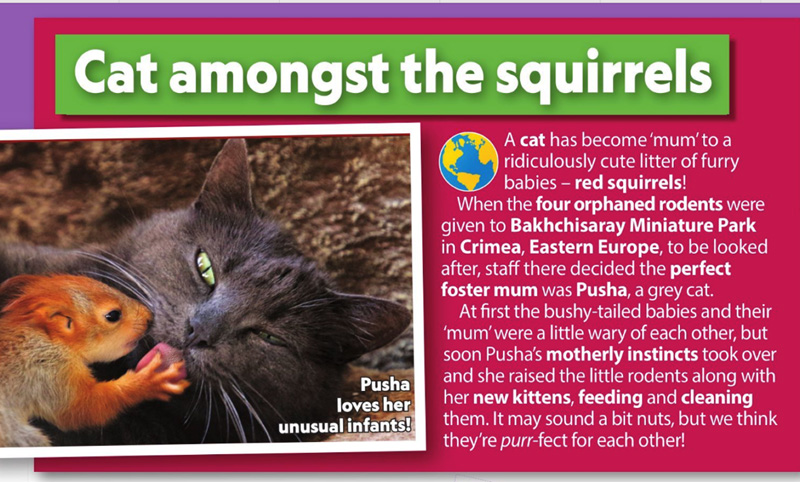
Figure 3.11 Article in National Geographic Kids (June 2019)
Additional exercises
Further resources
Idioms around the world
This post on the TED Blog focuses on idioms, showcasing the wide variety of such expressions used in different languages around the world: https://blog.ted.com/40-idioms-that-cant-be-translated-literally/
Another blog post on the European Day of Languages website highlights how languages often use very different idiomatic expressions to communicate similar ideas: https://edl.ecml.at/en/Fun/Idioms-of-the-world
Recommended Reading
Fernando, Chitra (1996) Idioms and Idiomaticity, Oxford: Oxford University Press.
Panou, Despoina (2014) Idiom Translation in the Financial Press: A Corpus-based Study, Newcastle-upon-Tyne: Cambridge Scholars Publishing. Chapter 2: ‘Linguistic and Translational Aspects of Idioms’.
Sinclair, John (1991) Corpus Concordance Collocation, Oxford: Oxford University Press. Chapter 8: ‘Collocation’.
Suggestions for Further Reading
Al-Wahy, Ahmed Seddik (2009) ‘Idiomatic False Friends in English and Modern Standard Arabic’, Babel 55(2): 101–123.
Chung, Dang Thi Kim (2024) ‘Challenges of Translating Idiomatic Expressions: A CrossLinguistic Analysis at a University in Hanoi, Vietnam’, International Journal of Social Science and Human Research 7(10): 7668-7678.
Dore, Margherita (2010) ‘The Audiovisual Translation of Fixed Expressions and Idiom-Based Puns’, in Carmen Valero-Garcés (ed.) Dimensions of Humor: Explorations in Linguistics, Literature, Cultural Studies and Translation, València: Universitat de València, 361-386.
Hoey, Michael (2005) Lexical Priming: A New Theory of Words and Language, Abingdon, Oxon: Routledge.
Kovács, Gabriella (2016) ‘An Evergreen Challenge for Translators – The Translation of Idioms’, Acta Universitatis Sapientiae, Philologica 8(2): 61–77.
Moon, Rosamund (1998) Fixed Expressions and Idioms in English, Oxford: Clarendon.
Sheridan, Sarah (2009) ‘Translating Idiomatic Expressions from English to Irish Sign Language (ISL): Theory and Practice’, The Sign Language Translator and Interpreter 3(1): 69–84.
Chapter 4
Chapter exercises
- Choose a notional category, such as time reference, gender, countability, visibility, modality or animacy and compare the way it is expressed in your target language with the way it is expressed in English. Comment in particular on the sort of problems that could arise in translation from differences in the way the notion in question is expressed in the two languages. You may find it helpful to refer to grammars of your source and target languages and to base your discussion on an analysis of authentic translated texts.
- Research the issue of gender-neutral language in at least two of the languages you work with. (How) is gender encoded into the conventional grammatical rules of the language? What options have been proposed to allow for gender neutrality? How widely accepted have these options been? What criticisms are brought against such adjustments?
- Imagine that you have been provisionally asked to translate John Le Carré’s The Russia House (1989) into your target language. Before you can sign the translation contract, the publishers insist that you provide a sample translation of a couple of pages to allow them to assess your competence as a translator of this type of literature. They choose the following extract and ask you to submit a target version of it, stating that they appreciate that you may not have had time to read the whole novel but that they just want to see how you might handle Le Carré’s distinctive use of language. They provide you with a short summary of the context to help you assess the tone of the extract.
Note to the translator:
John Le Carré’s The Russia House is a spy thriller which revolves around the then new era of glasnost in the Soviet Union. The general feeling that one gets from reading this novel is that nothing much has changed and that the Cold-War machinations are still at play and are as irrelevant and as brutal as ever. The narrator in the following extract is Palfrey, legal adviser to the British secret service or, in his own words, ‘Legal adviser to the illegals’ (p. 47). In this passage, which is very near the end of the book, he ironically sums up the manner in which the hypocritical bureaucrats of Whitehall and Washington dealt with their own inadequacies when their major spying operation went wrong. The various people mentioned, such as Ned and Barley, had all been involved in the operation in one way or another.
Extract for translation:
Oh, and note was taken. Passively, since active verbs have an unpleasant way of betraying the actor. Very serious note. Taken all over the place.
Note was taken that Ned had failed to advise the twelfth floor of Barley’s drunken breakout after his return from Leningrad.
Note was taken that Ned had requisitioned all manner of resources on that same night, for which he had never accounted, among them Ben Lugg and the services of the head listener Mary, who sufficiently overcame her loyalty to a brother officer to give the committee a lurid account of Ned’s high-handedness. Demanding illegal taps! Imagine! Faulting telephones! The liberty!
Mary was pensioned off soon after this and now lives in a rage in Malta, where it is feared she is writing her memoirs.
Note was also taken, if regretfully, of the questionable conduct of our Legal Adviser de Palfrey – I even got my de back* – who had failed to justify his use of the Home Secretary’s delegated authority in the full knowledge that this was required of him by the secretly agreed Procedures Governing the Service’s Activities as Amended by etcetera, and in accordance with paragraph something of a deniable Home Office protocol.
The heat of battle was however taken into account. The Legal Adviser was not pensioned off, neither did he take himself to Malta. But he was not exonerated either. A partial pardon at best. A Legal Adviser should not have been so close to an operation. An inappropriate use of the Legal Adviser’s skills. The word injudicious was passed around.
It was also noted with regret that the same Legal Adviser had drafted a glowing testimonial of Barley for Clive’s signature not forty-eight hours before Barley’s disappearance, thus enabling Barley to take possession of the shopping list,** though presumably not for long.
In my spare hours, I drew up Ned’s terms of severance and thought nervously about my own. Life inside the Service might have its limitations but the thought of life outside it terrified me.
(pp. 412–413)
* Palfrey’s full name is Horatio Benedict de Palfrey, but, as he explains earlier (p. 47), ‘you may forget the first two [names] immediately, and somehow nobody has ever remembered the “de” at all’.
** A document detailing information required by Whitehall and Washington from the informant/potential defector on the Russian side.
When you have translated the preceding text into your target language, discuss any differences between the source and target versions in terms of grammatical meaning, paying particular attention to the use of passive structures and the reflexive take himself to Malta (paragraph 6). You may also wish to use this opportunity to consolidate your knowledge of other areas covered so far, namely semantics and lexis. Consider, for instance, the evoked meaning of an expression such as all over the place (paragraph 1) or the impact of an unusual collocation such as lives in a rage (paragraph 4); how well do these expressions translate into your target language?
Comment at length on the strategies you used to overcome difficulties at the grammatical level in particular.
- Miss Smilla’s Feeling for Snow is the title of one of two English translations of an award-winning novel by the Danish author Peter Høeg, which first appeared in 1992. On the surface, the story revolves around Smilla Qaaviqaaq Jaspersen, daughter of a Greenlandic Inuit mother and a rich Danish dentist, who becomes suspicious about the death of a Greenlandic child in Copenhagen and decides to investigate it. At a deeper level, the story is about Denmark’s colonial history and the relationship between different groups in Danish society today.
In the following extract (Høeg 2005:262–263), Smilla switches from reflecting on her current situation to remembering aspects of her past life.
I put on my tracksuit. I knot the steel ball into a long white bath towel that I’ve folded double. Then I hang it back on its hook. And I sit down to wait.
If you have to wait for a long time, you have to seize hold of the waiting or it will become destructive. If you let things slide, your consciousness will waver, awakening fear and restlessness, then depression strikes, and you’re pulled down.
To keep up my spirits I ask myself, What is a human being? Who am I?
Am I my name?
The year I was born my mother travelled to West Greenland and brought home the girl’s name Millaaraq. Because it reminded Moritz of the Danish word mild, which didn’t exist in the vocabulary of his love relationship with my mother, because he wanted to transform everything Greenlandic into something that would make it European and familiar, and because I apparently had smiled at him – the boundless trust of an infant, which comes from the fact that she still doesn’t know what’s in store for her – my parents agreed on Smillaaraq. With the wear and tear that time subjects all of us to, it was shortened to Smilla.
Imagine that Peter Høeg and the English publisher of this novel have commissioned you and various other translators to render a number of passages, including this one, into your target language(s) in order to establish whether the English translation can serve as a source text in situations where translators from Danish (for example into languages like Ukranian or Kurdish) are unlikely to be available. When you have translated it, comment on the relevant difficulties and the strategies you used to convey the function(s) of each tense and the impact of the switch in tenses. Your comments need to be clear and accessible, because they will be passed on to the translators who will eventually be commissioned to render the full novel into a range of languages. These translators will need to be sensitized to the impact of the interplay of tenses, among other things, in the English translation – because they will use this English translation as a source text.
Additional exercises
Cochrane Reviews
Cochrane is an international organisation which aims to review research on a wide range of health topics, and summarize the best evidence to help patients and health organizations to make informed decisions (https://www.cochrane.org/about-us). As part of this mission, many of the abstracts and key findings of Cochrane Reviews have been translated for speakers of other languages.
Use the ‘Available Translations’ filter on the left hand side of the Search interface to find a review that has been translated by Cochrane into a language that you speak: https://www.cochranelibrary.com/cdsr/reviews Before consulting this translation, try your hand at translating the English abstract, paying particular attention to the grammatical structures employed in the original English and the extent to which these might need to be adapted in your target-language version. Once you have finished, compare your translation with the published version. Have Cochrane’s translators dealt with these structures in the same way as you have?
Machine translation tools vs grammar
While significant improvements have been made in recent years, machine translation engines have generally struggled to produce sufficiently fluent and accurate translations in cases where the grammatical rules of the source and target languages differ significantly.
Using a machine translation tool of your choice, have a go at translating a selection of the examples discussed in Chapter 4 into your other working language. How successful are the translations in each case? To what extent are any errors or slips in fluency a result of fundamental differences in the grammar of the source and target languages?
Further resources
Gender-inclusive language around the world
The United Nations has put together a detailed set of guidelines to help its staff use gender-inclusive language when communicating in Arabic, Chinese, English, French, Russian and Spanish. These guidelines provide useful insight into ways in which gender can be made more or less visible within the unique constraints imposed by the grammatical rules of each language:
- Arabic guidelines: http://www.un.org/ar/gender-inclusive-language/guidelines.shtml
- Chinese guidelines: http://www.un.org/zh/gender-inclusive-language/guidelines.shtml
- English guidelines: https://www.un.org/en/gender-inclusive-language/guidelines.shtml
- French guidelines: https://www.un.org/fr/gender-inclusive-language/guidelines.shtml
- Russian guidelines: http://www.un.org/ru/gender-inclusive-language/guidelines.shtml
- Spanish guidelines: http://www.un.org/es/gender-inclusive-language/guidelines.shtml
Recommended Reading
Baron, Dennis (2020) What’s Your Pronoun? Beyond He & She, Liveright Publishing, A Division of W.W. Norton.
Brown, Penelope and Albert Gilman (1960/1972) ‘The Pronouns of Power and Solidarity’, in Pier Paulo Giglioli (ed.) Language and Social Context, Harmondsworth: Penguin, 252–281.
Downing, Angela and Philip Locke (2006) English Grammar: A University Course, second edition, Abingdon, Oxon: Routledge.
Further Reading
Chan Ho-yan, Clara (2009) ‘Third Person Pronouns in Indigenous Chinese Texts and Translated Chinese Texts: The Westernization of Modern Written Chinese’, New Voices in Translation Studies 5. Available at www.iatis.org/newvoices/issues/2009/articlechan-2009.pdf.
Clason, Marmy A. (2006) ‘Feminism, Generic “He”, and the TNIV Bible Translation Debate’, Critical Discourse Studies 3(1): 23–35.
Cockerill, Hiroko (Shimono) (2003) ‘Futabatei Shimei’s Translations From Russian: Verbal Aspect and Narrative Perspective’, Japanese Studies 23(3): 229–238.
Hébert, Lyse (2009) ‘Feminization: A Socially and Politically Charged Translation Strategy’, in Raquel de Pedro, Isabelle Perez and Christine Wilson (eds) Interpreting and Translating in Public Service Settings: Policy, Practice, Pedagogy, Manchester: St. Jerome Publishing, 127–140.
Hellinger, Marlis and Hadumod Bussmann (2001-3) Gender Across Languages: The Linguistic Representation of Women and Men, Volumes 1-3, Amsterdam: John Benjamins Publishing Company.
Knisely Kris Aric (2020) ‘Le français non-binaire: Linguistic forms used by non-binary speakers of French’, Foreign Language Annals 53: 850–876.
Lathey, Gillian (2003) ‘Time, Narrative Intimacy and the Child. Implications of the Transition From the Present to the Past Tense in the Translation Into English of Children’s Texts’, Meta 48(1–2): 233–240.
Loison, Marie, Gwenaëlle Perrier and Camille Noûs (2020) ‘Inclusive Language as a Political Issue: A French specificity? (Introduction), Cahiers du Genre 69(2): 5-29; translated by Lucy Garnier. Available at https://shs.cairn.info/journal-cahiers-du-genre-2020-2-page-5?lang=en.
Sánchez, Dolores (2007) ‘The Truth about Sexual Difference: Scientific Discourse and Cultural Transfer’, The Translator 13(2): 171–194.
Chapter 5
Chapter exercises
- John Le Carré’s novel The Russia House opens with the following three paragraphs (1989:17–18):
In a broad Moscow street not two hundred yards from the Leningrad station, on the upper floor of an ornate and hideous hotel built by Stalin in the style known to Muscovites as Empire During the Plague, the British Council’s first ever audio fair for the teaching of the English language and the spread of British culture was grinding to its excruciating end. The time was half past five, the summer weather erratic. After fierce rain showers all day long, a false sunlight was blazing in the puddles and raising vapours from the pavements. Of the passers-by, the younger ones wore jeans and sneakers, but their elders were still huddled in their warms.
The room the Council had rented was not expensive but neither was it appropriate to the occasion. I have seen it – Not long ago, in Moscow on quite another mission, I tiptoed up the great empty staircase and, with a diplomatic passport in my pocket, stood in the eternal dusk that shrouds old ballrooms when they are asleep – With its plump brown pillars and gilded mirrors, it was better suited to the last hours of a sinking liner than the launch of a great initiative. On the ceiling, snarling Russians in proletarian caps shook their fists at Lenin. Their vigour contrasted unhelpfully with the chipped green racks of sound cassettes along the walls, featuring Winnie-the-Pooh and Advanced Computer English in Three Hours. The sack-cloth sound-booths, locally procured and lacking many of their promised features, had the sadness of deck chairs on a rainy beach. The exhibitors’ stands, crammed under the shadow of an overhanging gallery, seemed as blasphemous as betting shops in a tabernacle.
Nevertheless a fair of sorts had taken place. People had come, as Moscow people do, provided they have the documents and status to satisfy the hard-eyed boys in leather jackets at the door. Out of politeness. Out of curiosity. To talk to Westerners. Because it is there. And now on the fifth and final evening the great farewell cocktail party of exhibitors and invited guests was getting into its stride. A handful of the small nomenclatura of the Soviet cultural bureaucracy was gathering under the chandelier, the ladies in their beehive hairstyles and flowered frocks designed for slenderer frames, the gentlemen slimmed by the shiny French-tailored suits that signified access to the special clothing stores. Only their British hosts, in despondent shades of grey, observed the monotone of socialist austerity. The hubbub rose, a brigade of pinafored governesses distributed the curling salami sandwiches and warm white wine. A senior British diplomat who was not quite the Ambassador shook the better hands and said he was delighted.
Imagine that you have been asked to translate Le Carré’s novel into your target language. You have not yet read the whole novel – and you would normally read a text all the way through before you seriously get down to translating it. However, you decide that it might be helpful to ‘warm up’ to Le Carré by translating a few extracts to get the hang of his unusual style.
Translate the preceding extract into your target language and comment on any difficulties involved in maintaining the flow of information in terms of thematic and information structures. You should pay particular attention to marked information structures in the third paragraph. How does Le Carré’s manipulation of English syntax foreground certain items of information? Can this be successfully conveyed in your target language?
- The following extract is from Swee Chai Ang, From Beirut to Jerusalem: A Woman Surgeon with the Palestinians (1989:299–300). This book gives a firsthand account of death and suffering in Palestinian refugee camps in war-torn Beirut in the 1980s. Ms Ang, a surgeon, volunteered to provide medical assistance to Palestinians and was with them during the Israeli invasion of West Beirut in 1982. She also lived through the appalling 1982 massacres in the Sabra and Shatila camps. Since then, she has returned repeatedly to Lebanon and the Occupied Territories to help Palestinians.
Israeli bomber planes were breaking the sound barrier in south Lebanon. Villages in the south, as well as the Palestinian refugee camps, were attacked. In May 1988, two thousand Israeli troops crossed into southern Lebanon. People in Lebanon told me: ‘The Israelis failed to stifle the uprising in the occupied territories, so they take it out on us by threatening to invade Lebanon again.’
It was a multi-pronged attack on the Palestinians in Lebanon. Saida and the south were bombed by Israeli aeroplanes, and shelled from the sea by Israeli gunboats. The Beirut camps were attacked from the mountains, not by the Israelis, but by anti-PLO forces. Shatila and Bourj el-Brajneh were shelled incessantly from the month of May 1988. Both camps were flattened; homes and hospitals demolished.
Shatila finally collapsed on 27 June 1988, followed by Bourj el-Brajneh a few days later. I got the news of the fall of Shatila in London, having just returned from a fund-raising trip in the Gulf countries. People all over the Gulf wanted to support the uprising and build hospitals and clinics to mend the wounds of the Palestinians. What can I say? Each time I think of Shatila, I still cry. It was nearly six years since I first met the people of Sabra and Shatila. My understanding of the Palestinians began with them. It was they who taught a naive woman surgeon the meaning of justice. It was they who inspired me to struggle incessantly for a better world. Each time I felt like giving up, they would strengthen me with their example.
- The Project for the New American Century is a neoconservative think tank that exercised considerable influence on US foreign policy between 1997 and 2006. Imagine that you have been asked to translate its Statement of Principles into your target language, for inclusion in a forthcoming volume of scholarly articles intended to critique American foreign policy under George W. Bush (2001–2009). The statement, reproduced in full here, is now only available via the Internet Archive’s Wayback Machine: https://web.archive.org/web/20100317143058/https://newamericancentury.org/statementofprinciples.htm
Statement of Principles
June 3, 1997
American foreign and defense policy is adrift. Conservatives have criticized the incoherent policies of the Clinton Administration. They have also resisted isolationist impulses from within their own ranks. But conservatives have not confidently advanced a strategic vision of America’s role in the world. They have not set forth guiding principles for American foreign policy. They have allowed differences over tactics to obscure potential agreement on strategic objectives. And they have not fought for a defense budget that would maintain American security and advance American interests in the new century.
We aim to change this. We aim to make the case and rally support for American global leadership.
As the 20th century draws to a close, the United States stands as the world’s preeminent power. Having led the West to victory in the Cold War, America faces an opportunity and a challenge: Does the United States have the vision to build upon the achievements of past decades? Does the United States have the resolve to shape a new century favorable to American principles and interests?
We are in danger of squandering the opportunity and failing the challenge. We are living off the capital – both the military investments and the foreign policy achievements – built up by past administrations. Cuts in foreign affairs and defense spending, inattention to the tools of statecraft, and inconstant leadership are making it increasingly difficult to sustain American influence around the world. And the promise of short-term commercial benefits threatens to override strategic considerations. As a consequence, we are jeopardizing the nation’s ability to meet present threats and to deal with potentially greater challenges that lie ahead.
We seem to have forgotten the essential elements of the Reagan Administration’s success: a military that is strong and ready to meet both present and future challenges; a foreign policy that boldly and purposefully promotes American principles abroad; and national leadership that accepts the United States’ global responsibilities.
Of course, the United States must be prudent in how it exercises its power. But we cannot safely avoid the responsibilities of global leadership or the costs that are associated with its exercise. America has a vital role in maintaining peace and security in Europe, Asia, and the Middle East. If we shirk our responsibilities, we invite challenges to our fundamental interests. The history of the 20th century should have taught us that it is important to shape circumstances before crises emerge, and to meet threats before they become dire. The history of this century should have taught us to embrace the cause of American leadership.
Our aim is to remind Americans of these lessons and to draw their consequences for today. Here are four consequences:
- we need to increase defense spending significantly if we are to carry out our global responsibilities today and modernize our armed forces for the future;
- we need to strengthen our ties to democratic allies and to challenge regimes hostile to our interests and values;
- we need to promote the cause of political and economic freedom abroad;
- we need to accept responsibility for America’s unique role in preserving and extending an international order friendly to our security, our prosperity, and our principles.
the uprising:
commonly known in the West as the intifada – the Palestinian uprising against Israeli occupation in Gaza and the West Bank of Jordan
Saida:
Lebanese town
PLO:
Palestine Liberation Organization
Bourj el-Brajneh:
Palestinian refugee camp
Imagine that you have been asked to translate the preceding extract for inclusion in a review of the book, to be published in one of the leading newspapers in your country. Various reviews of the book in English papers have suggested that the poignancy of Dr Ang’s narrative is enhanced by her unadorned style, by her awkward, artless prose which has the raw immediacy of everyday speech. Consider how this straight-to-the-point, free-from-rhetoric, ‘artless’ style is reflected in the simplicity of the thematic and information structures in the extract. How does the contrast between this general feature and the build-up of emotion, culminating in marked thematic structures towards the end of the extract, enhance the emotional impact of the message? How successfully are these features reflected in your target version?
Such a Reaganite policy of military strength and moral clarity may not be fashionable today. But it is necessary if the United States is to build on the successes of this past century and to ensure our security and our greatness in the next.
When you have translated the text, comment on the ease or difficulty of maintaining the contrastive thematic choices of we and they and any resulting loss or shift in thematic patterning. You might also like to consider the various senses of we (inclusive of the American nation, exclusive to the group which drafted the statement) and whether these senses can be maintained in your translation while retaining the repetition of the same pronoun as theme.
Additional exercises
Another text in which the author frequently manipulates thematic and information structures for special effect is Samantha Harvey’s Orbital (2023). Try your hand at translating the extract reproduced at the following link, thinking carefully about how you might recreate these effects in your other language(s): https://thebookerprizes.com/the-booker-library/features/an-extract-from-orbital-by-samantha-harvey
The extract also plays creatively with common collocational patternings in English, presenting interesting challenges for translation relevant to our discussion in Chapter 3.
Recommended Reading
Firbas, Jan (1999) ‘Translating the Introductory Paragraph of Boris Pasternak’s Doctor Zhivago: A Case Study in Functional Sentence Perspective’, in Gunilla Anderman and Margaret Rogers (eds) Word, Text, Translation, Clevedon: Multilingual Matters, 129–141.
Halliday, Michael A.K. (1985) An Introduction to Functional Grammar, London: Edward Arnold. Chapter 3: ‘Clause as Message’, and Chapter 8: ‘Beside the Clause: Intonation and Rhythm’.
Hatim, Basil and Ian Mason (1990) Discourse and the Translator, London: Longman. Chapter 10: ‘Discourse Texture’, pp. 212–222: ‘Thematisation: Functional Sentence Perspective’.
Further Reading
Brown, Gillian and George Yule (1983) Discourse Analysis, Cambridge: Cambridge University Press. Chapter 4: ‘“Staging” and the Representation of Discourse Structure’, and Chapter 5: ‘Information Structure’.
Leong, Alvin Ping (2022) ‘Thematic and Rhematic Progression in Scientific Writing: A Pilot Study’, Journal of Language and Literature [Online], 22(1): 238 - 254.
Lorés Sanz, Rosa (2003) ‘The Translation of Tourist Literature: The Case of Connectors’, Multilingua 22(3): 291–308.
Rodríguez-Vegara, Daniel (2017) ‘A Systemic Functional Approach to the Passive Voice in English into Spanish Translation: Thematic Development in a Medical Research Article’, Open Linguistics 3: 1-17. DOI 10.1515/opli-2017-0001.
Rogers, Margaret (2006) ‘Structuring Information in English: A Specialist Translation Perspective on Sentence Beginnings’, The Translator 12(1): 29–64.
Sun, Xiaoyu (2022) ‘Thematic Progression and Discourse Analysis’, Academic Journal of Humanities & Social Sciences 5(15): 72-76. https://doi.org/10.25236/AJHSS.2022.051510.
Williams, Ian A. (2009) ‘Discourse Style and Theme-Rheme Progression in Biomedical Research Article Discussions: A Corpus-based Contrastive Study of Translational and Non-translational Spanish’, Languages in Contrast 9(2): 225–
Chapter 6
Chapter exercises
- Choose one cohesive device and explore its function in your source and target languages, preferably in a specific genre. To do this, start by looking at a number of original texts in the two languages and compare the use of the particular cohesive device in them. For instance, if you choose reference, note how participants and entities are typically traced in both texts: by pronominal reference, by repetition, by co-reference and so on. Next, look at a number of translated texts from the same genre. Compare patterns of cohesion in the translated target texts with those in the original ones. Comment on differences and, where necessary, suggest ways in which patterns of cohesion in the translated texts may be adjusted to reflect target language preferences.
- Imagine that you have decided to join a team of volunteer translators working to address gender biases in Wikipedia’s multilingual encyclopedia content. Your assignment is to translate the English-language Wikipedia articles written about a selection of famous women through history, using the following list as a starting point for the selection of suitable source texts: https://meta.wikimedia.org/wiki/List_of_biographies_of_women_every_Wikipedia_should_have. The following extracts are taken from the introductions of a couple of typical Wikipedia biographies:
Joan of Arc (French: Jeanne d'Arc [ʒan daʁk]; Middle French: Jehanne Darc [ʒəˈãnə ˈdark]; c. 1412 – 30 May 1431) is a patron saint of France, honored as a defender of the French nation for her role in the siege of Orléans and her insistence on the coronation of Charles VII of France during the Hundred Years' War. Claiming to be acting under divine guidance, she became a military leader who transcended gender roles and gained recognition as a savior of France.
Joan was born to a propertied peasant family at Domrémy in northeast France. In 1428, she requested to be taken to Charles VII, later testifying that she was guided by visions from the archangel Michael, Saint Margaret, and Saint Catherine to help him save France from English domination. Convinced of her devotion and purity, Charles sent Joan, who was about seventeen years old, to the siege of Orléans as part of a relief army. She arrived at the city in April 1429, wielding her banner and bringing hope to the demoralized French army. Nine days after her arrival, the English abandoned the siege. Joan encouraged the French to aggressively pursue the English during the Loire Campaign, which culminated in another decisive victory at Patay, opening the way for the French army to advance on Reims unopposed, where Charles was crowned as the King of France with Joan at his side. These victories boosted French morale, paving the way for their final triumph in the Hundred Years' War several decades later.
Source: https://en.wikipedia.org/wiki/Joan_of_Arc
Hannah Arendt (born Johanna Arendt; 14 October 1906 – 4 December 1975) was a German and American historian and philosopher. She was one of the most influential political theorists of the twentieth century.
Her works cover a broad range of topics, but she is best known for those dealing with the nature of wealth, power, and evil, as well as politics, direct democracy, authority, tradition, and totalitarianism. She is also remembered for the controversy surrounding the trial of Adolf Eichmann, for her attempt to explain how ordinary people become actors in totalitarian systems, which was considered by some an apologia, and for the phrase "the banality of evil." Her name appears in the names of journals, schools, scholarly prizes, humanitarian prizes, think-tanks, and streets; appears on stamps and monuments; and is attached to other cultural and institutional markers that commemorate her thought.
Hannah Arendt was born to a Jewish family in Linden in 1906. Her father died when she was seven. Arendt was raised in a politically progressive, secular family, her mother being an ardent Social Democrat. After completing secondary education in Berlin, Arendt studied at the University of Marburg under Martin Heidegger, with whom she engaged in a romantic affair that began while she was his student. She obtained her doctorate in philosophy at the University of Heidelberg in 1929. Her dissertation was entitled Love and Saint Augustine, and her supervisor was the existentialist philosopher Karl Jaspers.
Source: https://en.wikipedia.org/wiki/Hannah_Arendt
Translate the preceding extracts for publication in another language edition of the Wikipedia platform. (Alternatively, you could choose another biography from the Wikimedia list linked above – written either in English or in another of your working languages.) Pay particular attention to the ways in which different participants are traced in each entry and, when finished, comment on any differences in patterns of reference in the source and target versions of each entry
- The following is an extract from the Introduction to The Dragoman Renaissance: Diplomatic Interpreters and the Routes of Orientalism (Rothman 2021:4-5)
The scholarship on dragomans has mostly followed the sharp divide between studies of dragomans of the Ottoman Imperial Council (Divân-ı Hümâyûn tercümanı) on the one hand, and studies of dragomans employed by European powers in their own capitals as well as in Istanbul, on the other. However, dragomans of the two types not only were heirs to a largely shared, circum-Mediterranean body of diplomatic and chancery practices but often sustained strong and enduring ties with one another. Sometimes they were actually one and the same person, whose career trajectory led to work for multiple employers and across several empires. This book accordingly emphasizes the circulation of dragomans’ recruitment and employment patterns and kinship alliances, as well as interpretive practices (and, indeed, their very concepts of interpreting and translation) across linguistic, juridical, and confessional boundaries, while helping to articulate these very boundaries.
Several ancient precedents exist for the use of official diplomatic and state interpreters. Especially noteworthy are the empires of Pharaonic Egypt and Rome, where dragomans already featured many of the characteristics that appeared later, such as their role in mediating relationships between a sovereign and various subject populations, construed along lines of linguistic difference; the merging of diplomatic, commercial, proto-ethnographic, and juridical roles; the blending of written and oral communicative techniques; the effort to train cadres at the imperial center drawn from youth recruited in the provinces; and, more broadly, the discursive emphasis on polyglotism as the hallmark of imperial governmentality. These features came into full bloom in the premodern Mediterranean and Indian Ocean. Dragomans’ translingual disposition and multi-perspectival habitus, extended social ties, and flexible patronage relations proved highly desirable, whether in the context of flourishing courtly societies interested in facilitating literary and theological translations, or in pilgrimage sites, port cities, and other commercial hubs that attracted large numbers of foreign sojourners. Thus, we find Mamluk, Ottoman, Safavid, and Mughal dragomans serving as diplomatic emissaries as well as commercial brokers, pilgrim guides, and even spies. Ottoman dragomans especially were ubiquitous in a variety of state institutions, ranging from provincial and ministerial chanceries to customs houses and courts. Indeed, in their role as intermediaries between the sultan and his polyglot subjects as well as (inevitably lesser) foreign rulers and vassals, Ottoman dragomans performed as ritual figurations of sovereignty itself, of which mediated—rather than direct—communication increasingly became an essential aspect. Similarly, in the sprawling colonial administration of late medieval and early modern Venice, interpreters, while not always bearing the title of “dragoman,” performed equally diverse functions, both in Venice’s Dalmatian and Aegean colonial territories and in the city proper.
Study the preceding extract carefully, paying particular attention to the use of (a) conjunctions and the way they structure the argument, and (b) networks of lexical cohesion and the images and associations they trigger off in the mind of the reader.
Imagine that Cornell University Press, the publisher of the book, has given the translation rights to a publisher in your region, who is looking for a competent translator with some knowledge of the field. Securing a contract for this translation would enhance your portfolio considerably, so you offer to send a sample to demonstrate your competence to the publisher. At the same time, a friend who teaches on an MA in Translation and Interpreting in a local university has also expressed an interest in including a translation of the Introduction to the book in a portfolio of readings for the course (with permission), so it makes sense to choose your sample from the Introduction to serve both purposes. Translate the extract below into your target language and comment on any differences in the use of cohesive devices. If you decide to make adjustments that lead to noticeable departure from the content or structure of the argument, justify your decision by reference to the purpose(s) for which the translation is required.
- An Indian non-profit organization, Katha, wishes to commission translations of selected pages of its website into a range of languages in order to enhance its presence on the web and encourage the involvement of potential supporters in other countries. Examine Figure 6.2 carefully: this was the home page of Katha (www.katha.org/) until the organization revamped its website in August 2010 (now accessible via the Internet Archive’s WayBack Machine at https://web.archive.org/web/20091208060008/http://www.katha.org/). Make a note of the main cohesive links you can identify, both textual and visual. Clicking on the ‘ENTER OUR WORLD’ slogan at the bottom would have taken you to the page depicted in Figure 6.3. Examine the cohesive links on that page.
This is a time-consuming but useful exercise and is best done as a project. Its aim is to help you become familiar with cohesive devices typically used in your language and in the special types of text you hope to specialize in.
Translate the homepage and the first four paragraphs of the sub-page into your target language, bearing in mind that visuals, headings and hyperlinks will also need to be copied over or translated for the new website. Comment on any challenges you encounter and strategies you use to maintain or adapt different types of cohesive link, both within the textual material and between text and visuals, and within each page as well as between different pages. For example, how do you render (or compensate for) the cohesive link between children and kids (or rather kidz as it is spelled here)? How do you deal with instances of ‘phonetic cohesion’ (cohesive links established through sound patterns), such as the link between Mission and Vision (right-hand section of the sub-page)? Would you retain kidzzone as a loanword, given that it appears on both pages – in the visuals, the main text and as a hyperlink on the sub-page?

Figure 6.2 Homepage of Katha

Figure 6.3 Sub-page of Katha website
Additional exercises
Highlighting cohesive devices
Choose one of the texts linked below and highlight the networks of relations through which cohesion is produced, using a different colour for each type of cohesive device (e.g. red for reference, yellow for substitution, etc.):
- BBC News article: https://www.bbc.co.uk/news/science-environment-65013560.amp
- World Health Statistics report: https://www.who.int/publications/i/item/9789240110496
- EU Regulation (available in multiple languages): https://eur-lex.europa.eu/eli/reg/2016/679/oj/eng
Recommended Reading
Blum-Kulka, Shoshana (1986) ‘Shifts of Cohesion and Coherence in Translation’, in Juliane House and Shoshana Blum-Kulka (eds) Interlingual and Intercultural Communication: Discourse and Cognition in Translation and Second Language Acquisition Studies, Tübingen: Gunter Narr, 17–35.
Halliday, Michael A. K. and Ruqaiya Hasan (1976) Cohesion in English, London: Longman.
Hoey, Michael (1991) Patterns of Lexis in Text, Oxford: Oxford University Press.
Further Reading
Arhire, Mona (2017) ‘Cohesive Devices in Translator Training: A Study Based on a Romanian Translational Learner Corpus’, Meta 62(1): 155–177. https://doi.org/10.7202/1040471ar
Brown, Gillian and George Yule (1983) Discourse Analysis, Cambridge: Cambridge University Press. Chapter 6: ‘The Nature of Reference in Text and Discourse’.
Christiansen, Thomas (2011) Cohesion: A Discourse Perspective, Lausanne, Switzerland: Peter Lang.
de Beaugrande, Robert and Wolfgang Dressler (1981) Introduction to Text Linguistics, London: Longman. Chapter 6: ‘Cohesion’.
Giora, Rachel (1983) ‘Segmentation and Segment Cohesion: On the Thematic Organization of the Text’, Text 3(2): 155–181.
Hasan, Ruqaiya (1984) ‘Coherence and Cohesive Harmony’, in James Flood (ed.) Understanding Reading Comprehension: Cognition, Language and Structure of Prose, Newark: International Reading Association, 181–219.
Krein-Kühle, Monika (2021) ‘Cohesion and Coherence in Technical Translation: The Case of Demonstrative Reference’, Linguistica Antverpiensia, New Series – Themes in Translation Studies, 1. https://doi.org/10.52034/lanstts.v1i.5.
Shlesinger, Miriam (1995) ‘Shifts in Cohesion in Simultaneous Interpreting’, The Translator 1(2): 193–214.
Chapter 7
Chapter exercises
- The following is a short essay from J. B. Priestley’s Delight, a small collection of personal essays:
Giving advice
Giving advice, especially when I am in no position to give it and hardly know what I am talking about. I manage my own affairs with as much care and steady attention and skill as – let us say – a drunken Irish tenor. I swing violently from enthusiasm to disgust. I change policies as a woman changes hats. I am here today and gone tomorrow. When I am doing one job, I wish I were doing another. I base my judgments on anything – or nothing. I have never the least notion what I shall be doing or where I shall be in six months’ time. Instead of holding one thing steadily, I try to juggle with six. I cannot plan, and if I could I would never stick to the plan. I am a pessimist in the morning and an optimist at night, am defeated on Tuesday and insufferably victorious by Friday. But because I am heavy, have a deep voice and smoke a pipe, few people realize that I am a flibbertigibbet on a weathercock. So my advice is asked. And then, for ten minutes or so, I can make Polonius look a trifler. I settle deep in my chair, two hundred pounds of portentousness, and with some first-rate character touches in the voice and business with pipe, I begin: ‘Well, I must say that in your place –’ And inside I am bubbling with delight.
Try translating the preceding essay into your target language, paying particular attention to the question of implicature and the whole image that the writer draws of himself. If necessary, consider possible explanations (or other strategies) that could help the target reader draw the right inferences from the author’s statements. Consider, for instance, whether an analogy such as changing policies as a woman changes hats is likely to have the same implicature in your target language.
This essay appeared in Literature in English, one of the English for Today Series, published by the National Council of Teachers of English (1964), McGraw-Hill. The editors provide the following explanations of key words and expressions in footnote form. You may find these helpful.
drunken Irish tenor: A drunken singer is not in control of himself. Priestley is suggesting that he manages his own affairs badly.
flibbertigibbet on a weathercock: A flibbertigibbet is a frivolous and giddy person. A weathercock is a wooden or metal rooster that turns on top of a building and shows the direction of the wind. The whole expression suggests a very undependable person.
Polonius: A character in Shakespeare’s Hamlet, noted for giving advice.
two hundred pounds of portentousness…: In other words, a large man (‘two hundred pounds’) using an impressive voice and using impressive gestures with his pipe (‘some first-rate character touches’) gives grave (‘portentous’) advice. This is a humorous description of the author’s pose.
- The following extract from an article by Vanessa Baird, which appeared in the New Internationalist (January/February 2010, special issue on population growth), raises similar challenges, but the article does not come with notes and explanations this time. You may therefore need to undertake some research of your own to ensure that you understand the references and relevant implicatures before translating it into your target language. A good starting point would be to visit the New Internationalist website (www.newint.org), unless you are already familiar with the magazine, to establish what type of publication it is and where the sympathies of its contributors are likely to lie, especially since the author in this case is also one of the editors of the magazine.
Too many people?
When she was young, my great aunt – a tiny sprightly woman who painted vast canvasses – had wanted to become a nun. Then she met a Flemish poet and they fell in love. She agreed to marry him on one condition: that they have 12 children. True to the old baking tradition, they made 13.
Her niece, my mother, also briefly flirted with the holy life. Her tryst with celibacy was equally convincing. As the eighth of her brood, I approach the subject of global population with a touch of trepidation. By anyone’s standard of reasonable family size I really shouldn’t be here.
But then the subject of population – and in particular population growth – is one that seems capable of provoking all kinds of emotions….
Often the cause of concern is the speed at which others – be they people of other races or social classes or religions or political allegiances – are reproducing themselves, threatening, presumably, to disturb the wellbeing of whatever dominant group the commentator belongs to.
This was epitomized recently by Michael Laws, Mayor of Wanganui District in New Zealand, who proposed that in order to tackle the problems of child abuse and murder, members of the ‘appalling underclass’ should be paid not to have children. ‘If we gave $10,000 to certain people and said “we’ll voluntarily sterilize you” then all of society would be better off,’ he told the Dominion Post newspapers.
Most contemporary worries about population are less offensively expressed. For many, the issue is primarily an environmental one. The logic is simple. The more people there are, the more greenhouse gas is emitted, the more damage is done. Any attempts to reduce carbon emissions will be negated by runaway population growth.
This was echoed recently by the Financial Times when it called for an international debate on population. A leader column argued: ‘World population growth is making it harder to achieve cuts in carbon emissions’ and went on to quote a disputed London School of Economics study* maintaining that spending on family planning is ‘five times more cost effective at cutting carbon dioxide emissions than the conventional low carbon technologies’.
The UK-based Optimum Population Trust goes further, suggesting that to achieve sustainability we should be aiming to reduce global population by at least 1.7 billion people.
…
* Since found to be the work of a student funded by the Optimum Population Trust.
Imagine that you have been asked to translate this article for an activist site that is committed to promoting global justice and wishes to make key counter arguments on sensitive issues such as population growth available in a wide range of languages. In this context, it is vital that you convey the attitude of the author to the topic. You therefore need to pay particular attention to linguistic and typographic signals of this attitude, such as presumably and the use of scare quotes. Note also the reference to ‘work of a student’ in the footnote. What implicature might the author be trying to communicate here, and how would you ensure its accessibility to the target reader? Similarly, how would you handle the reference to ‘baker’s dozen’ and the use of ‘made’ (rather than ‘have’) at the end of the first paragraph? How do you ensure that the target reader will understand these references and associated implicatures?
- Stephen Hawking’s popular science book, A Brief History of Time from the Big Bang to Black Holes (1988) includes a number of appendices, each giving an insight into the life and personality of a famous scientist. This is one of them:
Isaac Newton
Isaac Newton was not a pleasant man. His relations with other academics were notorious, with most of his later life spent embroiled in heated disputes. Following publication of Principia Mathematica – surely the most influential book ever written in physics – Newton had risen rapidly into public prominence. He was appointed president of the Royal Society and became the first scientist ever to be knighted.
Newton soon clashed with the Astronomer Royal, John Flam-steed, who had earlier provided Newton with much needed data for Principia, but was now withholding information that Newton wanted. Newton would not take no for an answer; he had himself appointed to the governing body of the Royal Observatory and then tried to force immediate publication of the data. Eventually he arranged for Flamsteed’s work to be seized and prepared for publication by Flamsteed’s mortal enemy, Edmond Halley. But Flamsteed took the case to court and, in the nick of time, won a court order preventing distribution of the stolen work. Newton was incensed and sought his revenge by systematically deleting all references to Flamsteed in later editions of Principia.
A more serious dispute arose with the German philosopher Gottfried Leibniz. Both Leibniz and Newton had independently developed a branch of mathematics called calculus, which underlies most of modern physics. Although we now know that Newton discovered calculus years before Leibniz, he published his work much later. A major row ensued over who had been first, with scientists vigorously defending both contenders. It is remarkable, however, that most of the articles appearing in defense of Newton were originally written by his own hand – and only published in the name of friends! As the row grew, Leibniz made the mistake of appealing to the Royal Society to resolve the dispute. Newton, as president, appointed an ‘impartial’ committee to investigate, coincidentally consisting entirely of Newton’s friends! But that was not all: Newton then wrote the committee’s report himself and had the Royal Society publish it, officially accusing Leibniz of plagiarism. Still unsatisfied, he then wrote an anonymous review of the report in the Royal Society’s own periodical. Following the death of Leibniz, Newton is reported to have declared that he had taken great satisfaction in ‘breaking Leibniz’s heart.’
During the period of these two disputes, Newton had already left Cambridge and academe. He had been active in anti-Catholic politics at Cambridge, and later in Parliament, and was rewarded eventually with the lucrative post of Warden of the Royal Mint. Here he used his talents for deviousness and vitriol in a more socially acceptable way, successfully conducting a major campaign against counterfeiting, even sending several men to their death on the gallows.
Imagine that you have been asked to translate this appendix into your target language. Your translated version is to be included in a portfolio of light-hearted but factual background material for science students in secondary education, designed to stimulate their interest in the world of science at large.
Comment on the strategies you decide to use to convey Hawking’s implied meanings to your target audience. For instance, do you transfer typographic signals such as exclamation marks and the inverted commas around impartial (third paragraph), or are there better ways of signalling similar meanings in your target language? Does the text, as it stands, convey the same image of Newton in your target language as it does in English, or do you have to make adjustments to accommodate your target reader’s cultural background?
- Much of our discussion of pragmatics concerned ways of ‘making sense’ of a text or interaction and finding ways of communicating our interpretation to the target reader. But some texts deliberately set out to undermine sense – nonsense literature is a good, extreme example. Other texts stretch the limits of ‘sense’ in less radical ways, using structures and expressions that would normally fail to cohere in less experimental texts but that are part of the message being communicated in this context. With this in mind, try your hand at the following opening paragraphs of Robert Young’s article ‘The Procrastinator’ (Young 1999:7):
Too close to call, whether I am yet beyond the real deadlines that followed the final deadline because of course with deadlines there is always the possibility of a later insertion, at proof stage or even second proof stage, or even perhaps – No. That is no longer procrastination, that is living dangerously, the very thing the procrastinator wishes to avoid. The procrastinator is no revolutionary, leaping into the future: every procrastinator is at heart a conservative creature, cautious, politic, wishing to live on without the jolt of completion and the rush of emptiness that follows the offering up of a piece of writing no longer just one’s own, now exposed to the possibility of being read, ridiculed, rejected – and producing the inevitable question of what is coming next. Publish and perish. Unwilling to become the productive academic prestigateur, pulling ever more startlingly innovative writings out of a glamorous top hat, the procrastinator eyes the enfeebled mortar board warily. No key player he.
Nor she – though there is something very gendered about procrastination, an inexorable maleness in the spirit of Tristram Shandy, Leopold Bloom or Saleem Sinai. Viagra falls. The procrastinator hangs over the past, furtively stealing time’s proferred moments, seeking to retrieve what has already past, to delay what has not been done. He who hesitates is rarely lost. It may never happen. The present must live on into the future, at all costs it must be kept going, not detached from the past, but nurtured and maintained for its familiar comfort, recognisable, known, safe. Let us linger on, procrastinate that act of fulfilment that belongs to tomorrow, meanly measure out our lives as they unroll slowly through the debris of what has long since lapsed and elapsed. Stay with me, delay with me. Hang on a while.
Consider what Young is trying to achieve by the various structures he opts for. To what extent can you reproduce this effect in your translation, while still producing a coherent text that can make sense to the target readers?
- The Patient Information Leaflets (PILs) included in the pack with a medicine have been discussed by Zethsen (2018) and others as ‘intralingual translations’ (i.e. within the same language) of the Summaries of Product Characteristics (SmPCs) that are produced by the pharmaceutical industry for use by healthcare professionals. Databases such as the Electronic Medicines Compendium https://medicines.org.uk/emc facilitate the comparison of PILs and SmPCs for many medicines. Choose a medicine (e.g. Paracetamol tablets: https://www.medicines.org.uk/emc/product/11899/) in the EMC database and compare the information provided in the PIL and SmPC. What strategies can you observe being used in the PIL in order to help maintain the coherence of the text for patients and other non-expert readers with less prior knowledge and experience of medical terminology than healthcare professionals?
- As we will discuss at greater length in the next chapter (Chapter 8), the concepts of coherence and implicature can usefully be applied not only in the analysis of texts composed of written language, but also when reflecting on more semiotically complex materials such as films, video games, comics and social media content. Consider, for example, Figure 7.1: a tweet – entirely composed of emojis – posted by British tennis player Andy Murray on the morning of his wedding day:
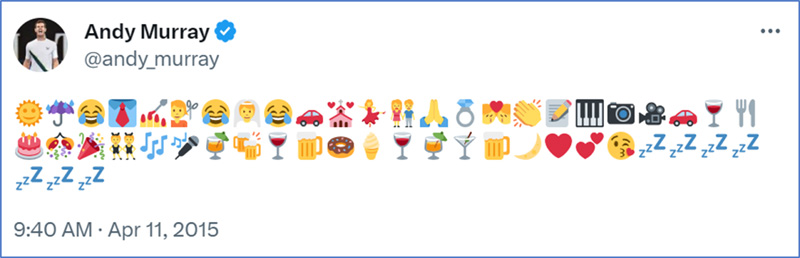
Figure 7.1 Andy Murray’s wedding day tweet, 11 April 2015, Twitter/X
How would you ‘translate’ this tweet out of the language of emojis and into words (in any written language)? What background knowledge (e.g. regarding wedding day traditions typical in the UK) might you require in order to make sense of the narrative implied by Murray’s carefully constructed sequence of emojis? To what extent might readers who do not share this background knowledge interpret this tweet differently and thus be able to achieve coherence? If you’re struggling to make sense of the tweet, you may find it helpful to consult the interpretations offered in some of the online news stories reporting on this wedding at the time – see e.g. https://www.foxsports.com/stories/tennis/andy-murrays-emoji-filled-tweet-perfectly-sums-up-a-wedding-day
Additional exercises
Multilingual museum guides
Many museums around the world offer multilingual versions of their visitor guides: see for example the muiltilingual guides to The University of Oxford’s Museum of Natural History made available here: https://oumnh.ox.ac.uk/learn-multilingual-guides
Read the English guide alongside the version translated into a language that you speak. (If the Oxford museum guide has not been translated into your language, look for similar museum guides published in multiple languages elsewhere.) Are you able to identify instances where the translator may have added or omitted information in the target-language version in order to accommodate differences in the background knowledge that can reasonably be expected to be shared by readers of the translation as opposed to readers of the original English?
Further resources
Implicature
The following online videos provide helpful introductions to the concept of implicature that is discussed in this chapter:
https://www.youtube.com/watch?v=YD82l_bUhLc
https://www.youtube.com/watch?v=we6uSVf4qss
Recommended Reading
Tipton, Rebecca and Louisa Desilla (eds) (2019) The Routledge Handbook of Translation and Pragmatics, London: Routledge.
Desilla, Louisa (2024) Translation and Pragmatics: Theories and applications, London: Routledge.
Suggestions for Further Reading
Abudayeh, Haneen and Barkuzar Dubbati (2020) “Politeness Strategies in Translating Donald Trump's Offensive Language into Arabic”, Perspectives 28(3): 424-439.
Dayter, Daria, Miriam A. Locher, and Thomas C. Messerli (2023) Pragmatics in Translation: Mediality, Participation and Relational Work, Cambridge: Cambridge University Press. https://doi.org/10.1017/9781009261210.
Farwell, David and Stephen Helmreich (2023) ‘Pragmatics-Based Machine Translation’, in Chan Sin-wai (ed.) Routledge Encyclopedia of Translation Technology, second edition, London: Routledge, 175-192.
Hickey, Leo (ed.) (1998) The Pragmatics of Translation, Clevedon: Multilingual Matters.
Kecskés, István (2014) Intercultural Pragmatics, Oxford: Oxford University Press.
Sidiropoulou, Maria (2021) Understanding Im/politeness Through Translation: The English-Greek Paradigm, Cham, Switzerland: Springer.
Stewart, Dominic (2010) Semantic Prosody: A Critical Evaluation, London: Routledge.
Valdeón, Roberto A. (2023) ‘Automated Translation and Pragmatic Force: A discussion from the perspective of intercultural pragmatics’, Babel. International Journal of Translation, 69(4): 447-464. https://doi.org/10.1075/babel.00328.val
Chapter 8
Chapter exercises
- Drawing on Flood (1993), O’Sullivan (2013) explains that the choice of font in sixteenth-century Germany, during the Reformation period, evoked important ideological distinctions. The roman typeface carried negative connotations while the gothic typeface carried positive connotations. ‘The system’, Flood (1993:133) suggests, ‘was that words importing “anger”, “threat” and “blame” were printed in roman, whereas those connoting “mercy” and “consolation” were given a gothic initial’.
- In many, but not all cultures, pink signifies femininity, and babies are often dressed in pink if they are female and in blue if they are male. What colours carry these connotations in your own culture? How would you interpret the visual message expressed on the cover of Sherry Simon’s well-known book Gender in Translation (Figure 8.3)? How do the visual elements (the two main colours and the amount of space occupied by each) complement the verbal content of the title? Would you advise a publisher of a translation of this book into your own language to retain or amend the cover design, and why?
- Consider the use of italics in the following extract from Gore Vidal’s The City and the Pillar (1948/65:120), which features an exchange between two homosexual men who are very different in character. Jim is ‘an ordinary American male who can, and often does, pass as heterosexual’ (Harvey 1998b:307). Rolly is a minor character in the novel who uses the kind of camp language and mannerisms often associated with openly gay men. Rolly and Jim meet at a party (1998b:307–308):
– ‘You know, I loathe these screaming pansies,’ said Rolly, twisting an emerald and ruby ring. ‘I have a perfect weakness for men who are butch. I mean, after all, why be a queen if you like other queens, if you follow me? Luckily, nowadays everybody’s gay, if you know what I mean … literally everybody! So different when I was a girl. Why, just a few days ago a friend of mine … well, I wouldn’t go so far as to say a friend, actually I think he’s rather sinister, but anyway this acquaintance was actually keeping Will Jepson, the boxer! Now, I mean, really, when things get that far, things have really gone far!’
Jim agreed that things had indeed gone far. Rolly rather revolted him but he recognized that he meant to be kind and that was a good deal.
– ‘My, isn’t it crowded in here? I love for people to enjoy themselves! I mean the right kind of people who appreciate this sort of thing. You see, I’ve become a Catholic.’
(Vidal 1948/65:120)
Five words are italicized in the preceding dialogue: gay, literally, friend, sinister and boxer. Harvey argues that the French translation by Philippe Mikriammos (Un Garçon Près De La Rivière, 1981) diminishes the gay character of the exchange, in part by failing to reproduce the italics. This typographical feature is ‘typical of representations of verbal camp in English’; it ‘exaggerates (and thereby renders susceptible to irony) the speaker’s own investment in the propositional content of his speech, and helps to take the addressee – willingly or not – into his confidence’ (1998b:309). The problem for the French translator is that French is a syllable-timed language, which means that its stress patterns ‘do not allow this prosodic feature (and its written encoding) to the same degree’ as English (1998b:309). Mikriammos makes no attempt to compensate for this typographical feature.
Imagine that you have been commissioned to translate Gore Vidal’s novel into your target language. Does the prosodic patterning of your language allow for the use of italics to signal similar meanings? Italics also poses a technical problem for Arabic and many Asian languages, such as Chinese and Japanese, and hence its use is very uncommon and, more importantly, it does not have the same meaning potential as in English. Can you technically use italics at all in the writing system of your language? How would you reproduce or compensate for the effect of this typographical feature, in this context?
- The National Geographic magazine is published in numerous language editions, including Arabic, Bahasa Indonesia, Bulgarian, Chinese, Croatian, Czech, Danish, Dutch, French, Finnish, Georgian, German, Greek, Italian, Hebrew, Hungarian, Japanese, Korean, Latvian, Lithuanian, Mongolian, Norwegian, Polish, Portuguese, Romanian, Russian, Serbian, Slovenian, Spanish, Swedish, Thai and Turkish, with accompanying language-specific websites for most editions: see, for instance, http://nationalgeographic.com.cn/ for the Chinese edition and www.nationalgeographic.com.tr/ for the Turkish edition.
- Barbara Reeves-Ellington is a scholar of oral history whose work involves interviewing people in Bulgarian and then reporting on the results in English academic journals. She therefore has to engage in two types of translation: first transcribing the oral into written Bulgarian and then translating it into written English. The switch from the oral to the written channel risks losing much of the emotion expressed through intonation and stress patterns. In transcribing and translating the speech of Olga Vezhinova, a seventy-five-year-old, university-educated interviewee, Reeves-Ellington thus proposes to replace the typical, dry prose format of written interviews with a poetic one, as in the following example.
Consider whether similar elements of typography – including the use of BLOCK CAPITALS and italics – might have specific connotations today, either globally, in your own culture, or in specific genres such as comics, advertisements (perhaps italics for femininity in advertisements for perfumes and cosmetics?), scholarly articles, and so on.
Figure 8.3 Cover of Gender in Translation (left-hand panel is blue, right-hand panel is pink)
Imagine that you have been asked to translate the article in which Figure 6.1 (Chapter 6, p. 219) appeared, for a special collection of open-access articles to be made available on your target-language edition website. For convenience, this figure is reproduced as Figure 8.4.
Try to approach this task creatively, bearing in mind that a website offers considerably more flexibility and opportunities for establishing links between visual and verbal material than a printed page. When you have translated the image (complete with verbal content) and embedded it in a mockup of a web page, comment on the strategies you used to reproduce or adapt the patterns of verbal-visual cohesion, including shapes, colour, idioms, patterns of verbal repetition, links and, if necessary, new subsidiary pages linked to the image.
Figure 8.4 ‘Not Beyond Compare’, National Geographic magazine, 1 March 2010, p. 26
Prose Format (Reeves-Ellington 1999:114)
One of the saddest moments in my life was my mother’s early death. She died from heart disease when she was 45 years old and I was still in high school. But I think the harsh village life killed her. She worked as a teacher, and she had village work and field work to do. Conditions were unimaginably harsh. The land was so mountainous and infertile. And then she had to help her mother-in-law. Quite simply the harsh village life had an adverse effect on her, and she passed away very early.
Poetic Format (Reeves-Ellington 1999:118)My mother.
I told you, didn’t I
that one of the harshest moments of my life
which I think most harshly affected my fate
was my mother’s early death.
My mother died when I was still a girl in high school.
My mother died when she was 45 years old
from heart disease.
But I think
my mother died because of the harsh village life.
Unimaginably harsh conditions.
And school work
And village work
And those fields
Mountainous
Infertile
She had to help with that
That and her mother-in-law.
Quite simply
the harsh village life affected her very badly
and she passed away very early
my mother.
Consider the differences between these two versions in terms of the use of semiotic resources such as typography (layout, italics) and verbal repetition. Taking the English poetic version as a source text, how might you render this in your own language? Do resources such as italics and repetition communicate similar meanings or do you need to employ other resources to recreate the emotional impact of this narrative?
Additional exercises
Colours across cultures
Building on exercise 2 above, what are the meanings typically associated with other colours in the cultures with which you are familiar? In mapping out these meanings, you might find it helpful to think about the associations of e.g. red, yellow or blue across a variety of fields of activity: e.g. in politics, religion, sport, marketing, etc.
When you’ve completed this activity, you might like to compare your responses with those collected in the Wikipedia article that discusses each colour:
- Red: https://en.wikipedia.org/wiki/Red#Symbolism
- Blue: https://en.wikipedia.org/wiki/Blue#In_society_and_culture
- Yellow: https://en.wikipedia.org/wiki/Yellow#Symbolism_and_associations
Can you imagine any scenarios in which your knowledge of this cross-cultural variation might shape your approach to translation?
Further resources
Subtitling puzzles
Many of the ‘subtitling puzzles’ posted on the website of SUBTLE (a professional association for subtitlers) include challenges generated by the complex interplay of multiple semiotic resources: https://subtle-subtitlers.org.uk/category/subtitling-puzzles/
Social semiotics videos
To deepen your understanding of the key ideas of social semiotics, you may find these interviews with Gunther Kress and Theo van Leeuwen helpful:
https://youtube.com/playlist?list=PLGzF-dGWO-1GDZOGrhct7XoohuN_gKSL3&si=-PjxDiYONxZce16I
https://youtube.com/playlist?list=PLGzF-dGWO-1GR67Mz7x6hA2jV0EUYU5ou&si=IkPvJyVOwQA2YSp7 >
Recommended Reading
Kress, Gunther. 2010. Multimodality: A social semiotic approach to contemporary communication. London: Routledge.
Pérez-González, Luis (2014) ‘Multimodality in Translation and Interpreting Studies: Theoretical and Methodological Perspectives’, in Sandra Bermann and Catherine Porter (eds) A Companion to Translation Studies, Chichester: Wiley Blackwell, 119–131.
Van Leeuwen, Theo (2005) Introducing Social Semiotics, London and New York: Routledge.
Suggestions for Further Reading
Adab, Beverly and Cristina Valdés (eds) (2004) ‘Key Debates in the Translation of Advertising Material’, Special Issue of The Translator 10(2).
Boria, Monica, Ángeles Carreres, María Noriega-Sánchez, and Marcus Tomalin (2020) Translation and Multimodality: Beyond words, London: Routledge.
Celotti, Nadine (2008) ‘The Translator of Comics as a Semiotic Investigator’, in Federico Zanettin (ed.) Comics in Translation. Manchester: St. Jerome, 33–49.
Kaindl, Klaus (1999) ‘Thump, Whizz, Poom: A Framework for the Study of Comics Under Translation’, Target 11(2): 263–288.
Lathey, Gillian (2016) Translating Children’s Literature, London and New York: Routledge. Chapter 3: ‘Translating the Visual’, pp. 55–69.
Meta (2008) ‘Le verbal, le visuel, le traducteur/The Verbal, the Visual, the Translator’, Special Issue 53(1).
Mueller, Barbara (2011) Dynamics of International Advertising: Theoretical and Practical Perspectives, second edition, New York: Peter Lang.
Stöckl, Hartmut, and Jana Pflaeging (2022) ‘Multimodal Coherence Revisited: Notes on the move from theory to data in annotating print advertisements’, Frontiers in Communication 7. https://doi.org/10.3389/fcomm.2022.900994.
Valdés, Cristina and Adrián Fuentes Luque (2008) ‘Coherence in Translated Television Commercials’, European Journal of English Studies 12(2): 133–148.
Chapter 9
Chapter exercises
- Goodwin (2010:26–27) proposes two ways of looking at the issue of ethics in translation:
- Writing as a literary translator who had to make difficult ethical decisions about whether or not to translate different Serbian authors whose works ‘could be used by nationalists to justify a campaign of hatred and genocide’ (2004:719), Jones (ibid.:723) presents two opposing arguments – one he dubs ‘Olympianism’ and the other Realpolitik:
- A number of translation agencies in various parts of the world increasingly offer work to student translators, many of whom undertake this work either free of charge or for a low rate, as a way of gaining experience. Aurora Humarán, one of the founding members of AIPTI (Asociación Internacional de Profesionales de la Traducción y la Interpretación / International Association of Professional Translators and Interpreters, based in Argentina), has this to say on the subject:
- Consider the following two statements:
- This exercise is adapted from Hermans (2009):
- Reproduce it?
- Reproduce and gloss it (e.g. in a footnote)?
- Replace it with a less offensive term?
- One of the cornerstones of all professional codes of ethics, including those relating to translation, is confidentiality. And yet, speaking of professional ethics in general, Cheney et al. argue that ‘[s]ometimes being morally responsible may mean resisting an order, going public with private information, or leaving a job or career altogether’ (2010:153). Reflect on this issue in the context of a real-life case, like that of Katharine Gun, former translator working for a British intelligence agency who leaked secret documents to the press in 2003; the documents related to illegal activities by the United States and Britain in relation to the then impending invasion of Iraq. For this particular case, you can consult Solomon (2003), Burkeman and Norton-Taylor (2004), Tyler (2004), BBC News (2004), Davies (2004) and Institute for Public Accuracy (undated). Much more material on this case can be retrieved by searching for ‘Katharine Gun’ on the web.
- Barsky (1996, 2010) notes that immigrants, refugees and asylum seekers are ill-served by a system that is inclined to criminalize them as a group, that treats them as ‘guilty by virtue of being there’ (2010:292). ‘The intrinsic shortcomings of the system’, he suggests, ‘are such that the poor and the persecuted are disadvantaged from the outset’ (1996:61). While accepting that interpreters cannot be expected to ensure justice for the vulnerable (ibid.), he argues that they:
For one group, ethics may be regarded as important but extrinsic to translation itself, so that the latter should be ethically governed (as all human activities are) but, once it is set within an overall moral framework, can proceed without it. An analogy might be mining exploration: there is such a thing as the ethics of mining exploration, but mining itself is a technical activity quite separate from the ethical framework within which it is conducted. Thus, we might send a geological mission to a foreign country to explore the potential for mining its natural resources: on one piece of paper we could write technical instructions for mining, and on another, quite separately, we could write an ethical code of conduct we wished the mission to observe. In sympathy with such an approach would be any translator who regards the activity itself as a technical procedure, in principle susceptible to remainderless scientific description.
The other way of thinking about translation … is that it is intrinsically ethical: that the activity itself cannot proceed without an account (explicit or implicit) of how the encounter with the ‘other’ human being should be conducted. An analogy might be trade: suppose that instead of a mining mission, we sent a trade mission to our imagined foreign country. In this case, the activity involves the other human beings which the mission will encounter, and the activity must be consensual (non-consensual trade is not trade, but pillage), such that the activity itself cannot take place other than in the context of an ethical framework which provides a basis for concepts such as volition, consent and exchange. It would perhaps be possible in such a case to divide our instructions into the ‘technical’ and the ‘ethical’, but only with difficulty, and the latter would play a much more important and integral role in the activity itself.
Consider the two scenarios outlined by Goodwin. To what extent is the distinction he draws applicable to mining, trading or any other human activity? Would you consider yourself part of the first or second group he refers to? Playing the devil’s advocate, irrespective of your own position, how would you explain to a potential client why translation is extrinsically or intrinsically ethical, in Goodwin’s terms? What impact might each explanation have on different types of clients and their trust in translators?
The former [Olympianism] argues that translators should remain true to texts that are artistically good, even in tainted social circumstances of production and reception – such as a source culture hijacked by extreme nationalism – in the knowledge or hope that the culture will recover. The latter [Realpolitik] claims that a text cannot remain separate from and thus untainted by its social context. Thus, for example, a translator should refuse to translate works whose imagery is being exploited to justify genocide, no matter how innocuous that imagery might have seemed at the time of first writing.
Discuss the ethical implications of both positions, bearing in mind that carefully considered ethical arguments can be presented in each case, and as Jones points out, the balance in such difficult situations may at times be tipped by the nature of the agent’s personal relations, rather than abstract ethical considerations: ‘In the end’, Jones explains:
[A] key reason that I did not break with Serbian and Croatian poetry was that it would have meant breaking personal ties built up over many years. I tended to be very wary of building up new ties, however, except on the rare occasions when I felt that my translation work supported some sort of opposition to the nationalist mindset.
(ibid.:719)
Does a dentistry student perform root canals? No. Does an architecture student build anything? Not a thing. Does a law school student defend anyone? No one.
Students from any of those career fields can, of course, perform some sort of work ‘within their areas’ of study. A dentistry student can work as an assistant in a dental office. An architecture student can get a handle on his/her future profession by doing administrative work in an architect’s office. And anyone in the legal field is certainly aware of how many law students act as paralegals, traipsing from one court to another every morning.
In our profession, however, there is no place, really, in which translation students can learn to take their first steps. There is no such job as dictionary handler, word researcher, glossarist or anything of the kind for those who are trying their hand at these tasks for the first time. No such position exists. Well, let me correct myself: It didn’t exist. It didn’t, that is, until some slick operators threw together an agency – the way you might slap together a stand for a rummage sale – and (voila!) translation students suddenly had a place to work. So, let’s translate! But translate just like a professional translator? No way! This is cut-rate translation in which students do the work professionals usually do, but for ridiculous rates, turning themselves into veritable ‘beggar translators’.
Compare this statement with the following argument about volunteer translation and interpreting offered by ECOS, a socially committed group of lecturers and students of translation in Spain (Manuel et al. 2004):
In the association ECOS, Translators and Interpreters for Solidarity, we perform volunteer work of translation and interpreting for NGOs, social forums and other nonprofit organisations with affinities to the philosophy of our organisation. In no case would we wish to accept a continuous role in the performance of a service which ought to be supplied by professionals under contract.
In other words, we do not intend that the voluntary nature of work performed should serve as an excuse for the creation of what is beginning to be called a ‘third sector,’ which would amount to the utilisation of volunteer work and non-profit organizations together with private initiative to organise, at low cost, services which in our opinion ought to be supplied by the public sector, the only one capable of the coverage necessary. … our work is like that of volunteers who supply medicines to third-world communities completely outside the trade network known as globalization.
… we consider it indispensable to broaden the concept of professional ethics in these times of neo-liberal globalization, which deepens the inequalities between peoples and within them. We can no longer limit our aims merely to defending decent working conditions and rejecting the intrusion of non-qualified persons into the profession. It would be hypocritical to bemoan the price per word paid by such-and-such a company, or the size of the interpreter’s booths in this or that convention centre, while feeling no scruples at working for those who organise exploitation, misery and war in this world.
Would you argue that translating and interpreting by students and/or volunteers of various levels of expertise is (a) always, (b) never, or (c) sometimes unethical? If the latter, under what conditions might it be considered ethical, in the sense of doing no harm or doing positive good, to various parties in the interaction and to other professional translators and interpreters?
There is … a category of texts which, at first sight, appear to be positively illegal. If a translator agreed to translate bomb-making instructions, would he be responsible for attacks committed with the bombs produced with the help of such instructions? He certainly would, in our view, if he did not take the trouble of finding out who needed the translation, and for what purpose it was required. If the nature of the client were sufficiently obscure to raise even the slightest concern, no translator in his right mind would accept such an order. However, if the translation was commissioned by a government authority as part of efforts to study terrorists’ practices, the translator might actually contribute to a good cause by translating even the most reprehensible texts.
(Simons 2010)
The law may itself be unjust. It may not serve the common good, but the good of the tyrant or the party. The apartheid laws in South Africa were a case in point. Laws that in certain countries discriminate against women or against minority groups pose a problem and the moral dilemma of whether obedience is appropriate. Such dilemmas have to be faced and require more than a simple injunction to ‘obey the law of the land’.
(Wright, undated)
What issues do these statements raise in relation to the link between ethics and legality? Are practices and objectives promoted by a government and enshrined in law necessarily ethical? Under what conditions do you believe the translator may be justified in breaking the law and entitled to receive support from fellow translators and the professional associations that represent them?
In his opening address to the post-apartheid South African parliament in 1994, President Nelson Mandela argued that ethnic slurs which were used to refer to black Africans in South Africa under apartheid should no longer be part of the nation’s vocabulary. The use of these words was subsequently outlawed in the country and they are now considered hate speech terms.
Imagine that you are asked to translate, for publication in that country, an historical document from the pre-apartheid era which contains one of these words. Should you:
If you choose Option B, what would strategy would you adopt if you encounter the word when creating a set of subtitles (where space constraints would make it impossible to gloss)? And to what extent would your chosen solution change if you were translating the document for publication in a different country (not South Africa)?
can help redress the wrongs of the system to some extent. … they can assist the persecuted by allowing them to articulate their claims and negotiate their ‘difference’ in an environment which is less sympathetic the more ‘different’ the claimant is seen to be. They can fill in cultural gaps and compensate for tactical errors to ensure that genuine stories of suffering and persecution are properly ‘heard’.
Consider the ethical implications of each type of assistance Barsky suggests an interpreter could offer. How would a Kantian balance the rights of different parties in the interaction, including the right of legal personnel to be allowed to assess each case on its own merits and the rights of immigrants and asylum seekers to be treated with dignity? How would an interpreter’s ‘duty’ be defined in Kantian terms in this instance? How would a utilitarian assess the various consequences of intervention and lack of intervention on the part of interpreters? How and on what basis would an ethics of care justify intervention to ensure that ‘genuine stories of suffering and persecution are properly “heard”’? What limits would it place on such intervention, if any? On balance, what would you view as the more ethical approach to adopt, and why?
Additional exercises
‘The Double Life of a Palestinian Translator’
Alaa Alqaisi’s article ‘The Double Life of a Palestinian Translator’ was written and initially published by Adi Magazine in July 2025, while the author was struggling to remain alive in Gaza: https://adimagazine.com/articles/the-double-life-of-a-palestinian-translator-a-bridge-between-wounds-and-words/
It offers a powerful account of the concrete challenges and ethical dilemmas faced by translators attempting to survive and bear witness while being the targets of intense violence and dehumanization.
The article was later republished, with minor changes and additions, in issue 4 (2025) of Encounters in Translation, together with an Arabic translation by the author herself, and numerous translations into other languages. The article and its translations constitute a unique resource for practising translators and students of translation to explore many of the challenges discussed in this coursebook, including those detailed in Chapter 9 (Beyond Equivalence: Ethics and Morality).
Read the original article in English carefully and translate it into your target language, with a view to submitting it to a literary magazine or another venue that you believe would be interested in it. Do not consult the available translation into your target language until you have produced at least a draft version of your own. Once you have done so, read the translation published in Encounters and compare the two, noting where each might have been particularly successful in conveying the urgency and trauma of the original, or has failed to do so.
Further resources
Glasgow Refugee, Asylum and Migration Network resources
These videos created by the Glasgow Refugee, Asylum and Migration Network usefully highlight the ethical complexities that public service interpreters frequently encounter: https://www.gla.ac.uk/research/az/gramnet/research/trainingmodel/resources/
Institute of Translation and Interpreting resources
The website of the UK Institute of Translation and Interpreting also hosts an interesting set of resources exploring a range of ethical issues pertaining to translation: https://www.iti.org.uk/resource-report/iti-exploring-ethics.html
Ethics and Machine Translation
Joss Moorkens has written an excellent chapter exploring the ethical questions raised by the development and use of machine translation technologies. It can be freely downloaded as part of Dorothy Kenny’s edited volume Machine Translation for Everyone (Chapter 6), available at the following link: https://langsci-press.org/catalog/book/342
Recommended Reading
Driver, Julia (2007) Ethics: The Fundamentals, Oxford: Blackwell.
Koskinen, Kaisa and Nike K. Pokorn (2021) The Routledge Handbook of Translation and Ethics, London: Routledge.
Lambert, Joseph (2023) Translation Ethics, London: Routledge.
Further Reading
Baker, Mona and Carol Maier (eds) (2011) ‘Ethics and the Curriculum: Critical Perspectives’, Special Issue of The Interpreter and Translator Trainer 5(1).
Boéri, Julie (2023) ‘Steering ethics towards social justice: A model for a meta-ethics of interpreting’, Translation and Interpreting Studies 18(1): 1-26.
Chesterman, Andrew (2001) ‘Proposal for a Hieronymic Oath’, The Translator 7(2): 139–154.
Hale, Sandra (2007) Community Interpreting, Basingstoke: Palgrave Macmillan. Chapter 4: ‘Analysing the Interpreter’s Code of Ethics’.
Hermans, Theo (2009) ‘Translation, Ethics, Politics’, in Jeremy Munday (ed.) The Routledge Companion to Translation Studies, Abingdon, Oxon: Routledge, 93–105.
Inghilleri, Moira (2008) ‘The Ethical Task of the Translator in the Geo-political Arena: From Iraq to Guantánamo Bay’, Translation Studies 1(2): 212–223.
Koskinen, Kaisa (2000) Beyond Ambivalence: Postmodernity and the Ethics of Translation, Tampere, Finland: University of Tampere.
Kruger, Haidee and Elizabeth Crots (2014) ‘Professional and Personal Ethics in Translation: A survey of South African translators strategies and motivations’, Stellenbosch Papers in Linguistics 43: 147-181. DOI 10.5842/43-0-613.
Monzó-Nebot, Esther and Vicenta Tasa-Fuster (eds) (2025) The Social Impact of Automating Translation: An ethics of care perspective on machine translation, London: Routledge.
Pearce, Sarah J. (2017) ‘Translating in a Time of Trump: Or, How to Think Like a Literary Terrorist’, 15 August. Available at https://wp.nyu.edu/sjpearce/2017/08/15/translating-in-a-time-of-trump/.
Translation Studies Forum (2021) ‘Representing Experiential Knowledge: Who may translate whom?’, Translation Studies 14(1,3). https://www.tandfonline.com/toc/rtrs20/14/1
General Resources
Mona Baker’s Sites
Personal website of Mona Baker: http://www.monabaker.org/
Mona Baker’s Research Gate profile includes a range of materials which can be downloaded: https://www.researchgate.net/profile/Mona-Baker-2
Henry Jones’ Sites
Research portal for Henry Jones: https://research.manchester.ac.uk/en/persons/henry.jones
Henry Jones’ Research Gate profile also offers a number of publications for download: https://www.researchgate.net/profile/Henry-Jones-18
International Associations
The International Association of Professional Translators and Interpreters (IAPTI)
IAPTI (or AIPTI - Asociación Internacional de Profesionales de la Traducción y la Interpretación) was created in 2009 as a vehicle for promoting effective professional ethics. It is legally established in Buenos Aires but is international in outlook and membership.
Globalization and Localization Association (GALA)
GALA is a trade association for the global language services and technologies industry. Their aim is to build professional communities, facilitate knowledge-sharing, and advance best practices.
International Federation of Translators / Fédération Internationale des Traducteurs (FIT)
FIT is an international federation of associations of translators, interpreters and terminologists. Its purpose is to promote professionalism in the disciplines it represents. FIT is also concerned with the conditions of professional practice in various countries and strives to defend translators’ rights in particular and freedom of expression in general.
International Association of Conference Interpreters / Association Internationale des Interprètes de Conférence (AIIC)
AIIC is the only international association that represents the interests of conference interpreters. It sets standards of practice, training and working conditions, negotiates collective agreements, and runs workshops and other training events for its members.
World Association of Sign Language Interpreters
An international association that represents sign language interpreters worldwide.
Subtle
https://subtle-subtitlers.org.uk/
Subtle is an association that brings together professional audiovisual translators from around the world.
Audiovisual Translators Europe (AVTE)
AVTE is the European federation of national associations and organizations for media translators of all kinds.
International Association for Translation and Intercultural Studies (IATIS)
IATIS is an international forum that enables scholars and students of translation and interpreting to stay abreast of developments in the field and to participate in shaping its future. It publishes a Yearbook, an online journal for new researchers, and a Bulletin that disseminates news of events, publications and training courses related to translation and interpreting. It also organises an international conference every three years.
European Society for Translation Studies (EST)
http://www.est-translationstudies.org/
Founded in Vienna in 1992, the society now has members in more than 46 countries. It functions as a network for research, a forum for exchange, and a centre for research resources.
ESIST – European Association for Studies of Screen Translation
ESIST is a non-profit making association of higher education teachers, practitioners, academics and students in the field of audiovisual translation set up to facilitate the exchange of information and to promote professional standards in the training and practice of screen translation.
American Translation and Interpreting Studies Association (ATISA)
The purpose of the Association is to encourage, support, and further the study of translation and interpreting studies, especially by organizing meetings, publishing a journal (Translation and Interpreting Studies -TIS), dissemination information to the public at large, fostering ties with allied organizations, and by such other means as the Association may deem appropriate.
For a list of national associations that represent translators and interpreters, consult the IATIS website: https://www.iatis.org/index.php/resources/web-links#associations
Blogs, Discussion Lists, Podcasts and Sources of News
Translatio Discussion List
https://www.jiscmail.ac.uk/cgi-bin/webadmin?A0=TRANSLATIO
A postgraduate forum for debates on translation. Also features news and announcements of forthcoming events.
Slator
Slator.com is a leading source of research and market intelligence for translation, localization, interpreting, and language AI.
Proz.com Blog
A useful source of news and career advice for people working in translation and interpreting.
About Translation
http://www.aboutranslation.com/
A blog which features posts on CAT tools, Translators’ Conferences, and localization.
eMpTy Pages
http://kv-emptypages.blogspot.co.uk/
A blog about translation technology, localization, and collaboration. Recent posts have explored Post Editing, BabelNet, and Translation Metadata.
Troublesome Terps
A roundtable-style podcast covering interpreting and the wider world of languages.
Meet the Translator
https://www.dotrobertstranslation.com/meet-the-translator
A podcast series in which British freelance translator Dot Roberts interviews colleagues from across the language services industry.
Words without Borders
http://www.wordswithoutborders.org/
An online magazine featuring contemporary international literature in English translation.
UniVerse: A United Nations of Poetry
http://www.universeofpoetry.org/poets.shtml
An interactive forum for promoting international poetry. Individual poets appear under their country with samples of their poetry translated into English; the names of translators are acknowledged.
General Resources for Translation Studies
Routledge Translation Studies Portal
http://routledgetranslationstudiesportal.com/
A portal which provides an array of resources for our books on Translation Studies, a collection of sample chapters and journal articles, and a full books catalogue.
Key Journals in Translation Studies
Diamond open access journals
Encounters in Translation https://publications-prairial.fr/encounters-in-translation/
Interpreting and Society https://journals.sagepub.com/home/ISY
inTRAlinea http://www.intralinea.org
JoSTrans (Journal of Specialised Translation) https://www.jostrans.org
Linguistica Antverpiensia, New Series – Themes in Translation Studies (LANS – TTS) https://lans-tts.uantwerpen.be/index.php/LANS-TTS/about
Translation & Interpreting: The International Journal of Translation and Interpreting Research http://trans-int.org/index.php/transint/
New Voices in Translation Studies https://newvoices.arts.chula.ac.th/index.php/en/index
trans-kom: Journal of Translation and Technical Communication Research http://www.trans-kom.eu/index-en.html
Cultus: The Journal of Intercultural Mediation and Communication http://www.cultusjournal.com
Revista Tradumàtica https://revistes.uab.cat/tradumatica/
Journal of Audiovisual Translation (JAT) https://jatjournal.org
STRIDON: Journal of Studies in Translation and Interpreting https://journals.uni-lj.si/stridon/about
Other key journals
The Translator https://www.tandfonline.com/journals/rtrn20
Target: International Journal of Translation Studies https://benjamins.com/catalog/target
Translation Studies https://www.tandfonline.com/journals/rtrs20
Interpreting: International Journal of Research and Practice in Interpreting https://benjamins.com/catalog/intp
Translation in Society https://benjamins.com/catalog/tris
Perspectives: Studies in Translation Theory and Practice https://www.tandfonline.com/journals/rmps20
Babel https://www.jbe-platform.com/content/journals/15699668
Meta: Journal des traducteurs / Meta: Translators' Journal https://www.erudit.org/en/journals/meta/
TTR : Traduction, Terminologie, Rédaction https://www.erudit.org/en/journals/ttr/ (archives available open-access)